Trump Is Quietly Showing His True Feelings About Gig Workers


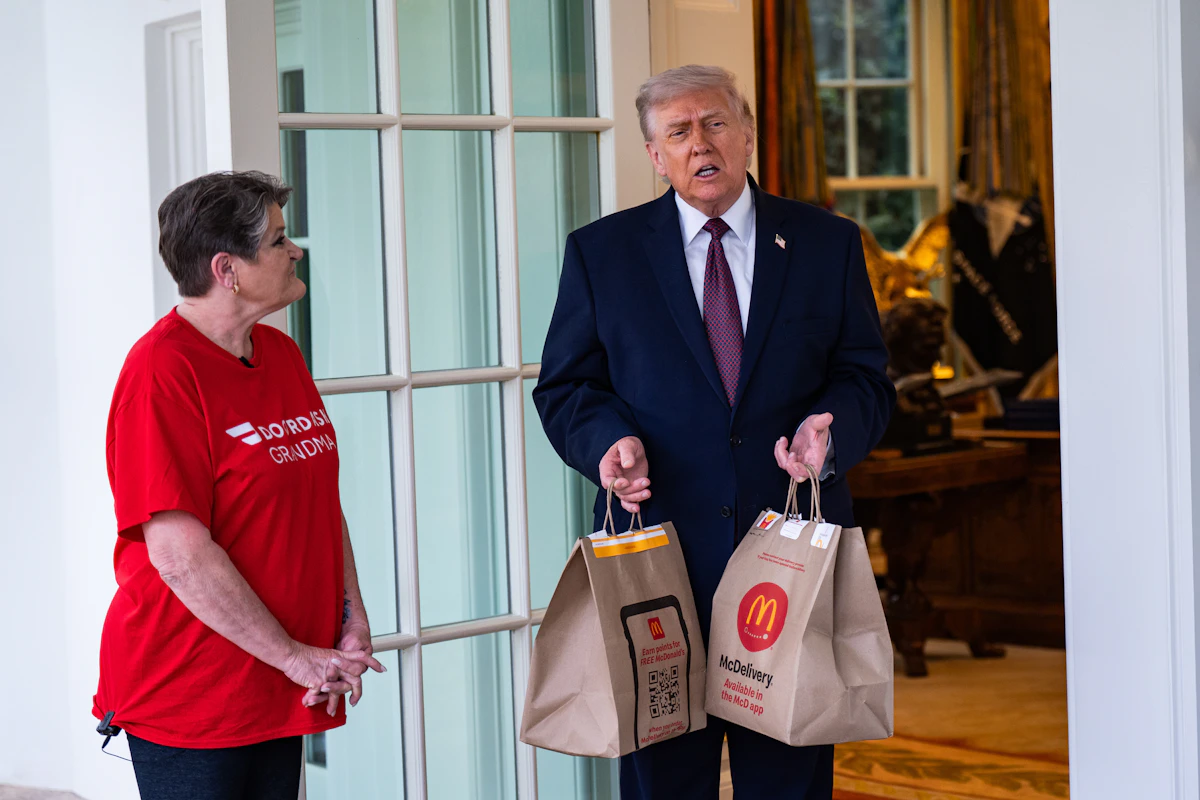
On Monday, in the vain hope that Americans might forget his economically disastrous war against Iran, President Trump attempted a symbiotic stunt with DoorDash in which he summoned Sharon Simmons, a 58-year-old woman who lives in Arkansas and works for the company, to deliver lunch from her favorite restaurant: McDonald’s. The goal as tax day approached was to remind Americans of the “no tax on tips” provision of the Republican Party’s One Big Beautiful Bill passed last year. Alas, it turned out that this humble “DoorDash Grandma” had already lobbied in Washington for this provision, and the savings she attributed to the new law were probably not due to the law at all.
But the event illustrates a grim economic reality: Simmons said she needs money to help pay her husband’s medical bills related to cancer treatment, and to do that she is turning, like a growing number of workers, to the gig economy.
The gig economy — which also includes ride-sharing services like Uber and DIY apps like Taskrabbit — is relatively new, but some of the problems its workers face are long-standing. One of the most important is determining who counts as an employee or independent contractor. This distinction can make a huge difference for both businesses and workers, as workers are covered by rules regarding overtime pay, workplace harassment, family and medical leave, and more.
The Biden administration has expanded the definition of an employee to try to cover more workers employed in the gig economy. But today, the Trump administration is trying to go back the definition in a way that, a new report from the Economic Policy Institute Report shows, could cost the most vulnerable workers thousands of dollars and make them less safe in the workplace.
The question of who is an independent contractor or employee may seem easy to answer, but it is actually a complex legal test set by the Department of Labor. On the one hand, a truly independent freelancer has complete freedom over their hours, what they do, who they work with, how much they get paid, and when they have days off. On the other, a traditional employer arrangement with guaranteed wages and a company that contributes to unemployment and social insurance programs. In between is a gray area made up of temporary workers, contract workers, on-call workers, and independent contractors, all of which constitute distinct categories in the eyes of the government. In July 2023According to the most recent data from the Bureau of Labor Statistics, there were 11.9 million independent contractors to whom the Trump rule change would apply, representing 7.4 percent of total employment, a share that has increased steadily over the past few decades, as union membership has declined and Washington has advanced even further. deregulated work and the economy.
App-based jobs are just one manifestation of a longer trend of more workers being classified as independent contractors. The classification traditionally relies on a three-pronged test that involves the degree of control the worker has over his or her work, whether outside the employer’s usual course of business (such as a law firm employing janitors for its office building) or whether the individual works in a business where independent contractor arrangements are traditional and common (such as freelance writers). The rise of apps like Uber and DoorDash has led to attempts to classify these workers as employees rather than independent contractors, triggering huge legal battles in California. Companies that rely on the gig economy have lobbied for the status quo, arguing that app-based jobs are typical of independent contractor arrangements.
But economists and labor rights advocates have long argued that employers misclassify workers as independent contractors because workers often perform the same essential functions as employees and companies fail one or more elements of the test. Several examplesas a class action trial brought by FedEx drivers in California and the decision of a home health startup not to rely on independent contractors, show that these assessments are often correct. “What we’re seeing is that employers still have considerable control over how work is done for independent contractors, but they’re not being held accountable as employers,” said Dr. Kate Bahn, chief economist and senior vice president of research at the Institute for Women’s Policy Research.
In a report released Wednesday, the Economic Policy Institute look at the areas in which workers are most likely to be misclassified. The list was filled with old-fashioned jobs like construction workers, truck drivers, home health and personal care aides, and manicurists and pedicurists. “This is happening to a lot of workers outside of the gigs and apps space, although I feel like gigs and apps [companies] have taken on a lot of air, and a lot of that is also because these companies have also been pushing a lot to … exclude drivers or gig workers from employment status in state laws,” said Margaret Poydock, senior policy analyst at EPI.
The report finds that on average, a worker who should be considered an employee but is treated as an independent contractor could lose thousands of dollars per year, depending on the industry, and up to $20,399 for construction workers. Workers stand to lose even more in states with higher wages. These workers also miss out on benefits such as paid vacation and health insurance, and pay the entire bill for their Social Security and Medicare taxes, instead of sharing it with their employer. It’s also harder for them to get promotions or raises, which reduces their long-term wealth.
Determining whether a worker is misclassified would require active enforcement by the Department of Labor or an employee to challenge their status in court. But presidents can significantly shape the lives of all these workers by how they attempt to define and enforce the rule. Under President Joe Biden, the Department of Labor adopted a change that expanded the definition of an employee to include the economic realities of a worker’s life and included six questions, all with equal weight, to determine the amount of control the person had over their day and tasks, the degree of permanence of the job, whether the work performed by the employee was an integral part of the company’s purpose, and the skills and initiative involved in the work. It came into force in March 2024.
But as soon as Trump was re-elected in November, he signaled he would not implement it. The rule change to overturn it, which was submitted in February, would focus on two issues above others: the nature and degree of control over the work and the worker’s opportunities for profit or loss. He sets aside many of the other issues and argues that Biden’s proposed expanded definition of employees was confusing and ignored the realities of the modern economy. (The public comment period on the proposed rule change ends April 28.)
Workers like flexibility, although nothing prevents companies from offering more flexibility to their employees while still fulfilling their obligations as full-time employers. “Sometimes I think when people try to discuss what they think are the benefits of self-employment, those things are also available to direct employees. I think that’s a bit of a false choice,” Bahn said.
But services that rely on independent contractors, like DoorDash, operate in an economy that relies on responsiveness to moment-by-moment demand — demand that was created in part by these apps themselves. And they remain popular, both with customers and workers who want to earn extra money. “When workers say they value flexibility, they often mean more than just planning,” said Kristin Sharp, CEO of Flex, an industry group of ride-hailing and food delivery platforms. “They mean an income that is suitable for the rest of their lives and tailored to their family, health, education, financial or entrepreneurial goals.” She pointed out that many on-demand jobs feature low barriers to entry and fast payouts.
Flex supports Trump’s proposed rule change, like many other industry groups, while many labor advocates and think tanks oppose it. More than 2,200 comments have been submitted so far, although many of them use the same language, clearly having been provided by groups on opposing sides. There are no comments yet from someone named Sharon Simmons.


