Curiosity Reveals Richest Trove of Organic Molecules Yet on Mars


NASA’s Curiosity rover detected more than 20 carbon-containing compounds, including seven never before seen on Mars, in a sample taken from 3.5 billion-year-old clayey sandstones in Gale Crater.
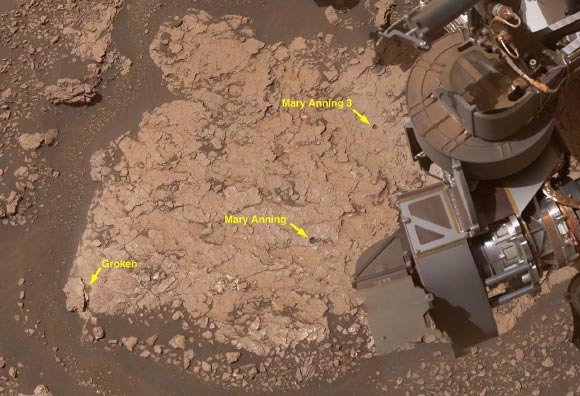
A close-up of three holes drilled by Curiosity in Martian rock at a location nicknamed Mary Anning in October 2020. Image credit: NASA/JPL-Caltech/MSSS.
Dubbed Mary Anning 3 after an English fossil collector and paleontologist, the rock sample was collected by Curiosity from a part of Mount Sharp covered by lakes and streams billions of years ago.
This oasis arose and dried up several times during the planet’s ancient times, eventually enriching the region with clay minerals, particularly effective at preserving organic compounds.
Among the newly identified molecules is a nitrogen heterocycle, a ring of carbon atoms that includes nitrogen.
This type of molecular structure is considered a predecessor of RNA and DNA, two nucleic acids essential for genetic information.
“This detection is quite thorough because these structures may be chemical precursors to more complex nitrogen molecules,” said Dr. Amy Williams, a researcher at the University of Florida.
“Nitrogen heterocycles have never before been discovered on the Martian surface nor confirmed in Martian meteorites.”
Another exciting discovery was benzothiophene, a carbon and sulfur-containing molecule found in many meteorites.
Some scientists believe that these meteorites, along with the organic molecules they contain, seeded prebiotic chemistry throughout the early solar system.
“It took dozens of scientists and engineers to locate this site, drill the sample and make these discoveries with our amazing robot,” said Dr. Ashwin Vasavada, a researcher at NASA’s Jet Propulsion Laboratory.
“This collection of organic molecules once again increases the prospect that Mars provided a home to life in the ancient past.”
The analysis of the Mary Anning 3 sample was carried out with a sophisticated minilaboratory called Sample Analysis at Mars (SAM), located in the belly of Curiosity.
A drill at the end of the rover’s robotic arm pulverizes a carefully selected rock sample into powder, then flows it into SAM, where a high-temperature furnace heats the material, releasing gases that the lab’s instruments analyze to reveal the rock’s composition.
Additionally, SAM can perform “wet chemistry,” dropping samples into a small cup of solvent.
The resulting reactions can break apart larger molecules that would otherwise be difficult to detect and identify.
Although the instrument has several such cups, only two contain tetramethylammonium hydroxide (TMAH), a powerful solution reserved for higher value samples.
Mary Anning sample 3 was the first to be exposed to TMAH.
To check TMAH’s reactions with otherworldly materials, the researchers also tested the technique on Earth with a piece of the Murchison meteorite, one of the most studied meteorites of all time.
More than 4 billion years old, Murchison contains organic molecules that were seeded throughout the early solar system.
A Murchison sample exposed to TMAH was found to break much larger molecules into some of those seen in Mary Anning 3, including benzothiophene.
This result verifies that the Martian molecules found in the sample could have been generated from the breakdown of even more complex compounds linked to life.
“Analysis of the spatial distribution of organic matter is not possible with SAM, so the origin of this material introduced from meteorites, produced abiotically via aqueous processing such as serpentinization or electrochemical production, is currently unknown,” the scientists said.
“Regardless, the confirmation of macromolecular organic matter supports the possibility that future optimized TMAH thermochemolysis experiments could release ancient biosignatures preserved in macromolecules on Mars (if they are present).”
“The large structural variety of organic molecules observed in situ from surface materials suggests that some chemical diversity is preserved in ancient Martian sediments despite more than 3.5 billion years of diagenesis and radiation exposure.”
“These results expand the library of confirmed and suggested organic molecules preserved during deep geological periods in the near Martian surface and confirm the presence of macromolecular carbon on Mars.”
The results were published on April 21, 2026 in the journal Natural communications.
_____
AJ Williams and others. 2026. Various organic molecules on Mars revealed by the first SAM TMAH experiment. Nat Common 17, 2748; doi: 10.1038/s41467-026-70656-0


