
“I do love an evil movie,” Aster said recently on Chapo Trap House’s Movie Mindset podcast. “And that probably has something to do with the fact that the world feels evil to me.” This comment probably doesn’t come as a shock to anyone who’s seen Hereditary, Midsommar, or Beau Is Afraid, his first three films, each of which plunges the viewer into a world of cruelty, manipulation, and inescapable anxiety, all wrapped in a smirk. Aster’s works are about the sick joke that is living in the modern world, though Eddington starts off feeling like a departure—from the Charlie Kaufman-inflected absurdity of Beau, from horror, and from the more internalized psychology of those earlier films.
Hereditary, which launched Aster as a feature filmmaker, is the story of a family haunted by a demon, and what makes the movie so deeply scary is its overriding feeling of inevitability. These are doomed characters, set on a path fuelled by familial narcissism and abuse; the horrors to come will unfold regardless of their attempts to stop it. Watching Hereditary is to immerse oneself in the psychological torture born of generational traumas with no way out. Midsommar, which pairs a kind of breakup comedy with the folk-horror spectacle of classics like The Wicker Man, works in a similarly representational manner. The calm, slow, ritualized behaviors of the cult are simultaneously unsettling and lulling. It’s a seduction technique on Aster’s part, a cool manipulation that mirrors the manipulations of star Florence Pugh’s jerky boyfriend, as well as the murderous cult she slowly replaces him with in her search for community and safety.
Aster’s misanthropic sense of humor lays the track for his films, which take some acknowledged measure of glee in punishing the audience. The director joked in the Movie Mindset interview that he deliberately made the three-hour Beau Is Afraid feel like it was about to end two hours in, just for the pleasure of forcing the audience to sit through a third. That film (his first with Phoenix), felt like it was tapping directly into the zeitgeist, rendering recent concerns over urban crime and societal deterioration as an outlandish series of set pieces reflecting its protagonist’s severe mental health issues. The world as it actually exists is immaterial next to the feeling of living in it for Beau, a man hopelessly warped by his controlling, narcissistic mother, terrified of everything around him, and ultimately alone.
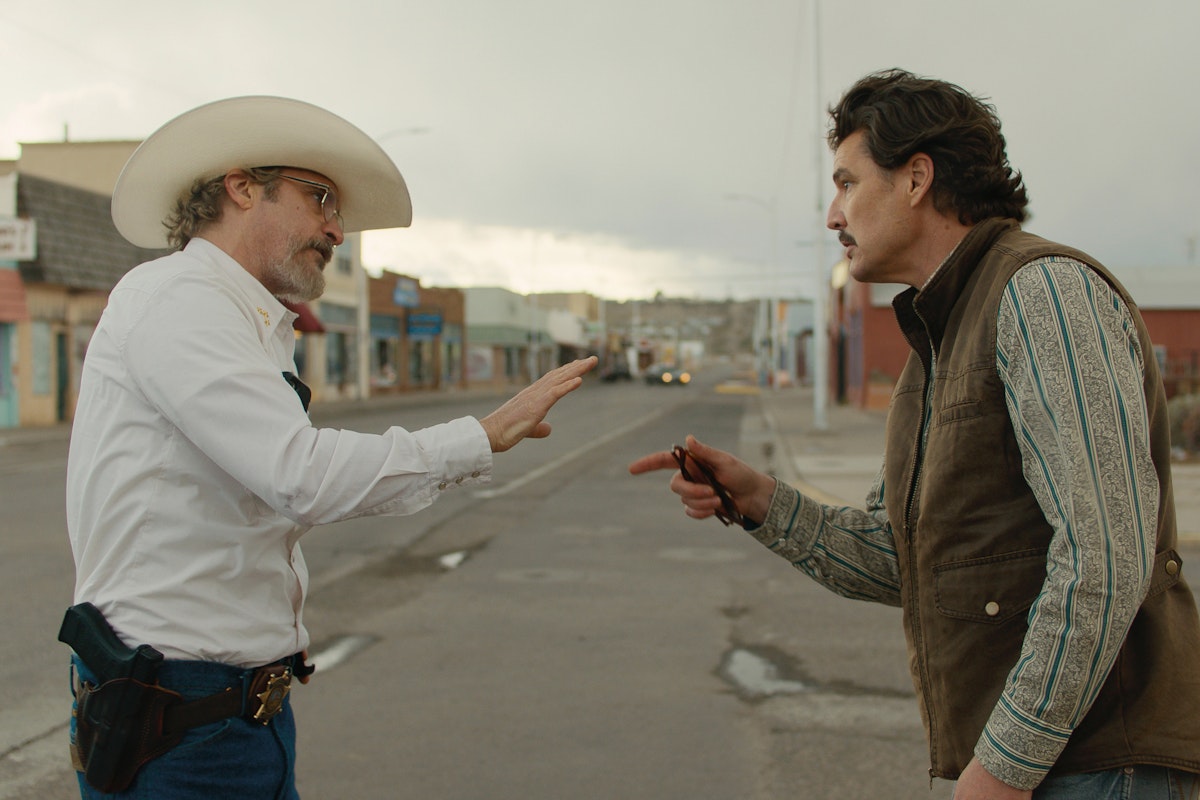
Where Midsommar and Beau Is Afraid expanded Aster’s scope of interest in social and political realities, Eddington makes them its subject. The first half is awash in screens—characters constantly watching videos, texting each other, and doomscrolling. A shot of Joe turning away from his wife in bed only to gaze at her image on his phone’s lock screen exemplifies the film’s disinterest in subtlety. The people of Eddington—like the rest of us—lead split lives, online and IRL, the lines between the two perpetually blurred. There are plenty of person-to-person interactions in the film, such as a very western-coded scene in which Ted confronts Joe on the town’s main drag, complete with trash blowing across the screen. But even these supposedly human interactions are mediated by life online, where communication is more performative than substantive, and perceptions of reality are individually tailored. Throughout their face-off, Joe has his phone in his shirt pocket recording a video of the whole thing, making any real conversation impossible. Nobody can actually talk to each other in Eddington. “I am listening. Shut up!” Joe sputters hilariously during one of the film’s earlier confrontations—another in which, inevitably, he comes out on the losing end.


