Webb Spots Icy Clouds on Distant Jupiter-Like Exoplanet


Using the NASA/ESA/CSA James Webb Space Telescope, astronomers detected clouds of water ice swirling in the atmosphere of Epsilon Indi Ab, a cold super-Jupiter that challenges existing models of giant planet atmospheres.
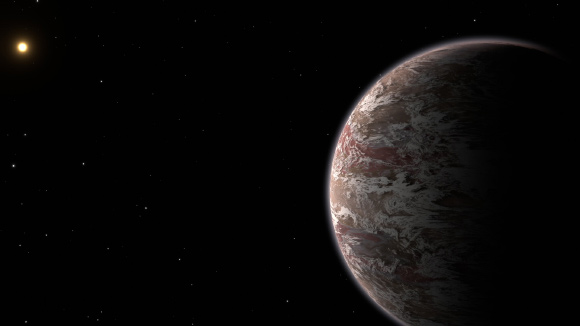
Artist’s impression of Epsilon Indi Ab with water clouds atop its ammonia-dominated atmosphere. Image credit: EC Matthews, MPIA / T. Müller, HdA.
Epsilon Indi A is a K5V star located about 12 light years from Earth in the southern constellation Indus.
Also known as HD 209100 or HIP 108870, the star is between 3.7 and 5.7 billion years old.
The star is a little less massive and a little cooler than our Sun and is orbited by a gas giant exoplanet several times the mass of Jupiter.
Known as Epsilon Indi Ab, the alien world has a surface temperature of around 200 to 300 K (between minus 70 degrees Celsius and 20 degrees Celsius).
The reason the planet is slightly hotter than Jupiter (140 K, minus 133 degrees Celsius) is that there is still a lot of heat left over from the planet’s formation phase.
Over the next billion years, Epsilon Indi Ab will gradually cool, eventually becoming colder than Jupiter.
“This planet has a considerably larger mass than Jupiter – the new study pegs its mass at 7.6 Jupiter masses – but the diameter is about the same as its solar system cousin,” said Bhavesh Rajpoot, a doctoral student. student at the Max Planck Institute for Astronomy.
Using Webb’s Mid-Infrared Instrument (MIRI), Rajpoot and colleagues obtained direct images of Epsilon Indi Ab.
They also estimated the amount of ammonia present in the planet’s atmosphere.
“For Jupiter, ammonia gas and ammonia clouds dominate the upper layers of the atmosphere visible in observations,” they said.
“Given its properties, Epsilon Indi Ab was thought to also contain enormous amounts of ammonia gas, but not ammonia clouds.”
“Surprisingly, the photometric comparison showed slightly less ammonia than expected.”
The best explanation astronomers found for this deficit was the presence of thick but patchy water ice clouds, similar to high-altitude cirrus clouds in Earth’s atmosphere.
“This is a major problem, and it speaks to the tremendous progress we are making thanks to Webb,” said Dr. James Mang, an astronomer at the University of Texas at Austin.
“What once seemed impossible to detect is now within our reach, allowing us to probe the structure of these atmospheres, including the presence of clouds. »
“This reveals new levels of complexity that our models are now beginning to capture, and opens the door to even more detailed characterization of these cold, distant worlds. »
The results appear in the Astrophysical journal letters.
_____
Elizabeth C. Matthews and others. 2026. A second visit to Eps Ind Ab with JWST: New photometry confirms ammonia and suggests thick clouds in the exoplanet atmosphere of the nearest super-Jupiter. ApJL 1002, L5; doi: 10.3847/2041-8213/ae5823


:max_bytes(150000):strip_icc()/GettyImages-1365294801-66eeef3fc5e3424c854395c8a13e1b1c.jpg?w=390&resize=390,220&ssl=1 "8 Ways Mushrooms Can Improve Your Health")


