MIT’s virtual violin offers luthiers a new design tool


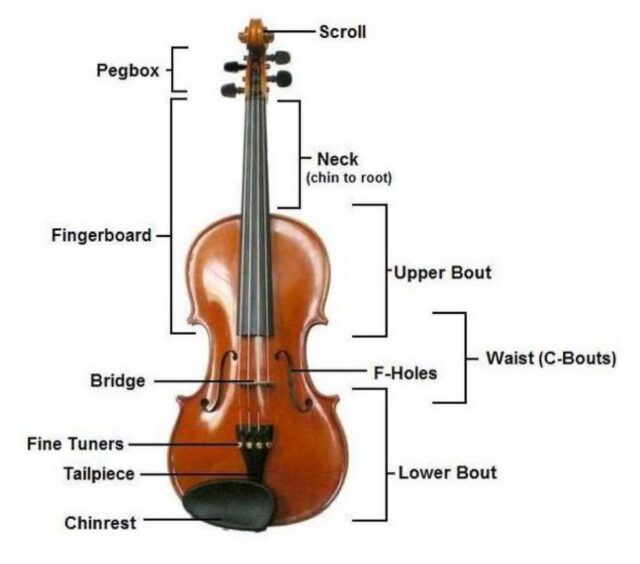
Building a violin.
Building a violin.
Credit: Sotakeit/CC BY-SA 3.0
Or maybe it was the polish Stradivari used: a cocktail of honey, egg whites and gum arabic. A 2022 study involving nanoscale imaging of two such instruments revealed a protein-based layer at the interface of wood and varnish, which may influence the natural resonance of wood.
Biochemist Joseph Nagyvary has argued that it is the chemicals used to treat wood that give Stradivari violins their unique sound, particularly the copper, iron, and chromium salts used to preserve the wood, all of which are excellent wood preservatives but may also have altered the acoustic properties of the instruments. A 2021 study supported this argument, identifying borax, zinc, copper, alum, and limewater as the chemicals most likely to affect sound.
CT scans have provided a good insight into the puzzle, since the technique can reveal the density, size and shapes of wood, volume measurements and thickness grading, as well as any damage or repairs on a given instrument. For example, a 2009 study used CT scans to study the material properties of wood. In 2011, Minnesota radiologist Steven Sirr took detailed CT scans of the 1704 “Betts” violin, then collaborated with two violin makers to make a replica.
One of the most in-depth investigations was the Strad3D project, started in 2006 by the late George Bissinger. This project used 3D scanning lasers to make detailed quantitative measurements of the acoustic properties of several Stradivarius violins, essentially mapping how the instruments vibrate and thus produce their distinctive sound. (For what it’s worth, when I interviewed Bissinger in 2007, he was skeptical of efforts to ever replicate the sound quality of a Stradivarius violin on a large scale, insisting that making an instrument is as much an art as a science and that there is not a single secret behind the Stradivari sound.)


