‘They weren’t burned by accident’: Mysterious green rocks discovered high in Pyrenees reveal ancient copper-smelting camp


Mysterious green rock discovered in the Pyrenees suggests prehistoric humans maintained high altitudes copper mining camp in Spain for more than four millennia, according to archaeologists. The cave was filled with layers of green mineral fragments and abundant pieces of charcoal, suggesting that people returned to the seasonal camp repeatedly for generations.
Archaeologists discovered the cave about 7,333 feet (2,235 meters) above sea level in Spain’s Girona province, near the mountainous border with France. Inside, researchers found human remains, animal bones, broken ceramic vessels and prehistoric fireplaces – all evidence that humans used the cave for more than 4,000 years. They also discovered nearly 200 pieces of the mysterious green rock that was not naturally present in the cave.
The Copper Age (also called Chalcolithic) of prehistoric Europe lasted from approximately 5,000 to 2,000 BC. Around this time, people began to exploit natural reservoirs of copper to create tools, jewelry, and vessels. For example, Ötzi the iceman He had a copper ax in his possession when he died in 3300 BC, and some experts believe he may have been exploring the Alps for copper-rich minerals.
It is relatively simple to extract copper from a mineral like malachite. The copper carbonate mineral is heated, which releases carbon dioxide and transforms the green mineral into a black residue called copper oxide. The copper oxide is then subjected to a carbon source, such as charcoal, which releases carbon dioxide and leaves a small copper nugget.
The high-altitude cave that archaeologists excavated in the Pyrenees contained nearly 200 fragments of a green mineral they believe to be malachite, as well as dozens of prehistoric burn pits or hearths where people likely processed the mineral to extract copper.
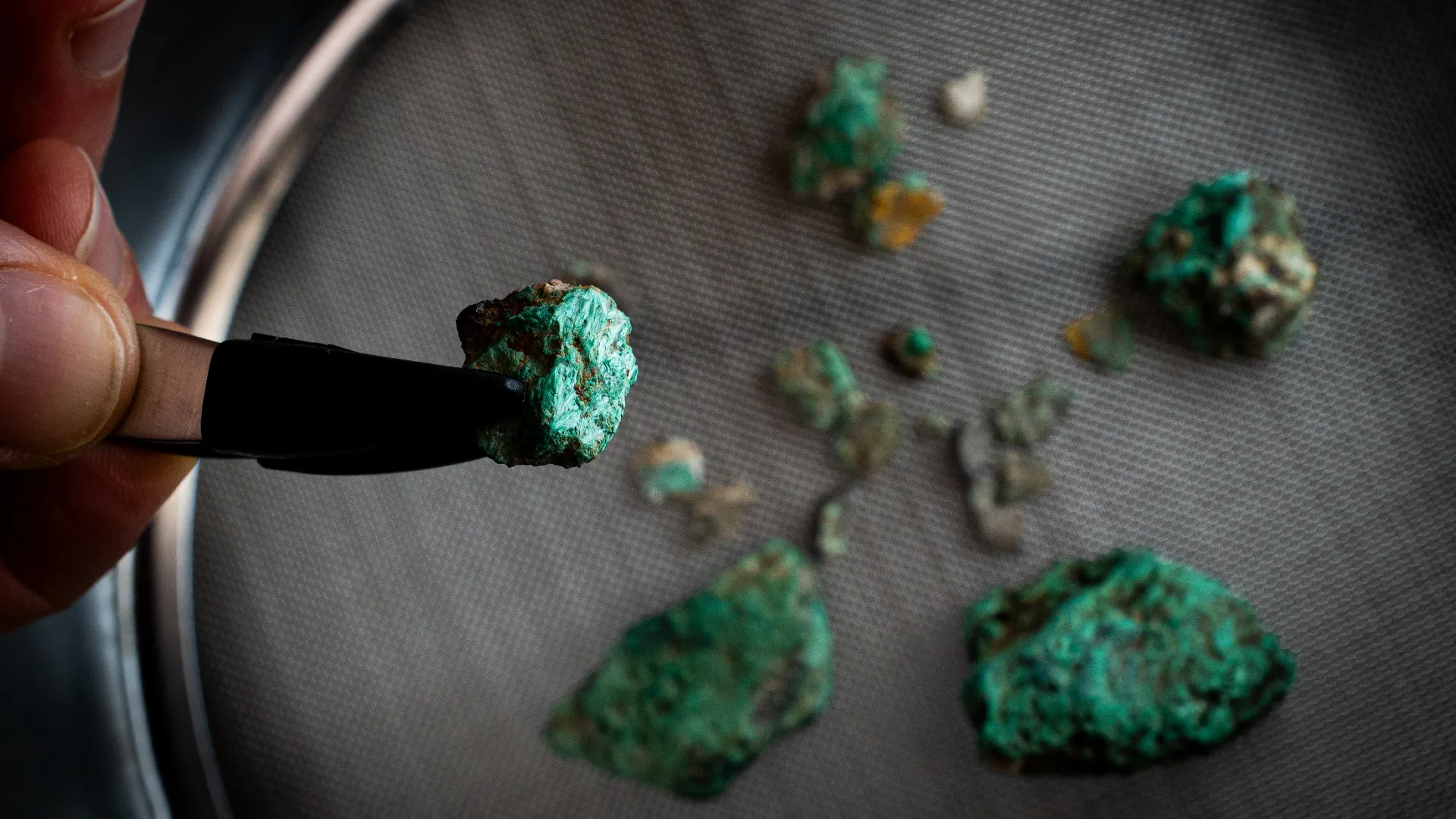
Researchers have recovered dozens of fragments they suspect are malachite, a copper-rich rock, from an archaeological site high in the Pyrenees.
(Image credit: Maria D. Guillén/IPHES-CERCA)
“Many of these fragments are thermally altered, whereas other materials in the cave are not, clearly suggesting that fire played an important role in their processing and that there was deliberate intent behind this,” co-author of the study. Julia Montes Landaarchaeologist at the University of Granada, said in a statement. “In other words, they weren’t burned by accident.”
The first occupation of the cave occurred between 5,000 and 4,300 BC, according to the study, but the most intensive use occurred between 3,600 and 2,400 BC, during the height of the Copper Age.
Archaeologists also recovered two personal ornaments and human remains from the cave’s most intensive occupation. One of the pieces of jewelry was an elongated pendant made from a shell (Glycymeris), and the other was a brown bear (Ursus arctos) tooth which had been perforated to be worn as a pendant. The human remains included a baby tooth and a finger bone, which could suggest the cave was used as a burial deposit, the researchers wrote in the study.
“For the first time in the Pyrenees, prehistoric high mountain occupations of significant intensity have been documented, characterized by repeated activities and direct exploitation of mineral resources within the cave,” studies the first author. Carlos Torneroprehistoric archaeologist from the Autonomous University of Barcelona and researcher at the Catalan Institute of Human Paleoecology and Social Evolution, said in a separate statement statement.
Given the intense exploitation of the cave for thousands of years, knowledge of the site and its resources must have been passed down from generation to generation, the researchers note in the study.
“This site demonstrates that the Pyrenees was not a marginal territory for prehistoric communities, but a space fully integrated into their strategies of mobility and territorial exploitation,” Tornero said.
The team plans to continue its excavations for several years. They also plan to soon confirm the identification of the green rock as malachite, which will help them better understand the ultimate purpose of the processing activities that have taken place in the cave for thousands of years.
Tornero, C., Diez-Canseco, C., Soler, R., Calvo, S., Delgado-Raack, S., Messana, C., Montes-Landa, J., Morales, JI, Picornell-Gelabert, L., Soriano, E., Carbonell, E. (2026). Beyond 2,000 meters, first evidence of intense prehistoric occupation in the Pyrenees. Frontiers of Environmental Archeology. http://dx.doi.org/10.3389/fearc.2026.1811493
Find out everything you know about gemstones with our quiz on gold and precious stones!


