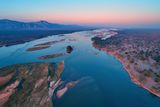
Before a continent visibly splits apart, Earth may begin leaking gases from underground. That may already be happening in Zambia, where gases bubbling through geothermal springs along the Kafue Rift carry chemical fingerprints linked to Earth’s mantle — a possible sign that part of the African continent is beginning to slowly pull apart.
By analyzing helium and carbon dioxide isotopes trapped in the springs, the team found that faults beneath the region may already connect mantle fluids to the surface. The findings, published in Frontiers in Earth Science, add evidence to the idea that the Kafue Rift may represent the beginnings of a future tectonic plate boundary.
“The hot springs along the Kafue rift of Zambia have helium isotope signatures which indicate that the springs have a direct connection with the Earth’s mantle,” said Mike Daly of the University of Oxford, in a press release.
Kafue Rift Gases May Signal Early Continental Breakup
Continental breakup does not usually begin with dramatic volcanic eruptions or giant cracks opening in the ground. In its earliest stages, the process can be much quieter, marked instead by slowly stretching crust, subtle fault movement, and gases escaping upward through fractures deep underground.
That is part of what makes the Kafue Rift so interesting.
The fault system forms part of a roughly 2,500-kilometer-long zone extending from Tanzania to Namibia. Geologists have proposed that the region could represent a developing branch of the broader African Rift System, but evidence linking the rift to Earth’s mantle has been limited.
To investigate, researchers collected gas samples from geothermal springs and wells both inside and outside the suspected rift zone. Springs within the Kafue Rift contained unusually high helium isotope ratios, too high to come only from Earth’s crust or the atmosphere, pointing instead to mantle-derived fluids rising upward through faults beneath the region.
The springs also contained carbon dioxide signatures associated with mantle-derived gases, reinforcing the idea that deep fluids are moving upward through the rift zone.
Read More: About 34 Million Years Ago, Earth’s Most Powerful Ocean Current Emerged and Reshaped the Climate
Why This Rift Looks Different From East Africa’s
The East African Rift System (often used as a model for continental breakup) includes volcanoes, large lakes, and highly active tectonic regions. The Kafue Rift, by comparison, is relatively quiet, defined mostly by fault lines, hot springs, geothermal anomalies, and subtle seismic activity.
The lack of major volcanism may offer researchers a better view of continental breakup before large volcanic systems fully emerge.
“A rift may become a plate boundary, but commonly a rift’s activity ceases before the point of lithospheric break-up and plate boundary formation,” said Daly.
The gas chemistry also resembles measurements previously recorded in younger sections of the East African Rift System, particularly regions where crustal stretching appears to be occurring before major volcanism begins.
What The Zambia Rift Could Mean For Energy And Resources
Early-stage rift systems may create favorable conditions for geothermal energy production, as well as underground accumulations of helium and hydrogen. Researchers note that younger rifts often contain less volcanic gas contamination than more mature volcanic systems, potentially making them attractive targets for future resource exploration.
The study examined only one portion of the much larger Southwestern Rift of Africa, and additional work will be needed to determine whether similar mantle signatures appear elsewhere along the system.
Still, the gases bubbling through Zambia’s hot springs may show that tectonic changes are already underway beneath the region.
Read More: Waiting for selection…
Article Sources
Our writers at Discovermagazine.com use peer-reviewed studies and high-quality sources for our articles, and our editors review for scientific accuracy and editorial standards. Review the sources used below for this article: