Baby ‘cosmic fossil’ galaxy brings JWST closer to glimpsing the universe’s first stars


May 13, 2026
5 min reading
 Add us on GoogleAdd SciAm
This tiny galaxy is a ‘missing link’ in the quest to spot the universe’s first stars
Observed just 800 million years after the Big Bang, an object called LAP1-B is a galactic building block that appears to contain some of the first stars to ever shine.
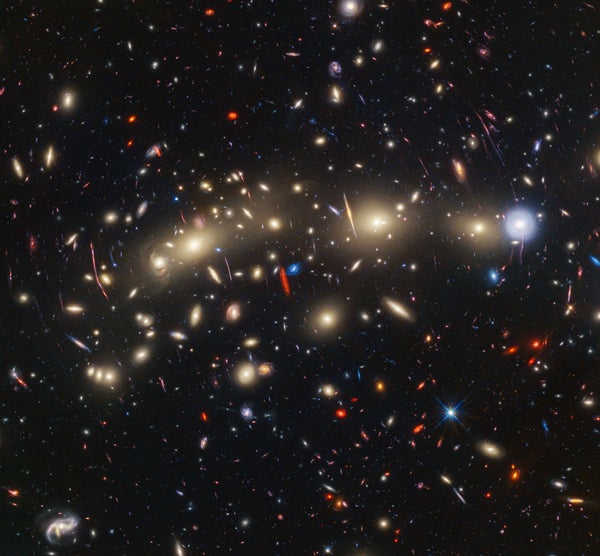
The galaxy cluster MACS J0416.1-2403 (MACS0416) amplifies light from more distant background galaxies through gravitational lensing.
NASA/ESA/CSA/STScI/J. Diego/Institute of Physics of Cantabria/J. D’Silva/University of Western Australia/A. Koekemoer/STScI/J. Summers/Arizona State University/R. Windhorst/Arizona State University/H. Yan/University of Missouri
It’s a discovery so full of mind-blowing ideas that it seems straight out of science fiction: Using humanity’s largest off-world observatory to focus on a tiny, distant arc of light amplified by a space-time quirk, astronomers have glimpsed a faint galaxy as it was 13 billion years ago, when it was teeming with dark matter, along with what may be new remains of the oldest and strangest stars of the universe.
The small, distant galaxy is called LAP1-B, the observatory is NASA’s James Webb Space Telescope (JWST), and the strange stars would have been what astronomers call “population III” stars: titanic suns that shone brilliantly and died young near the dawn of time.
These stars constitute the key quarry for which JWST was designed: stellar orbs composed of primitive, primitive hydrogen and helium gases that were created by the big bang. These stars are not really the stuff most cosmologists’ dreams are made of, but rather the sources of the atoms that made cosmologists themselves. The oxygen in your lungs, the iron in your blood, the calcium in your bones, the carbon in your cells, and even the silicon in your smartphone can all be attributed to Population III stars, which shed cosmic fertilizers of heavy metals (astronomers call all elements heavier than helium “metals”) during their explosive deaths. The debris from their demise coalesced to form subsequent stellar generations – Population II and Population I stars – as well as planets and eventually humans.
On supporting science journalism
If you enjoy this article, please consider supporting our award-winning journalism by subscription. By purchasing a subscription, you are helping to ensure the future of impactful stories about the discoveries and ideas shaping our world today.
In any case, this is the story of creation that astronomers tell themselves. The problem with proving all of its details is that these early stars are so far away in space and time that even the mighty JWST has not yet seen them directly and definitively. Instead, telltale clues to their existence appear primarily in studies of galaxies large and bright enough for JWST to see clearly across the universe. Rather than collecting light from Population III stars, JWST has so far only inferred their presence in such locations via glowing fogs eerily lit from within by the intense radiation of early stars.
LAP1-B is different. It is a trickle of incandescent gas nestled in a pool of invisible dark matter, a cosmic “fossil” observed just 800 million years after the big bang. Yet it looks a lot like the swarms of “ultrafaint dwarf galaxies” (UFDs) that astronomers find near our Milky Way. Cosmologists suspect that in the early universe, these objects were like puzzle pieces fitting together to form larger galaxies; The UFDs we see around us today are part of a larger population of remnants scattered throughout the cosmos that have never found a larger home. JWST’s ability to see LAP1-B is solely due to the galaxy’s fortuitous placement behind a cosmic monster called MACS J0416.1-2403, a giant galaxy cluster so immense that its mass distorts space-time to create a “gravitational lens” that magnifies LAP1-B’s faint light 100-fold.
Ironically, this boost is so large that JWST, tailor-made to find things like LAP1-B, was not needed to discover it. Instead, the object was first announced in 2020 from data collected from a ground-based facility, the European Southern Observatory’s Very Large Telescope in Paranal, Chile, which followed earlier Hubble Space Telescope studies of MACS0416. Subsequent studies with JWST gradually revealed more about this mysterious object. The last one, published in Nature today, strengthens the argument that LAP1-B is an early cosmic puzzle piece filled with freshly made material from dying Population III stars.
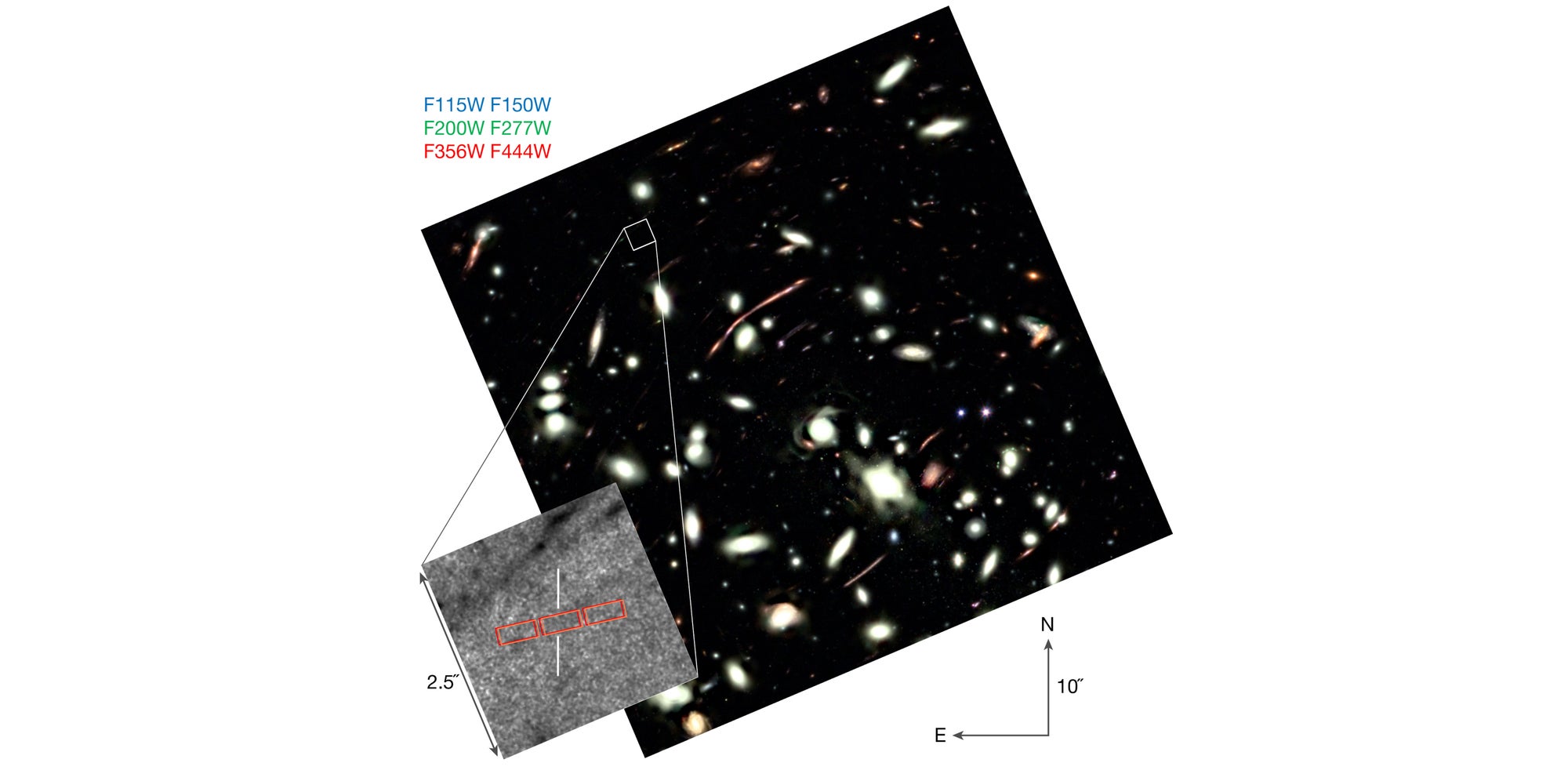
A false-color image of part of the galaxy cluster MACS0416, seen at multiple infrared wavelengths by NASA’s James Webb Space Telescope (JWST). The “cosmic fossil” LAP1-B – a small, faint background galaxy magnified by MACS0416’s gravitational lensing – appears as a faint arc of light in a magnified inset image. LAP1-B is believed to contain relics of the first generation of stars in the universe. The orange bars around LAP1-B denote the slits used for JWST’s spectroscopic measurements of the galaxy.
“LAP1-B shows us the ‘first generation’ of element production,” says the study’s lead author, Kimihiko Nakajima, an astronomer at Kanazawa University in Japan. “We see a galaxy that has just inherited its first batch of heavy elements from the very first stars to ever shine. This tells us that these tiny dark matter-filled galaxies were the building blocks of the universe, and we have finally captured the moment when they began to exist.”
These key insights arise from JWST’s ability to perform spectroscopy on LAP1-B, scattering light from the tiny galaxy in a rainbow-like color spectrum; the specific mixture of colors can reveal the chemical composition of an object. By reading this chemical “barcode,” Nakajima and his colleagues discovered that the gas in LAP1-B is mostly pure hydrogen and helium from the big bang, with meager traces of oxygen likely pumped in by the first generation of stars. The data also shows a surprising excess of carbon – a sign, Nakajima says, that Population III stars are ending their lives in a “weak” supernova, as some theoretical models predict. This would imply that stars would eject their carbon-rich outer layers while the oxygen-rich inner layers would be swallowed by a newly formed black hole at their core.
The data further reveal that the galaxy’s gas glows due to high-energy radiation, which is consistent with predicted emissions from Population III. Yet the actual stars were not detected by the JWST instruments, allowing the team to put an upper limit on their number: LAP1-B contains no more than about 3,300 solar masses of stars (the Milky Way, by comparison, contains about 100 billion solar masses). If there were more, JWST should have seen the glow of the stars. Meanwhile, the small galaxy’s gas swirls so fast that it would disperse if not held in the gravitational grip of a sprawling cloud of dark matter.
All of this, Nakajima says, makes LAP1-B “exactly what we expect from the ancestors of the ultra-faint dwarfs we see today. Until now, we have only seen these fossils in their ‘final’, old, silent state. LAP1-B has turned a theoretical ‘missing link’ into a physical reality that we can now measure and analyze.”
Independent experts view the result with cautious optimism, noting the uncertainties associated with studying the spectra of such a strange object over such great distances.
“I think it’s a fascinating object,” says Roberto Maiolino, an astronomer at the University of Cambridge, who uses JWST to study early galaxies. “LAP1-B could indeed trace the transition between the first pristine stellar populations and the regime of chemically enriched galaxies.”
Evan Kirby, an astronomer studying the chemistry of dwarf galaxies at the University of Notre Dame, agrees. “This is the galaxy that chemical evolution experts wanted JWST to discover,” he says. The team’s interpretations of LAP1-B, however, “will need to be corroborated by future observations and by other research groups.”
Eros Vanzella, an astronomer at Italy’s National Institute of Astrophysics, who previously studied LAP1-B with JWST and led the team that first discovered the galaxy, finds these latest results compelling and promising.
“I am very happy to see that our first claim on [LAP1-B’s] very low metallicity is confirmed by deeper spectroscopic observations,” he says, adding that direct detection of starlight from the small galaxy might still be possible through even deeper observations with JWST. “The story of this remarkable source is far from over.”