Why sloths risk their lives to poop


Every week, without fail, the three-toed sloth takes a breathtaking, almost suicidal risk, all to have a bowel movement. Or, to put it in terms familiar to anyone who has sat through a long Zoom meeting, a “bio-pause.”
With fast-moving predators on the prowl, being on or near the ground is the leading cause of sloth mortality. And because sloths have one of the slowest metabolisms ever recorded in animals, going down and back up the tree represents one of the largest energy expenditures of their entire week.
“It’s like having to do a 5K run in the middle of a highway, just to go to the bathroom,” says Dr. Jonathan Pauli, a wildlife ecologist at the University of Wisconsin-Madison. Popular science. “It’s very expensive and very risky.”
Which begs the question: why do three-toed sloths take such risks to poop? Why not just do the sensible thing and poop in the trees?
The answer involves mutualism – a relationship in which all parties benefit – between sloths, moths, and that precious pile of dung that sloths risk their lives to leave behind.
Sloths are home to flightless butterflies
The key to this whole system turns out to be a much smaller, less glamorous creature: slothful butterflies (Cryptoses choloepi). These butterflies spend their entire adult lives in sloth fur – yes, all of it. Once a butterfly finds and colonizes its slow-moving host, it loses the ability to fly. Permanently.
This is okay, because lazy butterflies don’t need to fly once they find their lazy habitat. Instead, the butterflies hitch a ride with the sloth to the base of the tree for its weekly pooping session.

🦥Have you ever seen a POOP Sloth dance?
Some sloths wiggle or dance a little when trying to poop. Video: Have you ever seen a sloth poop dance?, The Sloth Conservation Foundation
Once the sloth has deposited its droppings on the forest floor, the pregnant females jump from the sloth into the pile of droppings (because they can’t fly, they literally jump), lay their eggs, and that’s pretty much the end of the butterfly.
Meanwhile, a new generation of lazy butterflies is dreaming big dreams. After hatching in feces, the newborn larvae quickly begin to eat the feces that spawned them.
“The larvae feed on sloth droppings. They actually chew a chamber in the sloth droppings,” Pauli explains. “The larvae then pupate and emerge as moths. »
And then, for a fleeting moment, the lazy butterflies can fly. The newly emerged butterflies drift toward the tree canopy, find and inhabit a lazy host, and the cycle begins again. The butterflies are definitely grounded. Until the day their offspring begins this brief one-way flight again.
Algae creates a sloth’s green camouflage coat
Enter the third actor in this strange triumvirate: algae.
Because butterflies do not fly, many of them live their entire lives in the sloth’s fur and die there. As they decompose, they release nitrogen and phosphorus directly into the sloth’s fur.
Pauli describes the sloth’s distinctive hairs that absorb water as “almost like a hydroponic growing area” for algae.
More moths means more fertilizer, and more fertilizer means more algae, especially Trichophilus, or “hair-loving algae,” a species found nowhere on earth except sloth fur. Pauli likens the effect to a ghillie suit (the head-to-toe camouflage gear that snipers wear to disappear into the foliage). The algae turns the sloth’s fur green enough to disappear into the forest canopy.
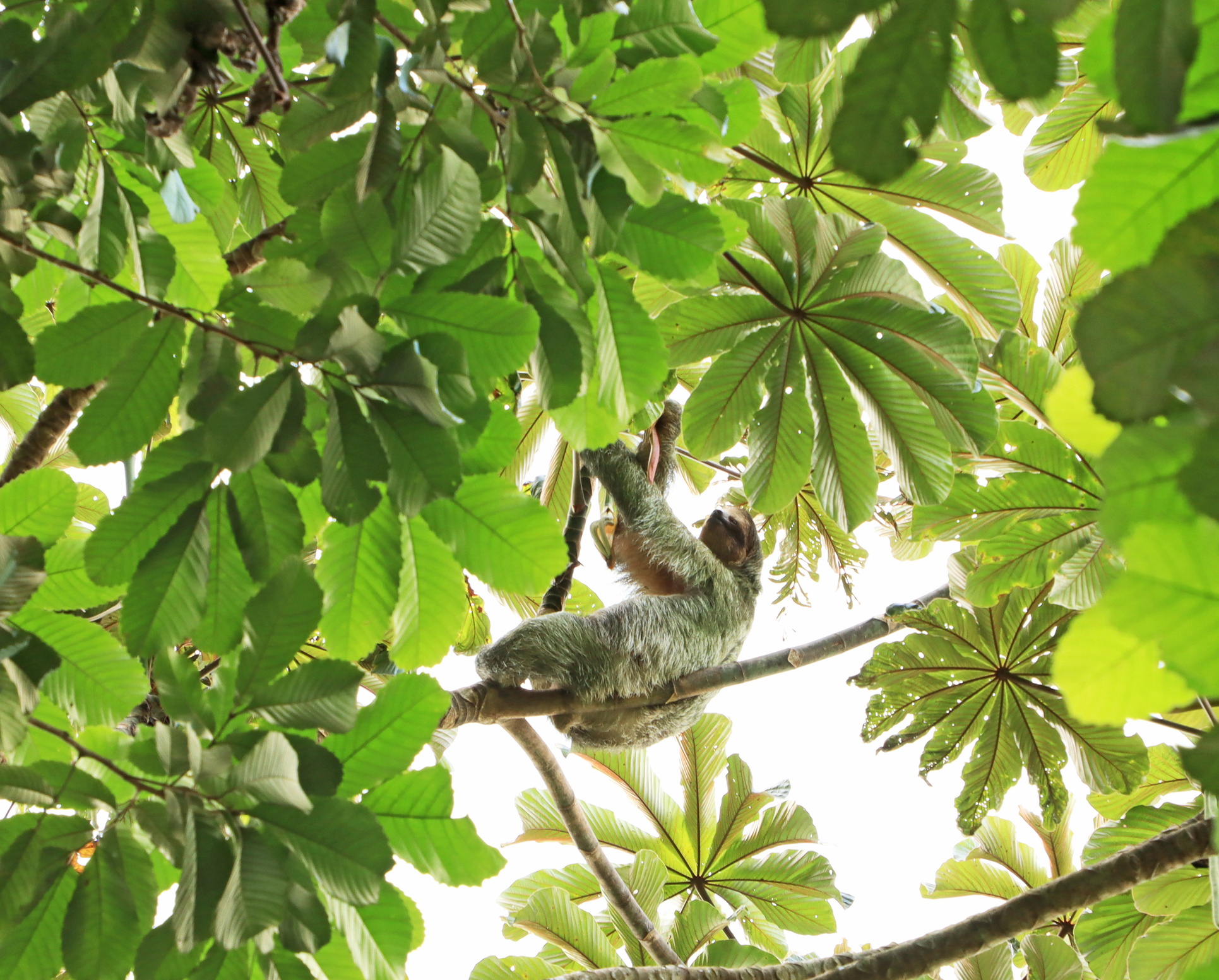
But these algae also serve another purpose, beyond being cool, lively camouflage. It is also a potential food source for these slow-moving mammals.
Do sloths grow algae on their bodies? Maybe.
To find out whether the sloths were actually eating these nutrient-rich algae, Pauli and his colleagues did something that sounds alarming but seems like a normal Tuesday in wildlife ecology: They pumped the stomachs of about a dozen three-toed sloths.
What they found wasn’t so surprising: lots of Cecropia leaves, a staple food of sloths. But they also found Trichophilus algae. And since Trichophilus doesn’t exist anywhere on earth except in the sloth’s fur, there was only one way to get there: the sloth ate its fur. By testing the algae, Pauli and his team found that it was digestible and rich in lipids, a potentially valuable addition to a diet of nutrient-poor leaves.
What the research team doesn’t know is whether it matters. Does the sloth grow, snack and extract nutrition from its own snack?
“It could be totally trivial and unimportant,” Pauli says. “They might get some in their stomach by accident. That would be the equivalent of eating a Snickers bar too fast and accidentally eating part of the wrapper.”
It could also be that sloths consume it deliberately, extracting real nutrition from the algae growing on their own bodies. Whatever the cause of this phenomenon, Pauli is pretty sure of one thing: the lazy person doesn’t do it on purpose.
“It’s not conscious – I don’t think the sloth ever thinks, ‘It’s time to regenerate my algae.’ I think it’s more that individuals who have these behaviors, who strengthen these relationships with these other species, see fitness benefits. This is why we see these behaviors persist.
In other words, this whole system—from flightless sloth butterflies to algae to sloth diets—could help sloths survive.
Which brings us back to that suicidal weekly commute. It turns out that the sloth’s journey to the forest floor may be doing more than answering nature’s call. In fact, it could be the key to maintaining the entire system. No land travel, no delivery from moth to dung. No distribution of moths, no fertilizer. No fertilizer, no algae. And no algae means no camouflage, and maybe even no nutritional supplement for a pet that can barely afford to lose any. Not bad for a bathroom break.
In Ask us anythingPopular Science answers your wildest and most burning questions, from everyday things you’ve always wondered to bizarre things you never thought to ask. Do you have something you always wanted to know? Ask us.
Related Stories “Ask Us Anything”

The best new PopSci 2025 releases


