VLT Spots Protoplanet and Substellar Object Candidates around Young Stars


Using the imagery and instrument of improved resolution spectrographers (ERIS) on the very large ESO telescope (VLT), two teams of astronomers have detected a protoplanet candidate integrated into a disc spiral around the young star HD 135344B, as well as the ASA subpart candidate.
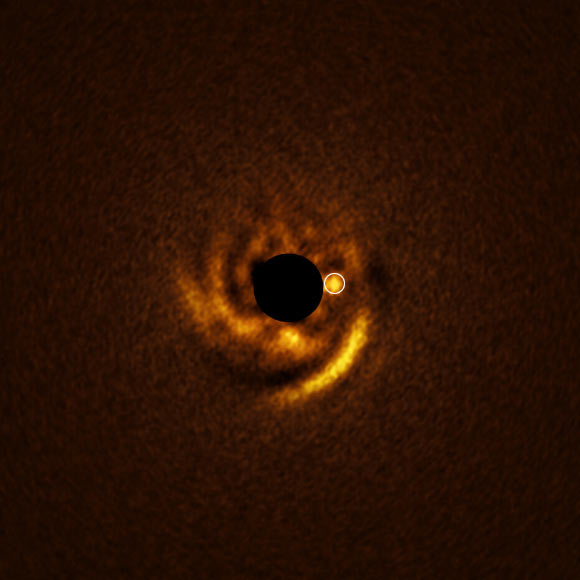
This image shows a spiral disc around the Young Star HD 135344B. The image was obtained with the improved STC resolution instrument and the spectrograph instrument (ERIS), which found a candidate planet that could sculpt the spiral characteristics of the disc. The location of this planet is indicated by a white circle. Image credit: ESO / Maio and al.
“We will never witness the formation of the earth, but here we can look at a planet exist in real time,” said Francesco Maio, doctoral researcher at the University of Florence, Italy, and principal author of an article published in the journal Astronomy and astrophysics.
Maio and his colleagues detected a protoplanet candidate in a protoplanetary disc around HD 135344B, a F8V star 11.9 million, located at 135 parsecs (440 light years) of the sun in the constellation of the lupus.
The protoplanet is estimated twice as much of Jupiter’s size and as far from its host star that Neptune is sun.
It was observed by shaping its environment in the protoplanetary disc as it turns into a fully formed planet.
Protoplanetary discs have been observed around other young stars, and they often have complex patterns, such as rings, gaps or spirals.
Astronomers have long predicted that these structures are caused by babies’ planets, which sweep the material in orbit around their parent star.
But, so far, they had not caught one of these planetary sculptors in the act.
In the case of the HD 135344B disc, swirling spiral arms had already been detected by another team of astronomers using the instrument of the VLT sphere.
However, none of the previous observations of this system found proof of a planet forming in the disc.
The use of the ERIS instrument of VLT, Maio and co-authors may have found their first suspect.
They spotted the planet’s candidate just at the base of one of the spiral arms of the disc, exactly where the theory had predicted that they could find the planet responsible for the sculpture of such a model.
“What makes this detection potentially a turning point is that, unlike many previous observations, we are able to directly detect the protoplanet signal, which is still highly incorporated into the disc,” said Maio.
“This gives us a much higher level of confidence in the existence of the planet, because we observe the own light of the planet.”

This image shows a possible companion subsular in orbit around the young star V960 Mon. The candidate object was found with the very large eSo telescope (VLT), using its new imagery and improved resolution spectrograph (ERIS). The new Eris data is presented here in orange, superimposed on older images of the dusty disc seen with the VLT (yellow) and Alma (blue) sphere instrument. Image credit: ESO / A. DASGUPTA / ALMA / ESO / NAOJ / NRAO / WEBER and al.
In a distinct study, Anurooop Dasgupta, doctoral researcher at ESO and the DIEGO Portales University, and his colleagues used the Eris instrument to observe another young star, V960 MON, which is located 1637.7 Parsecs (5,342 light years) in the constellation of Monoceros.
Previous observations with the instrument of the sphere and the large network of ATACAMA millimeter / submillimeter (Alma) revealed that the V960 MON orbit material is transformed into a series of complex spiral weapons.
They have also shown that the material is fragmented, in a process known as gravitational instability, when large heaps of the material around a star contract and collapse, each with the potential to form a larger planet or object.
DASGUPTA and the co -authors were able to detect a substrate companion – a brown dwarf or a large planet – around V960 Mon.
“With Eris, we have decided to find compact and luminous fragments signaling the presence of a companion on the disc – and we did,” said Dasgupta, first author of an article published in the Astrophysical newspaper letters.
“We found a potential companion object very close to one of the spiral arms observed with Sphere and Alma.”
“This object could be either a planet in formation, or a brown dwarf – a larger object than a planet that has not won enough mass to shine as a star.”
“If it is confirmed, this complementary object can be the first clear detection of a planet or the brown dwarf forming by gravitational instability.”
_____
F. Maio and al. 2025. Unveiling a protoplanet candidate integrated into the HD 135344B disc with VLT / Eris. A&A 699, L10; DOI: 10.1051 / 0004-6361 / 202554472
Anuroop Dasgutta and al. 2025. VLT / Eris observations of the V960 MON system: A subsulance object inclined formed by gravitational instability? Apjl 988, L30; DOI: 10.3847 / 2041-8213 / ADE996


