These ants navigate with a compass tuned to the moon


May 17, 2026
2 min reading
 Add us on GoogleAdd SciAm
These ants navigate with a compass pointing towards the moon
New nighttime navigation system challenges what entomologists thought they knew about how ants find their way
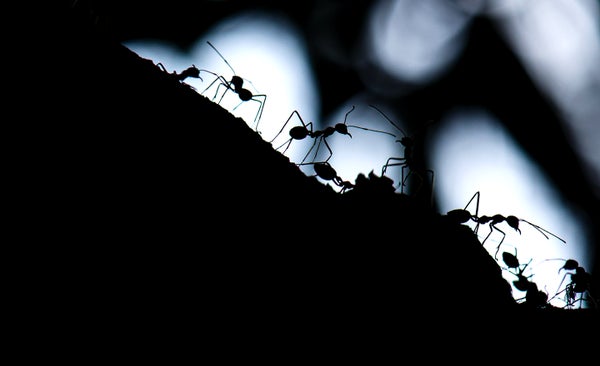
Ants demonstrate new lunar navigation skills.
Ajith Gopinath/Getty Images
When the sun sets, millions of nocturnal ants wake up ready to eat. Some species feed throughout the night, traveling from nest to food source and back, often following trails they mark with their scent. Scientists hypothesized that male ants, which do not rely primarily on scent navigation, must wake up before dark and use the last lights of the day to find their way to sustenance. But a new study on a species of bull ants shows that the insects continue to move when the sun sets, using an innate lunar compass.
Just as diurnal ants follow the relatively steady movement of the sun, bull ant species have adapted to the constant changes of the moon’s orbit, according to a study published in Current biology. Ants use what researchers call temporal compensation: They note the time since they left the nest to determine where the moon should be in the night sky, much like early human navigators used the North Star.
“This was an area where we didn’t really know what was going on” until now, says the study’s lead author, Cody Freas, an entomologist at the University of Toulouse in France. “These ants use many different signals at the same time, which helps them in case one signal becomes unreliable.”
On supporting science journalism
If you enjoy this article, please consider supporting our award-winning journalism by subscription. By purchasing a subscription, you are helping to ensure the future of impactful stories about the discoveries and ideas shaping our world today.
The researchers captured the insects as they headed toward their usual feeding areas and placed a subset in dark boxes lacking any environmental cues about the passage of time. (They put others in clear boxes.) After several hours, the scientists released the ants in a new location and watched them try to find their way to food. When they remained in the dark long enough for the moon to move significantly, the ants veered off course, suggesting that its position was their main signal.
“It’s just kind of crazy,” says Rodolfo da Silva Probst, an entomologist at the University of California, Davis, who was not involved in the study. “They have to compensate for the trajectory of the moon. I mean, I don’t know how to do that.”
Other nocturnal creatures, including sand grasshoppers and moths, are thought to use the position of the moon to find their way, but these bull ants are the first to have such a complex, time-based approach to lunar navigation. Additionally, researchers learned that ants combine their impressive lunar compass with terrestrial and solar signals, at dawn and dusk, to navigate consistently even if the moon’s visibility varies throughout the lunar month.
There are more than 12,000 species of ants in the world, and they all do things a little differently, but understanding how one species has adapted to its unique ecological niche could help researchers understand others, da Silva Probst says. “Perhaps by studying other nocturnal ants you will discover other mechanisms.”
It’s time to defend science
If you enjoyed this article, I would like to ask for your support. Scientific American has been defending science and industry for 180 years, and we are currently experiencing perhaps the most critical moment in these two centuries of history.
I was a Scientific American subscriber since the age of 12, and it helped shape the way I see the world. SciAm always educates and delights me, and inspires a sense of respect for our vast and beautiful universe. I hope this is the case for you too.
If you subscribe to Scientific Americanyou help ensure our coverage centers on meaningful research and discoveries; that we have the resources to account for decisions that threaten laboratories across the United States; and that we support budding and working scientists at a time when the value of science itself too often goes unrecognized.
In exchange, you receive essential information, captivating podcasts, brilliant infographics, newsletters not to be missed, unmissable videos, stimulating games and the best writings and reports from the scientific world. You can even offer a subscription to someone.
There has never been a more important time for us to stand up and show why science matters. I hope you will support us in this mission.


