New NASA Hubble image captures a rare, turbulent galaxy


May 19, 2026
2 min reading
 Add us on GoogleAdd SciAm
New NASA Hubble image captures rare, turbulent galaxy
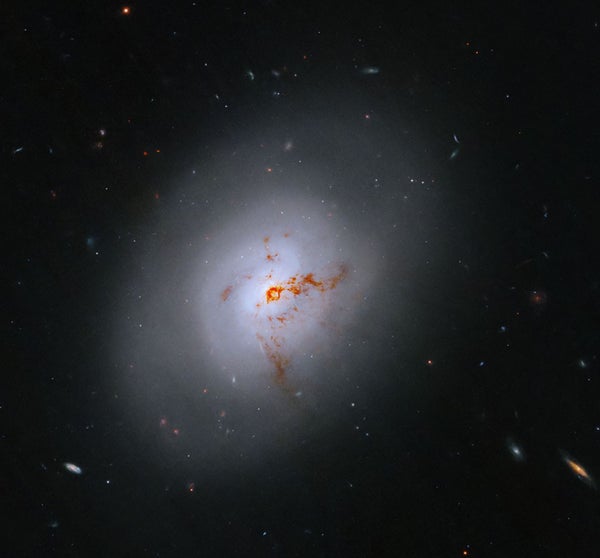
The new image shows the galaxy NGC 1266, a middle-aged object with a cluster of young stars that likely collided with another smaller galaxy 500 million years ago.
NASA/ESA/K. Alatalo/STScI (picture); G. Kober/NASA/Catholic University of America (image processing)
The universe is full of galaxies, but in our neighborhood of the universe, some are rarer than others. Most local galaxies are young, vibrant objects that are full of freshly born stars or quieter elliptical galaxies that have minimal star formation. Only 1 percent fall somewhere in between, and NASA’s Hubble Space Telescope now appears to have sighted one of these transitional galaxies.
Located 100 million light years from Earth in the constellation Eridanus, the galaxy, called NGC 1266, is what is known as a lenticular galaxy. In a statement, NASA explained that these galaxies are considered by astronomers to be an “evolutionary bridge” between spiral galaxies such as the Milky Way and elliptical galaxies, known to have a shape similar to an elongated circle. NGC 1266 is shaped like a flattened, lens-shaped disk and a bright central bulge of a spiral galaxy. But it has no spiral arms and, like an elliptical galaxy, appears to have little or no star formation taking place.
In the new Hubble image, the galaxy is partially obscured by clumps of rust-colored dust and gas. While NGC 1266 may not be generating new stars, that wasn’t the case in the not-so-distant past (relative to the age of the universe, at least). The stars in the galaxy appear relatively young, meaning that NGC 1266 is a post-stellar explosion galaxy. Nearly one in 100 galaxies in the area near the Milky Way fall into this middle-age category.
On supporting science journalism
If you enjoy this article, please consider supporting our award-winning journalism by subscription. By purchasing a subscription, you are helping to ensure the future of impactful stories about the discoveries and ideas shaping our world today.
Astronomers think that about 500 million years ago, NGC 1266 merged with a smaller galaxy, leading to an explosion of star formation, but the collision also increased the mass in the central bulge. Although the extra gas could have led to the formation of more new stars, it appears that this gas was instead sucked into the galaxy’s central supermassive black hole. As the black hole became more active, it generated powerful bursts of gas along its rotation axis, which would have further disrupted the star formation process. Previous observations by Hubble and other observatories have detected gas leaks from NGC 1266, further supporting this theory of why so few new stars are being born there.
It’s time to defend science
If you enjoyed this article, I would like to ask for your support. Scientific American has been defending science and industry for 180 years, and we are currently experiencing perhaps the most critical moment in these two centuries of history.
I was a Scientific American subscriber since the age of 12, and it helped shape the way I see the world. SciAm always educates and delights me, and inspires a sense of respect for our vast and beautiful universe. I hope this is the case for you too.
If you subscribe to Scientific Americanyou help ensure our coverage centers on meaningful research and discoveries; that we have the resources to account for decisions that threaten laboratories across the United States; and that we support budding and working scientists at a time when the value of science itself too often goes unrecognized.
In exchange, you receive essential information, captivating podcasts, brilliant infographics, newsletters not to be missed, unmissable videos, stimulating games and the best writings and reports from the scientific world. You can even offer a subscription to someone.
There has never been a more important time for us to stand up and show why science matters. I hope you will support us in this mission.


