South Korea’s Overnight Highway Chaos Explained

South Korea had a rough night on the roads. In just a few hours, two separate road accidents left vehicles wrecked and lanes closed across the country and, for good measure, a building also caught fire. If you live near the highways of the Gyeongbu First Ring Road or the capital region, chances are you already know this story after sitting in the resulting traffic jams.
These types of incidents, when clustered together over the course of a single night, tend to surprise people. But road accidents in South Korea, particularly involving large commercial vehicles, are not exactly rare. The country has one of the highest rates of freight truck involvement in fatal road accidents among developed countries, a reality that makes nights like this all too familiar to regular commuters and highway workers.
What makes this particular set of events worth attention isn’t just the number of people injured or the number of lanes closed. This is the model. Two of the three incidents directly involved large freight trucks failing to stop in time, hitting whatever was in front of them. This is a detail that deserves attention for a moment.
Authorities are still piecing together exactly what went wrong in each case. But as investigators examine dash-cam footage and black box data, a broader conversation about road safety on Korea’s highways is gaining momentum.
4.5-ton truck turned Pangyo highway into demolition derby
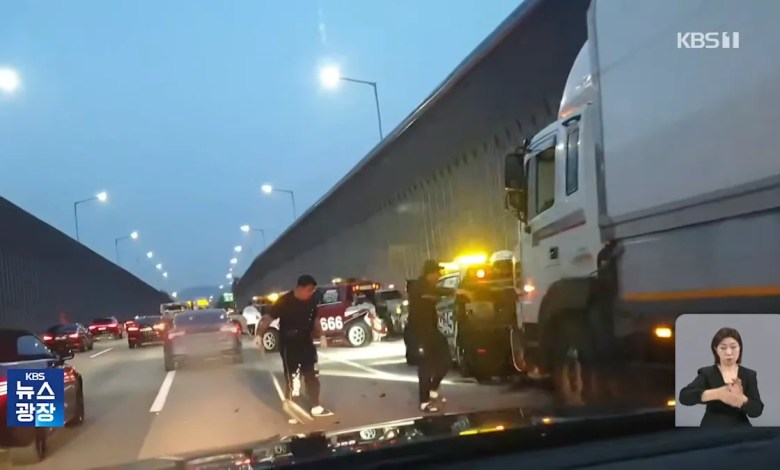
The more serious of the two highway accidents occurred near the Sanbon Interchange on the capital region’s First Ring Road in Gunpo, Gyeonggi Province, on the stretch heading to Pangyo. A 4.5-tonne cargo truck slammed into a line of passenger cars, hitting five of them in a chain reaction that left the vehicles scattered across the track.
A witness at the scene described the scene vividly, saying a large truck came from behind and left a pile of cars tangled like a bad game of bumper cars. Fortunately, despite the scale of the collision, only four people were taken to hospital with minor injuries. Considering what that scene probably looked like, four minor injuries is honestly a best-case scenario.
Police have opened an investigation into the truck driver, a man in his 40s, to establish exactly what caused him to lose control of the vehicle or fail to brake in time. Distracted driving, fatigue and brake failure are the usual suspects in these situations, although no cause has been confirmed.
Sintanjin Interchange Crash Closes Half of Road to Seoul
A few hours later, a few hundred kilometers to the south, another accident involving a truck occurred near the Sintanjin Interchange on the Seoul-bound Gyeongbu Expressway in Daedeok-gu, Daejeon. This time, a trailer hit the back of a large freight truck in front of it.
The trailer suffered the worst, with the front reportedly crumpled and debris strewn across the road. The driver of the trailer was injured and taken to hospital for treatment. To manage the aftermath, two of the four lanes were temporarily closed, which, predictably, slowed traffic on one of the nation’s busiest freight corridors.
The Gyeongbu Expressway essentially forms the backbone of South Korea’s highway network, running from Seoul to Busan. A lane closure on this road at any time, let alone around 10 p.m., is going to cause headaches for a lot of people.
Meanwhile, an apartment fire in Changwon sent 25 people onto the streets.
Adding to an already eventful evening, a fire broke out around 5 p.m. at a residential building in Seongsan-gu, Changwon, South Gyeongsang Province. Thick black smoke was seen coming from the windows before firefighters brought the blaze under control in just under an hour.
A man in his 50s who was inside the unit at the time of the fire was injured and taken to hospital. Twenty-five other residents of the building were evacuated as a precaution. Authorities noted that initial reports included the sound of an explosion before the fire spread, leading investigators to determine whether an appliance, gas line or other ignition source could have started the fire. No official cause has yet been determined.
What these incidents remind us about road and domestic safety
Three incidents, one night, one common thread: the consequences of things going wrong faster than people can react. In both cases of road accidents, large commercial vehicles were involved in collisions that smaller vehicles simply could not absorb. Passenger cars are not designed to withstand the impact of a multi-ton truck, which is exactly why Gunpo’s injuries were considered fortunate despite the scale of the pileup.
For everyday drivers, the bottom line is simple: Maintaining a generous following distance around freight trucks is not only courteous, it’s a practical survival strategy. Large trucks require a much longer stopping distance than passenger cars and, if something goes wrong, they become extremely dangerous projectiles.
An apartment fire is a separate but equally important reminder to check smoke detectors and know evacuation routes. The relatively quick response time and the fact that firefighters brought the fire under control in less than an hour probably limited what could have been much more serious consequences for the residents of the building.
Authorities continue to investigate all three incidents and more details are expected as evidence is reviewed.
If you want more stories like this, follow Guess the headlights on Yahoo so as not to miss the rest.