OWC Thunderbolt 5 Dock review: Docking station with just enough ports


Expert note
Pros
- 11 ports, including four Thunderbolt 5
- 2.5 GB Ethernet
Our verdict
This platform could be the Sweet Spot for commercial or home users who wish to take advantage of the new ports of Thunderbolt 5 of the Mac.
Price during the examination
This value will show the geolocated pricing text for the undefined product
Best price today
Best prices today: OWC Thunderbolt 5 dock

$ 299.99
Thunderbolt 5 is a much larger change in performance than Thunderbolt 4 was on Thunderbolt 3, which was only a few Windows certification changes plus some real specifications updates.
The latest Thunderbolt 5 connection standard (TB5) doubles the bandwidth from 40 Gbit / s to 80 Gbps Bidirectional, with 120 GB The PCIE flow rate from 32 Gbit / s to 64 GB The power supply potential on Thunderbolt 5 Passes from 100 W to 240W.
OWC is one of the main manufacturers of reception stations, so we look forward to testing its first dock Thunderbolt 5. OWC also has a HUB Thunderbolt 5 coupe, which we will test soon.
Aside from the new faster connection standard, there are some differences on the company Thunderbolt 4.
Simon Jary
Design
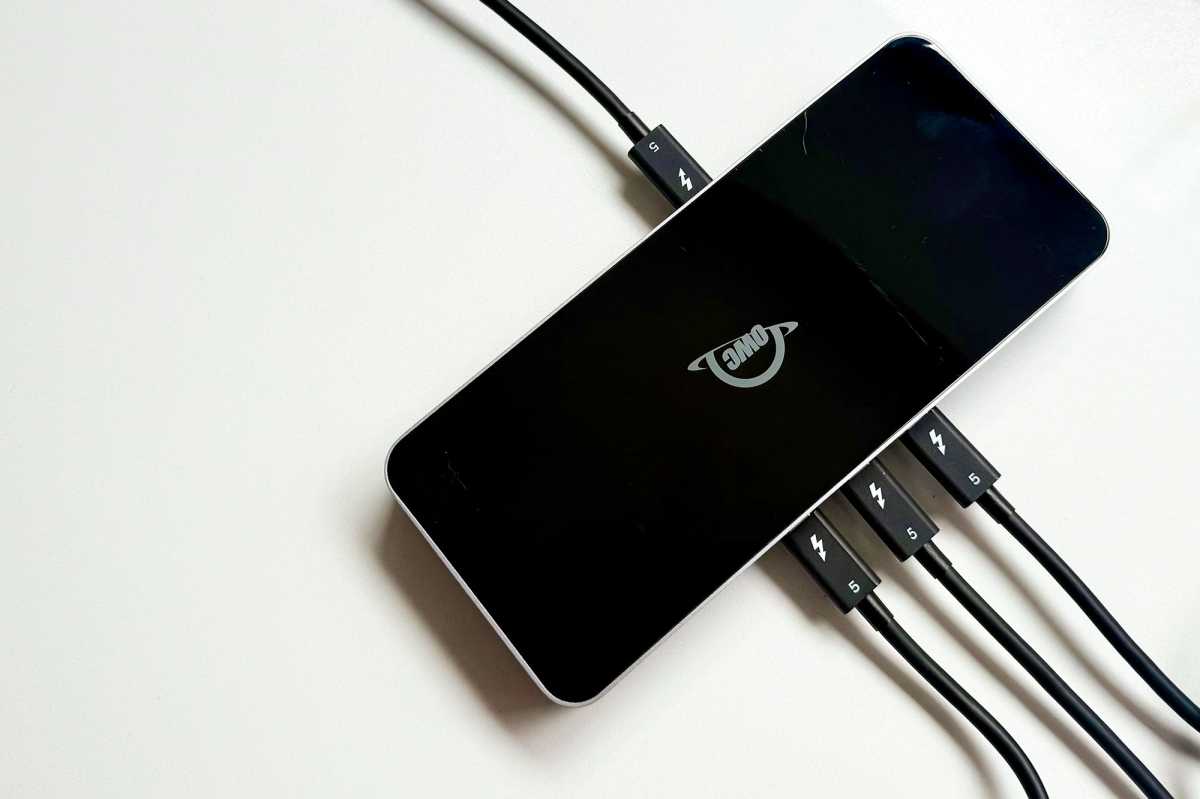
The Thunderbolt 5 OWC quay is squatted that the TB4 quay but keeps the aluminum shell with a shiny black top. While the high shiny looks elegant, it is subject to brands and stripes, then keep it nesting on your desk – to be seen, of course, but not caressed.
It measures 7 x 3.1 x 1.7 inches (17.8 x 7.8 x 4.2 cm) and weighs 1.17 lb (530 g).
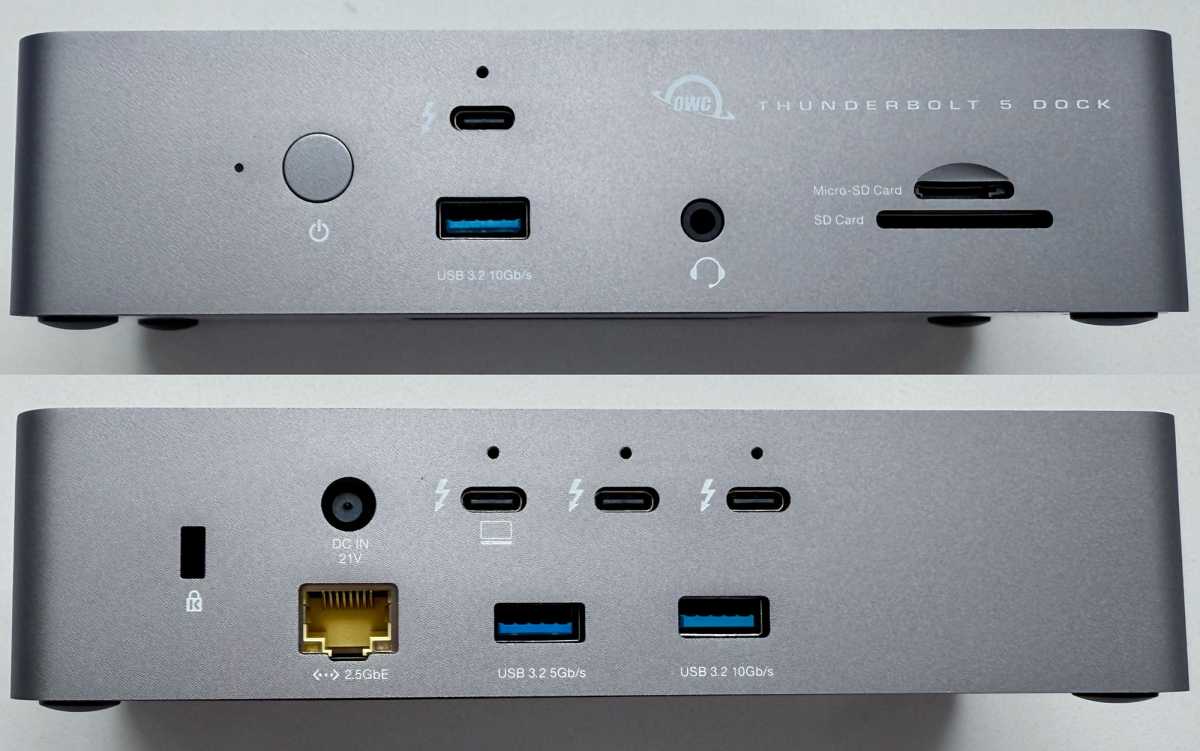
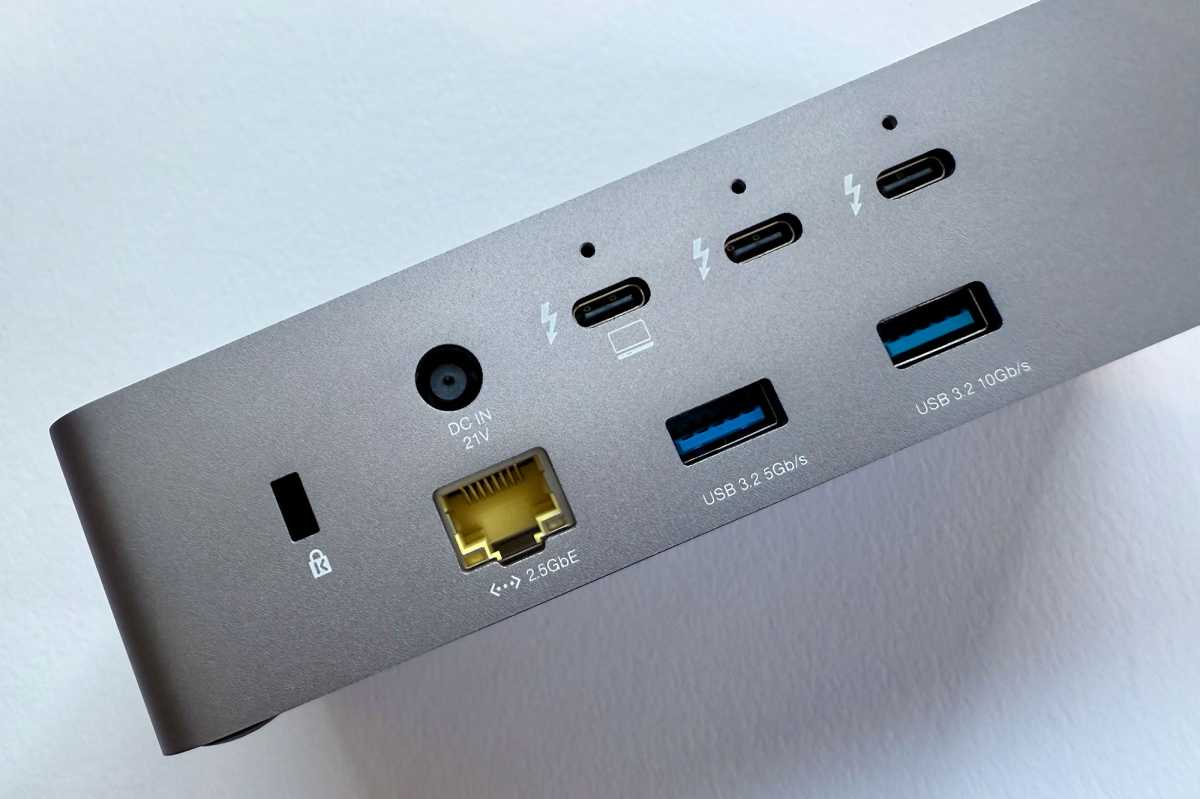
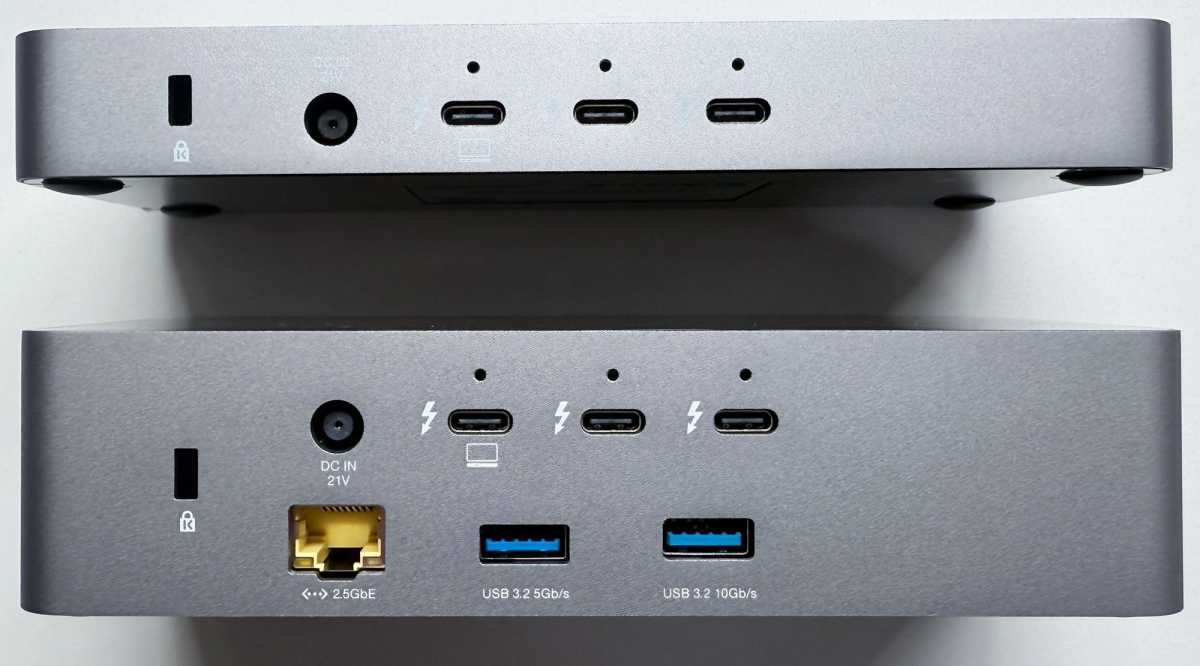
The ports are well located with the Thunderbolt 5 port upstream which connects to your laptop at the back, rather than the forehead as was the case with the TB4 model. We prefer that the laptop Thunderbolt cable is hidden at the back, so it is a welcome change compared to the OWC.
At the rear are two of the Thunderbolt 5 ports downstream. Some quay manufacturers, such as Caldigit, compromise with a tb port less to make room for a dedicated video port. They argue that Dock users will attach at least one external screen, so it would be necessary to use one of the TB ports and will also require a video adapter cable.
However, placing a HDMI or a DisplayPort means that you must either use this type of video connection, or buy an adapter if your monitor uses the other video connector. And if your monitor connects via USB-C, you will need to use one of the Thunderbolt ports and leave the video port empty.
The choice of OWC to give you flexibility to decide how you want to join an instructor could mean that you need to buy a USB-C adapter for DisplayPort or HDMI, but you will not give a precious port if you connect via USB-C / THUNDERBOLT.
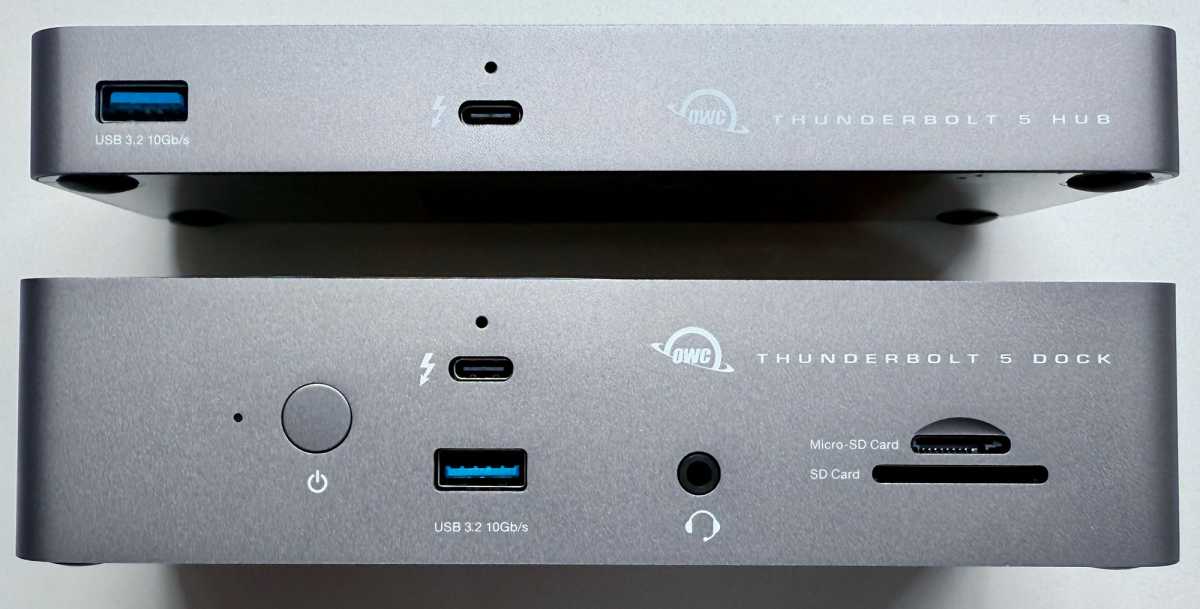
At the front are the two fast card players, a USB-A port of 10 Gbit / s, the audio plug and a power button. A recent improvement added a lip to the slit microsd to facilitate the release of the quay card. It’s not pretty but it works well.
Video options
While we are talking about video, the OWC Thunderbolt 5 Dock is an excellent solution if you want to connect to two monitors.
Windows users can add up to three (up to three 8K to 60 Hz screens, or two 8K screens to 120 Hz), but Apple limits the Thunderbolt quays to two. This is the same for all quays with Mac – to connect more than two external screens between dock and Mac, you will need a reception station that supports DisplayLink software or uses the Thunderbolt or HDMI port of the MacBook.
The refreshment rate is, to a certain extent, determined by if the connected display supports compression of the display flow (DSC). Non -DSC screens offer lower refresh rates. Currently, MacBooks equipped with high -end M4 M4 M4 M4 support to Dual 8K at 60 Hz with DSC, while all other Apple Silicon models support up to Dual 6K at 60 Hz with DSC. See our list of best screens for Mac.
In terms of refresh rate, all Apple silicon macs can lead a single 4K screen to 144 Hz. New models, such as all M4 and M3 PRO chips and MAX, can also support 4K to 240 Hz. For high -elected refreshing rate displays, only M4 Pro and M4 Max models can manage the double 4K.
Looking beyond the current mac limitations, the quay itself can support up to three 8K screens at 60 Hz with DSC for Windows users.
Simon Jary
Specifications and features
- A port of Thunderbolt 5 upstream (80 Gbit / s, 140w)
- Three ports of Thunderbolt downstream (80 Gbit / s, 15W)
- Two USB-A ports (10 Gbit / s, 7.5 W)
- A USB-A port (5 Gbit / s, 7.5 W)
- Ethernet (2.5 GB)
- UHS-II SD card reader (312 Mbps)
- UHS-II microSD card reader (312 Mbps)
- 3.5 mm combo audio socket (in front)
- 180W power supply
11 ports is almost average for a reception station. There are quays with more – the Caldigit TS5 more has an amazing 20, including ten USB, but the OWC list should be good for most users.
There are three USB-A inherited ports, two to 10 Gbit / s and one to 5 Gbit / s. Although Thunderbolt can be used as USB-C, we would have liked to see at least one additional USB-C port at 20 W or more to allow a quick load of the iPhone. TB ports support 15W Power, but the minimum recommended Apple for the fast load is 18 W. Some other quays offer a frontal USB-C port with an output potential of 20 W or more for this purpose.
The Thunderbolt 5 port upstream can provide 140 W of power to the laptop, which is enough to quickly load the 16 -inch high -end MacBook Pro.
With the other three TB ports valued at 15 W and three USB-A at 7.5 W, the 180 W power will not be able to deal with all the ports producing their maximum. The same goes for many other quays, including the Sonnet Echo 13 Thunderbolt 5 Dock, and being just 180W is higher than you get some quays and should be sufficient for most users.
USB-A ports can go out up to 7.5 W if you install the DOCK OWC ejector software; Otherwise, they are limited to 4.5 W. The platform ejector allows users to unresolve storage connected to the reception station. The macOS version contains an optional driver to activate the former Apple Superdrive Apple Superdrive DVD writer but still used.
If you need more energy from your platform, you will have to pay a bonus for the Caldigit TS5 Plus which Maxais at 330W, which is the highest that we have seen.
The two card readers are both evaluated at SD 4.0 UHS-II, so they can manage the transfer speeds of 312 Mbps, faster than the 250 MBPS SDXC card niche integrated into the Apple MacBook Pro. The use of these tiny storage cards is a cheap way to stimulate the storage of your MacBook. At the time of writing a 1 TB microSD card, a price for less than $ 100, although it is 104 Mbps UHS-I. The faster cards will cost you more.
Simon Jary
Network speeds
The majority of domestic networks are always assessed in the standard Ethernet State of 1 GB (Gigabit), but more modern offices are much faster at 2.5 GB, 5 GB or even 10 GB of speeds.
The last professional quays, including an Ethernet Gigabit port of 2.5 gigabit (2.5gbe), as standard, and the Quai OWC Thunderbolt 5 is one of them. If your network is not yet up to this speed, do not worry, because the faster ethernet is compatible behind and to the future test when your network is upgraded.
Price
The OWC Thunderbolt 5 Dock is at the price of $ 329.99 and sometimes a discount on Amazon, which is cheaper than the Caldigit TS5 ($ 369) and TS5 Plus ($ 499) but with fewer ports and the Sonnet Echo 13 Thunderbolt 5 Dock (from $ 439) but without the integrated SSD storage.
Its main competition is the Luvable 5 dock Thunderbolt 5 (TBT-ARAD3) which is at a price of $ 299.99. This has an almost identical range of ports and power, although the OWC quay has slightly more powerful USB-A ports.
A cheaper option Thunderbolt 5 is to consider a hub rather than a complete dock. OWC offers its own, unsurprisingly, called the Howc Thunderbolt 5, and at the price of $ 189.99. This gives you the same number of Thunderbolt 5 but just a USB-A port of 10 Gbit / s. This is a solid option if you don’t need Fast Ethernet readers or cards offered by the full quay.
Simon Jary
Simon Jary
Consult our complete recommendations from the best Thunderbolt quays for MacBook.
Should you buy the Thunderbolt 5 OWC quay?
It is a quay that does not light up in too many ports or does not push the boat to even faster Ethernet and maximum power. While Studio Pros can choose to spend much more for a quay that does, the OWC quay could be the Sweet Spot for commercial or home users who want to take advantage of the new superb ports of Mac.


