Building blocks of life may be far more common in space than we thought, study claims


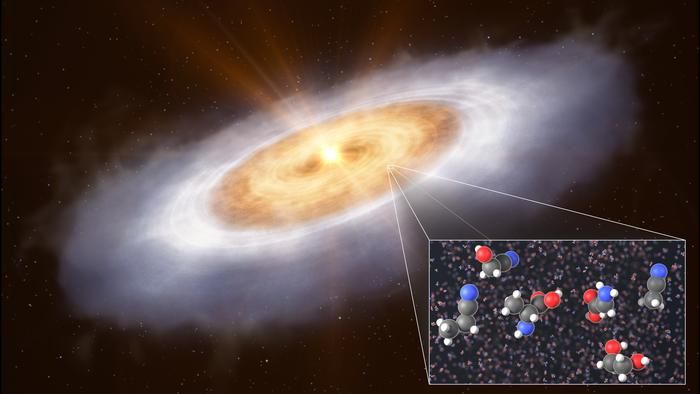
Astronomers have discovered key components of the building blocks of swirling life around a distant baby star, suggesting that the fabric of life is much more widespread throughout the universe than you thought.
The material, discovered by surrounding the Protostar V883 Orionis 1,300 light years of the earth in the Orion constellation, consists of 17 complex organic molecules which include glycol ethylene and glycolonitrile – precursors with components found in DNA and RNA.
La Découverte, published on July 23 in the Astrophysical newspaper lettersCould encourage scientists to rethink how common chemical progenitors are. Although similar compounds have been discovered elsewhere in spaceAstronomers previously supposed that a large part of these were destroyed by the violent births of the stars, leaving the seeds of life dispersed around the rare planetary systems capable of reproducing them.
“Now it seems that the opposite is true”, co-author of the study Kamber SchwarzAn astrochemist at the Max Planck Institute for Astronomy in Heidelberg, Germany, said in a press release. “Our results suggest that the protoplanetary discs inherit the complex molecules of the previous stages, and the formation of complex molecules can continue during the protoplanetary disc stage.”
Scientists have long retraced fundamental chemicals to the origins of space in space. Until now, this research has given prebiotic molecules in comets,, asteroids and floating in the gas and dust of Interstellar space.
The stars begin in clouds of gas and dust, which collapse slowly and warm up when they merge into protostars and protoplanetary discs from which comets, asteroids and planets end up forming. However, this process is violent, where the outputs of shocked gas and intense stellar radiation produce enough energy to disturb and even reset the constant chemical enrichment which leads to complex organic molecules.
In relation: “ Missing link ” for earth water found around Baby Star distant
Or that’s what scientists thought. Using the large network of millimeters / submillimetrics of Atacama (Alma), a collection of 66 radiotelescopes in northern Chile, scientists behind the new study have identified Telltale emission lines from a group of organic molecules inside the protoplanetary disc of V883 Orionis. The young star still spreads fire from nuclear fusion to her heart, leading to powerful explosions of radiation.
“These explosions are strong enough to heat the surrounding disc with regard to frozen environments, releasing the chemicals we have detected,” study the first author Abubakar FadulA student graduated from the Max Planck Institute for Astronomy, said in the press release.
This means that instead of destroying these organic compounds, the growth of the star could rather release them from the frozen surfaces on which they generally form, pointing “a straight line of chemical enrichment and increased complexity between interstellar clouds and fully advanced planetary systems,” said Fadul.
Although the results are exciting, scientists have warned that they remain temporary. Researchers still have to recover higher resolution data to confirm their detections and conduct narrower studies on how these compounds are due as their host star develops.
“Maybe we also have to look at other regions of the electromagnetic spectrum to find even more advanced molecules,” said Fadul. “Who knows what we could discover else?”


