Thai and Cambodian leaders to meet in Malaysia for talks to end deadly border dispute : NPR

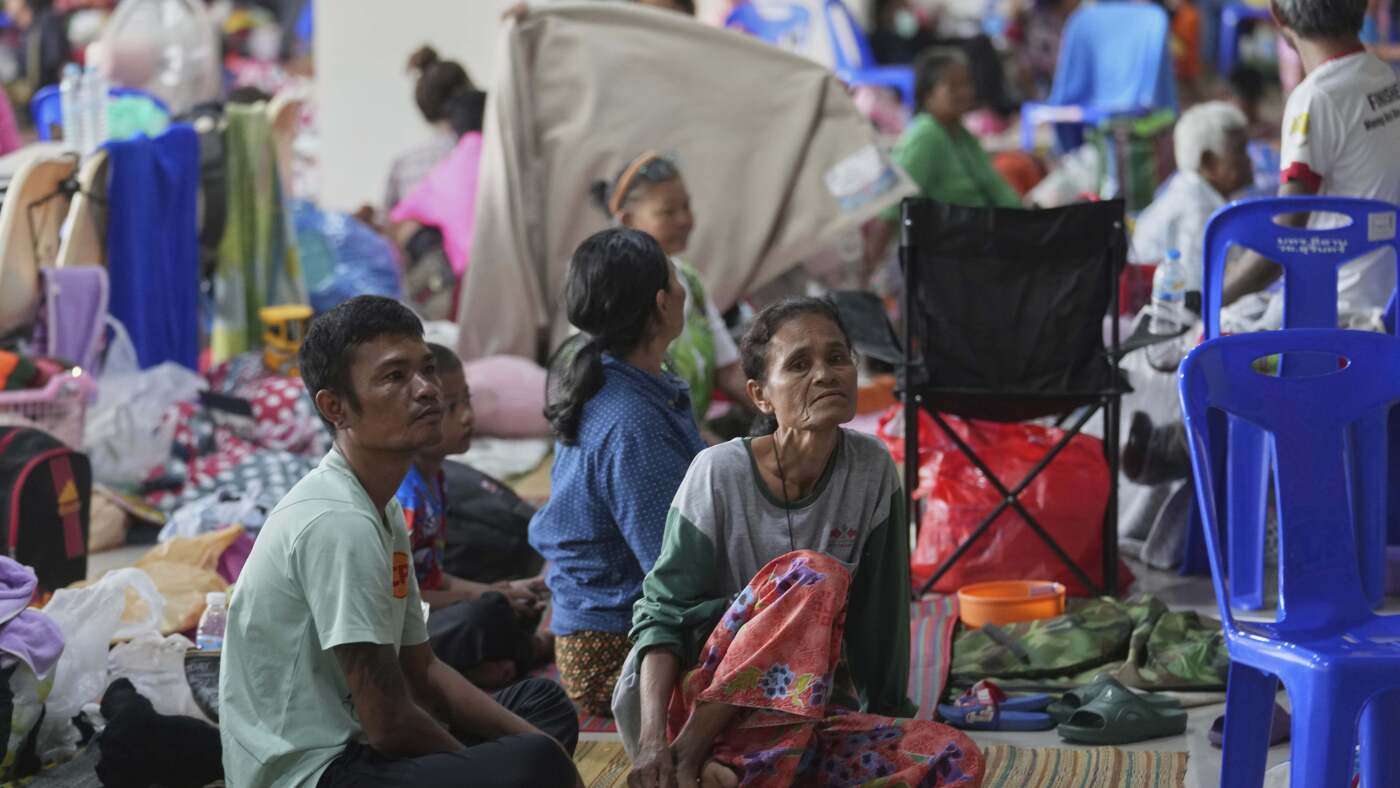

Thai residents who fled the houses following clashes between Thai and Cambodian soldiers rest in an evacuation center in the province of Surin, Thailand, Sunday, July 27, 2025.
SAKCHAI LALIT / AP
hide
tilting legend
SAKCHAI LALIT / AP
Bangkok – Thai and Cambodian leaders will meet in Malaysia for conferences to end hostilities, a spokesman for the office of the Thai Prime Minister said on Sunday. This comes following the pressure of American president Donald Trump to end a deadly border dispute, now on his fourth day, which killed at least 34 people and moved more than 168,000.
Jirayu Huangsap said that acting Prime Minister Phumtham Wechayachai will attend the talks on Monday in response to an invitation from Malaysian Prime Minister Anwar Ibrahim “to discuss peace efforts in the region”.
The spokesman also said that the Cambodian counterpart of Phumtham, Hun Manet, would also attend talks, although this was not immediately confirmed by the Cambodian team. He added that Anwar acted in his capacity as president of the Association of Nations of Southeast Asia, or Anase, held on an annual rotary basis by its 10 members.
Trump posted on Truth Social on Saturday that he had spoken to the leaders of Thailand and Cambodia and suggested that he would not reach the trade agreements with one or the other country if hostilities were continuing. He later said that the two parties agreed to meet to negotiate a ceasefire.
Both parties agree to discuss a ceasefire
Cambodian Prime Minister Hun Manet said earlier on Sunday that his country had agreed to continue an “immediate and unconditional” ceasefire “. He said Trump told him that Thailand also agreed to stop the attacks after the American president’s conversation with Phumtham.
He said that he had in charge of his deputy, the Minister of Foreign Affairs, Prak Sokhonn, to coordinate the next steps with the American Secretary of State Marco Rubio and to engage directly with the Minister of Foreign Affairs of Thailand to implement the ceasefire.
Thailand has expressed cautious support. Phumtham thanked Trump and said that Thailand was in principle in principle to a cease-fire, but underlined the need for a “sincere intention” of Cambodia, said the Thai Foreign Ministry. Phumtham called for quick bilateral talks to discuss concrete steps towards a peaceful resolution, he said.

A house is damaged after Cambodia has drawn artillery shells in the province of Surin, Thailand, Sunday July 27, 2025.
SAKCHAI LALIT / AP
hide
tilting legend
SAKCHAI LALIT / AP
Both sides blame the other for clashes
The fighting broke out Thursday after an explosion of terrestrial mines along the wounded border five Thai soldiers. Both sides were blamed for the start of clashes. The two countries recalled that their ambassadors and Thailand have closed its border passages with Cambodia.
Despite diplomatic efforts, the fighting continued on Sunday along certain parts of the disputed border, the two parties refusing to move and exchange blame over renewed bombardments and troop movements.
Colonel Richa Suksowanont, deputy spokesperson for the Thai army, said that Cambodian forces had drawn strong artillery in the province of Surin, including in Civil Homes, early on Sunday. He said Cambodia also launched rocket attacks targeting the old temple of Ta Muen Thom, affirmed by the two countries, and in other regions in order to recover the territory guaranteed by Thai troops. Thai forces responded with long -range artillery to strike Cambodian artillery and rocket launchers.
Richa said Trump’s efforts to Medier were a “separate affair”. The operations of the battlefield will continue and a cease-fire can only occur if Cambodia officially triggers negotiations, he added.
“Any cessation of hostilities cannot be reached while Cambodia is lacking seriously in good faith and repeatedly raped the fundamental principles of human rights and humanitarian law,” the Ministry of Foreign Affairs of Thailand said separately.
Cambodian defense ministry spokesman, lieutenant-general Maly Scheata, accused Thai forces of degenerating violence with the bombing of Cambodian territory on Sunday, followed by a “large-scale foray” involving tanks and land troops in several areas.
“Such actions undermine all efforts towards a peaceful resolution and expose the clear intention of Thailand to degenerate rather than deflect the conflict,” she said.
Thailand reported on Sunday the death of a soldier, bringing the total number of deaths to 21, mainly civilians. Cambodia said 13 people had been killed. More than 131,000 people in Thailand have evacuated to safe places and more than 37,000 people fled three Cambodian provinces. Many border villages are mainly deserted, with many schools and closed hospitals.
Evacue hope for a quick end to the fighting
Pichayut Surasit, air conditioning technician in Thailand, said the sudden combat epidemic meant leaving her work in Bangkok to go home to protect her family.
“I didn’t have the heart to continue with my work when I heard the news. I wanted to come back as soon as possible, but I had to wait until evening,” he said. Now in a refuge in Surin housing some 6,000 evacuated, Pichayut is worried about his wife and twin daughters, hoping that the conflict will end soon so that they can return home in the district of Kap Chong, one of the hardest struck by the bombardments.
Bualee Chanduang, a local saleswoman who moved to the same shelter on Thursday with her family and her pet rabbit, is counting on quick negotiations to end violence. “I pray for God to help so that the two parties can accept to speak and put an end to this war,” she said.
The United Nations Security Council called the Anase, a regional block, to mediate peace between the two members. Human Rights Watch condemned the reported use of cluster ammunition, weapons prohibited by international law, in populated areas and urged the two governments to protect civilians.
The 800 -kilometer (500 mile) border between Thailand and Cambodia has been challenged for decades, but past confrontations have been limited and brief. The last tensions broke out in May when a Cambodian soldier was killed in a confrontation that created a diplomatic rift and disrupted the internal policy of Thailand.


