The legacy of Hulk Hogan’s sex tape scandal : NPR

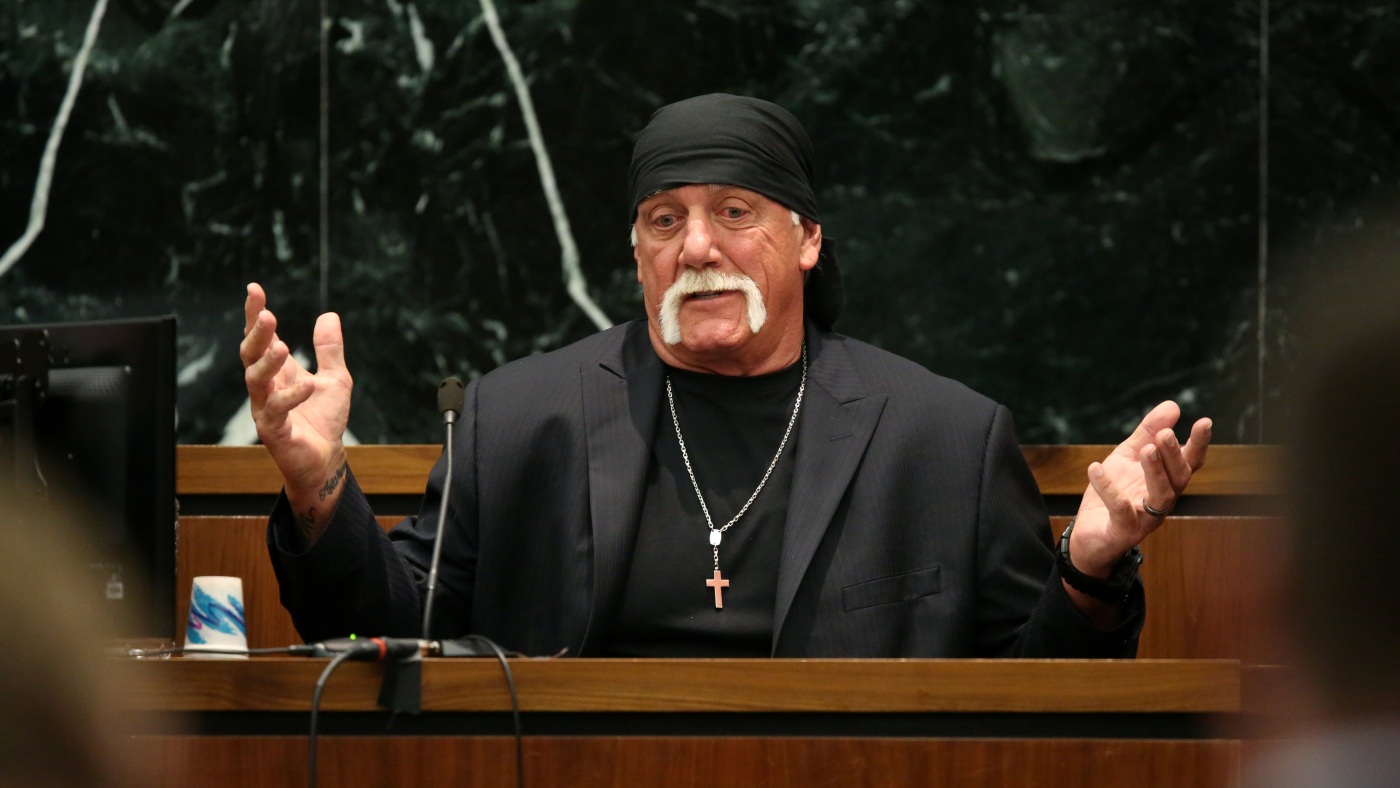

Terry Bollea, alias Hulk Hogan, during a testimony of jurisdiction during his trial against Gawker Media at the Palaté de Pinellas justice on March 8, 2016 in Saint Petersburg, Florida.
Pool / Getty Images / Getty Images North America
hide
tilting legend
Pool / Getty Images / Getty Images North America
For decades Hulk Hogan, the wrestling character larger than life whose name is Terry Bollea, dominated American popular culture. He helped push Pro-Wrestling on the world scene, played in television shows, films and cartoons. But it was much later in his life that he also dominated legal discussions on the first amendment and the right of celebrities to privacy.
His slam body of a victory over Gawker Media in 2016 will remain in the memory as part of the legacy of the wrestler, according to his death at the age of 71 THURSDAY. Although the case did not establish new legal precedents, it was a shock for the media system. He showed the limits of the protections of the first amendment with regard to explicit video and demonstrated ordinary people that they had the right of privacy in the digital age. He also clarified the idea that even if something is worthy of interest, showing graphic representations of this one constitutes an invasion of privacy.
Supported by the billionaire Peter Thiel, who had been released gay by the point of sale, Hogan continued Gawker, a site of short stories and gossip, after having published a surreptitiously animated sexual meeting between Hogan and the wife of a former friend. The black and white video was published under the title: “Even for a minute, watching Hulk Hogan having sex in a canopy bed is not sure for work but looking at it anyway” and was accompanied by a long article describing the appointment.
Throughout the civil trial, Hogan argued that he was not aware that he was recorded and that the publication of the sexual meeting was an invasion of privacy. Meanwhile, Gawker lawyers said he had obtained the band through an anonymous source and argued that he had the right to publish news that is true. In the end, an Florida jury granted Hogan $ 140 million in civil lawsuits, which finally led to the Disappearance of the Gawker media.
The case has raised major questions on the border between freedom of expression and privacy, and what is really worthy of interest. Questions that were to be re -examined in the light of the invention of the Internet, told NPR Amy Gajda, told NPR.
“Some of my research has shown that before, privacy was really not really a problem, because before the internet, the only publishers were mainly news, media and ethical restrictions prevented these people from publishing deeply personal information,” said Gajda, a law expert in the first amendment.
These points of sale have done a lot of self-censorship with regard to deeply personal information, including nudity or graphic sexual information, and medical records, which are protected by existing confidentiality laws, she said. But in the internet era, it was not clear if these same railings were to remain in place.
Rodney Smolla, president of Vermont Law and Graduate School said that Hogan v. Gawker has proven to be “being a rotating case in culture or the media law”, even if it did not establish new legal precedents.
“If they had published photos that were still or even pixelisted by the most graphic parties of the video, Gawker could have gotten away with it. They would have won their case under the existing laws of press freedom,” said Smolla, a scholar of the first amendment, at NPR.
“Normally, generally, press freedom prevails over the laws on privacy, but by showing real sexual intercourse, in the eyes of many people, [Gawker] I just went too far. “”
“In the past, things have been left to our imagination,” said Gajda. The media that seeks to push the limits can choose to perform rated photographs using black bars on naked body parts when they wanted to publish titillage information. But, underlined Gajda, they knew that if they were going too far, there would be a trial or a backlash of the readers.
Although Hogan’s verdict was a coup for celebrities, Gajda said her heritage was more relevant to ordinary people because he taught them their own rights with regard to the violation of privacy, even when something is true. This is particularly relevant for people taken in the event of revenge porn, said Gajda. Many people wrongly believed, she said, that if they shared naked images of themselves to someone else, the other person had the power to publish such images.
Smolla said that the trial repercussions were mainly felt by “the responsible media, which now feel even more pressure to respect journalistic standards and not be exposed to bankruptcy”.
“It was a blow against the arc,” noted the first scholar amendment, adding that the case “also established the idea that it is simply not true that everything happens, and it is simply not true that you can show anything on anyone who is a celebrity and that you think that you have a responsibility to invade his private life.”


