Meskalamdug’s Helmet: One of the world’s oldest helmets depicts a Mesopotamian prince’s man bun


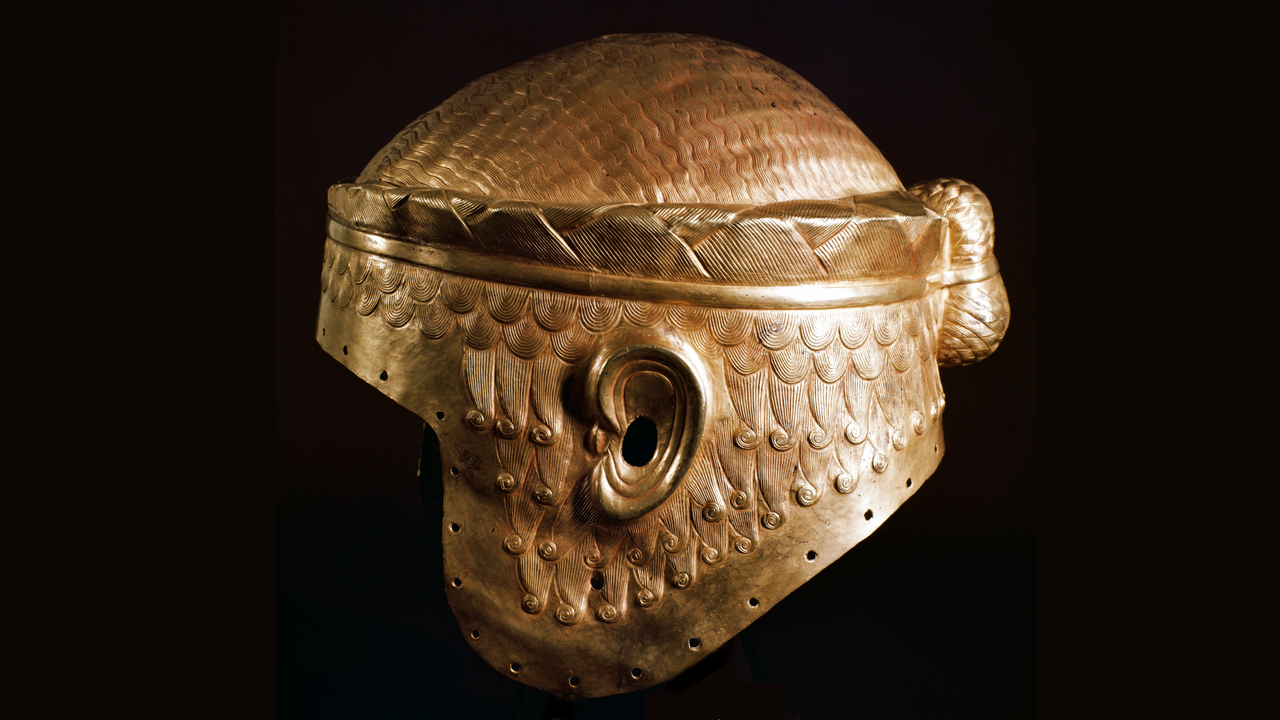
Rapid facts
Name: Meskalamdug helmet
What is: A gold helmet of 15 carats in the shape of a wig
Where he comes from: The royal cemetery at UR, in what is now southern Iraq
When it was done: Around 2600 BC
This golden helmet, meticulously decorated to look like the wavy hairstyle and the ears of its wearer, was found in 1927 by the British archaeologist Sir Leonard Woolley during the excavations in Ur, an old town in Mesopotamia This is now part of Iraq.
The artifact has been recovered in a tomb of the royal cemetery with alabaster vases, gold daggers and golden bowls – one of which listed the name of Meskalamdug, which means “hero of good earth”. But since the grave was not as tall or as richly furnished as the other royal tombs, Woolley suggested The deceased was Probably a prince rather than a king of ur.
Two copies of the helmet were manufactured in the few years after the discovery, one going to the British museum and one to the Penn Museum. The original helmet, which was hidden before the first Gulf War and protected against looting until He was recovered At the end of 2003, was at Iraqi museum in Baghdad.
In relation: Vainly bowl: a 4000 -year -old old -fashioned pool containing 4 miniature cows and 18 people – which was buried for mysterious reasons in a bronze age tomb in Cyprus
According to the Penn MuseumThe helmet measures 8.9 inches (22.7 centimeters) high and 8.3 inches (21 cm) wide. And according to James OgdenGoldsmith from the beginning of the 20th century which created the two exact replicas in 1928, the original helmet was made from a 15 -carat gold leaf.
Ogden describe The helmet in his personal notes as “life-size” and “perhaps a ceremonial hairstyle”. The small holes around the edge were probably used to fix a quilted fabric lining, and Ogden noted that he had found traces inside.
Gold beaten by hand was modeled and engraved to represent the hair that was attached with a ribbon and pulled in a bun on the back. The ears had holes so that the wearer could hear through the helmet, and additional holes under the ears were probably for the attachment of a layer of chin.
More amazing artifacts
The Meskalamdug helmet is very different from the ordinary copper helmets carried by private soldiers, Woolley wrote in a 1928 report On the tomb of Meskalamdug. But it is similar to hairstyles and helmets worn by Mesopotamian leaders Eannatum and Sargon Le Grand, also known as Akkad Sargon, in the 25th and 24th centuries before JC.
Although there is evidence of the royal cemetery that a man named Meskalamdug was a Sumerian king, this particular meskalamdug was not identified as a king by the artifacts of his grave. The helmet may therefore have belonged to the son or his eponymous grandson of King Meskalamdug, part of the first dynasty of Ur, whose second wife was Queen Puabi.


