Why the Tsunami from Russia’s Earthquake Wasn’t as Large as Feared


Why did the Russian earthquake not cause huge tsunami
The magnitude of Russia 8.8 earthquake has caused serious warnings of tsunami, but the waves have been moderate so far. Here is the geological reason why
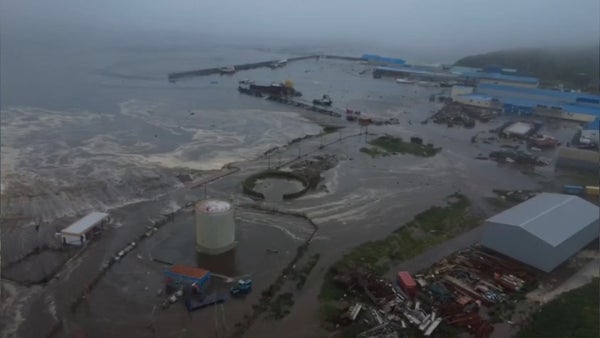
An Aerial View of the City of Severo-Kurilsk Flooded due to a tsunami triggered by the 8.8 Magnitude Earthquake that struck off russia’s kamchatka peninsula on July 30, 2025. The epicenter was located at a depth of 20.7 kilometers (12.8 miles) Centered 119 kilometers (73.9 miles) East-Southeast of Petropavlovsk-Kamchatsky. The earthquake was shallow and powerful enough to trigger waves or a tsunami.
Geophysical Survey / Anadolu Kamchatka via Getty Images
As seismologists learned that an 8.8 magnitude earthquake had struck near the Kamchatka peninsula in Russia, they felt an acute feeling of anxiety. This location – where the Pacific plate plunges under an arm of the North American plate and near the Eurasian plate – can produce generalized and very destructive tsunamis. He did exactly this in 1952, when an earthquake of magnitude 9.0 effortlessly won a neighboring Russian city while causing significant damage to distant Hawaii.
When the seabed next to Kamchatka fought violently at 11:24 am local on Wednesday (7 p.m. HAE Tuesday), everything seemed ready for a dangerous tsunami. The first forecasts of scientists (properly) predicted that several countries of the Pacific Ocean would be flooded to a certain extent. Millions of people have been evacuated from coastal Japan and many people in Hawaii have been ordered to seek higher land. People were also advised from all the sides of Central America and South to flee the Recoil Ocean. And as a smaller initial tsunami formed on the northern island of Japan in Hokkaido, there was a certain preliminary concern that the waves could reach a height of almost 10 feet.
But for the most part (at the time of writing), many countries of the shooting line have not been struck by an extremely deadly wall of water. It seems that waves of just over four feet hit Japan and Hawaii – two places that have now considerably demoted their Tsunami alerts and canceled certain evacuation notices. A tourist in Hawaii told BBC News that “the disaster we expected had not come”. Parts of California have seen water up to eight feet but without considerable damage.
On the support of scientific journalism
If you appreciate this article, plan to support our award -winning journalism by subscription. By buying a subscription, you help to ensure the future of striking stories about discoveries and ideas that shape our world today.
Learn more: Tsunami warnings issued after magnitude 8.8 shots of earthquake offshore off the Russian coast
This raises a key question: since the oceanic megaquare of Kamchatka had an 8.8 scale – one of the most powerful ever recorded – why did the resulting tsunami result? The answer, in short, is as follows: the specific fault that has broken almost exactly the tsunami that he was able to do, even if we have the impression that the effect should have been worse.
“First, it is important to recognize that the program of any warning is a success,” explains Diego Melgar, a scientist from the earthquake and tsunami at the University of Oregon. A tsunami does not have to measure 30 feet high to cause intense destruction and death; Even a relatively modest can wash people and structures with ease. So far, it seems that there will not be a high number of victims – and it is partly because “the warnings have been extinguished, and they were effective,” said Melgar: people have come out of the danger.
It is also fair to say that, for Kamchatka and his environment, there in fact was Localized destruction. The earthquake itself seriously shook the eastern Russian city of Petropavlovsk-Kamchatsky and dispersed damage to buildings. And the waves of tsunami have reached heights up to 16 feet in Severo-Kurilsk, a city in the north of the Kuril islands just south of Kamchatka. The houses and sections of a port have been destroyed or swept away.
Learn more: The 8.8 earthquake of Russia is one of the strongest ever recorded
The way each nation issues a tsunami warning differs slightly. But in general, if a tsunami is most likely incoming and is supposed to be potentially Dangerous, an evacuation prescription for people on the afflicted coast is issued. When such alerts go out, certain estimates of the height of tsunami waves are often given, but these figures are initially difficult to nail.
One of the reasons is that, when a tsunami manufacturing earthquake occurs, “the energy of tsunami is not distributed symmetrically”, explains Amilcar Carrera-Cevalos, an independent earthquake scientist. A tsunami does not move outwards in all directions with the same time because the faults do not break in a careful linear rupture. The movement of the seabed does not occur smoothly and in one direction either.
“The initial warnings are based solely on the estimated size and location of the source, but this does not alone determine the amount of water moved or where the waves will concentrate,” explains Melgar. “To predict the impacts with precision, scientists must know how much the defect has slipped, on which area and how the trench took place.” And this information is generally gleaned one or two hours after the appearance of the tsunami.
A tsunami as today is followed by a network of deep pressure sensors, which help scientists update their forecasts in real time. But “the network is sparse. It does not always attract the total complexity of the energy of the waves radiating across the basin, ”notes Melgar. This means that he only gives scientists that a partial understanding of the tsunami at the ocean scale.
Another problem is that the height of the waves of a tsunami when the wave reaches the shore is influenced by the shape and the height (technically called Bathymetry) from the seabed it passes. Tsunamis are also hampered, or helped, by the shape and nature of the coast in which they slam. “Features such as berries can amplify waves heights; Tsunami waves can also be diffracted (curved) around the islands, “explains Stephen Hicks, scientist of the earthquake at the University College in London.
It can also be tempting to compare the earthquake of magnitude 8.8 today with the earthquake of magnitude 9.1 of 2011 which struck eastern Japan, triggering a tsunami with a maximum wave height of 130 feet, the one that killed more than 18,000 people. The earthquake and the tsunami of magnitude 9.2 of 2004 in the Indian Ocean – which cost the lives of more than 220,000 people in a large area – perhaps in mind.
It is understandable, but the 8.8 magnitude earthquake of today was not quite powerful as one might think. The magnitude scale of earthquakes is not linear; In other words, a small increase in magnitude is equivalent to a huge unleashed energy jump. According to the US Geological Survey, an earthquake of magnitude 9.1 (such as the Japanese example of 2011) is almost three times stronger than that of today.
The 2004 and 2011 cataclysms “were in fact much more important than this event,” explains Judith Hubbard, scientist of the earthquake at Cornell University. They were simply more capable of pushing a giant volume of water through the ocean than today’s Temblor.
Not knowing the exact height of a tsunami entering several places around the Pacific, however, is a secondary concern. What matters most is that tsunami warnings were quickly and precisely endangered the times to which the tsunamis would arrive at each coast. “The current preventive evacuation strategy does a good job of safeguarding lives,” explains Hubbard.


