Australia’s pink lakes: The remnants of ancient rivers now teeming with microbes that make rosy pigments


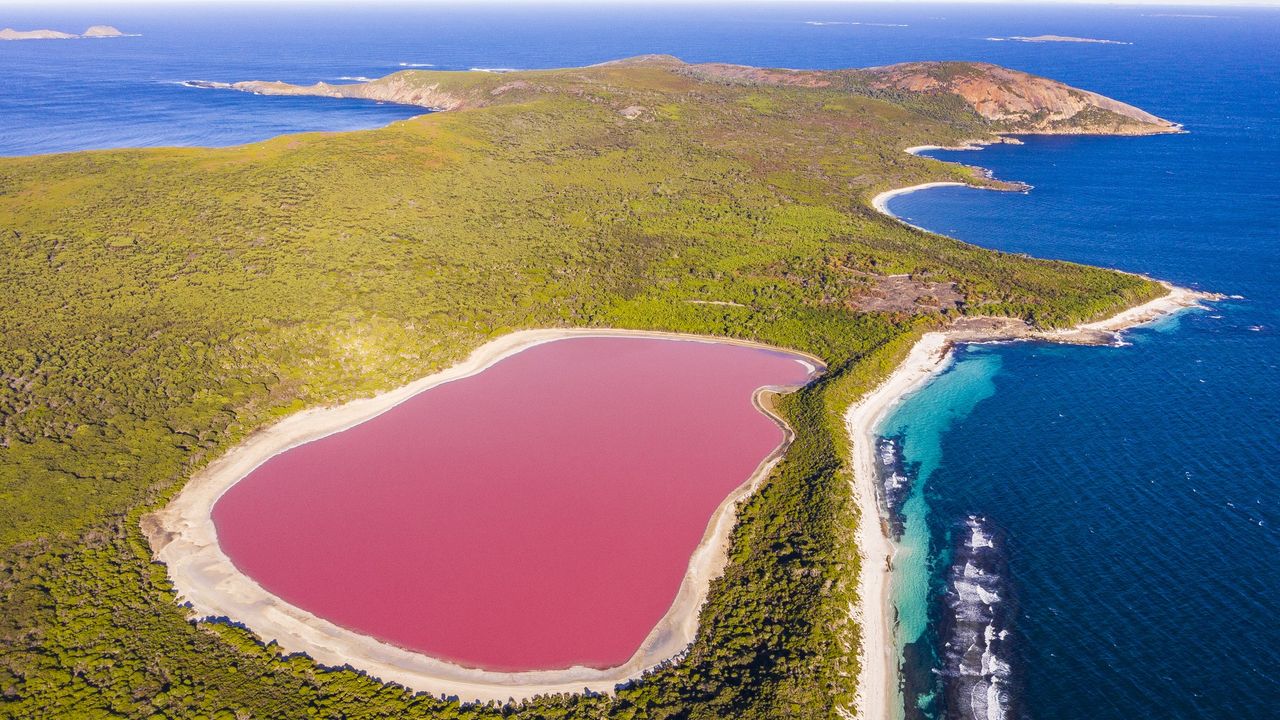
Rapid facts
Name: Lake Hillier, Lake Rose and others
Location: Australia-Western
Contact details: -34.09487137998776, 123.20277096721424
Why it’s incredible: Bacteria and microalgae run these bubble lakes-rose.
The pink lakes of Australia are bodies of water which shelter rare microbes and producers of pigments. The lakes are about 10 times more salty than the ocean, attracting algae and bacteria that produce beta-carotene-a red-orange pigment which also gives carrots, crayfish and flamingos their characteristic colors.
Most of the country’s pink lakes are in Australia-Western, which has about a dozen. The lakes are the remains of the rivers that crossed the landscape over 15 million years ago, which makes them thousands of years, according to National Geographic.
While the old rivers have dried up, pockets of water have been left and partially evaporated over time, concentrating salt and attracting microorganisms that like salt such as Dunaliella Salina And Salinibacter Ruber – which are unicellular algae and red bacteria, respectively. D. Salina And S. Ruber Produce the beta-carotene when exposed to the sun, turning the different shades of pink as a function of salt levels. The beta-carotene protects these microorganisms from ultraviolet rays and absorbs light energy, allowing them to prosper and reproduce, according to National Geographic.
But the pink lakes are fragile because the changes in salinity can upset their ordinary inhabitants. Strong precipitation, for example, can dilute the salt content of the lakes insofar as photosynthetic algae completely replace D. Salina And S. Ruber.
This recently occurred in Lake Hillier on Western Australian Middle Island, according to ABC News. Lake Hillier previously nourished a Large range of pigment producer microbesBut extreme precipitation due to climate change in 2022 disrupted this community. Consequently, the lake has gone from pink to blue -gray – but experts think that it could recover over the next 10 years if salinity returns to its previous levels.
In relation: Lake Natron: Lake Round-Rouge Caustique in Tanzania which transforms animals into “stone”
Lake Hillier is not the only pink lake to have lost its pink shade. Lake Rose, located near Hope in Western Australia, became blue-gray in the 2000s after a century of salt extraction. Salt was extracted to make table salt, salt lips for livestock and meat and skins, according to National Geographic. In the early 2000s, there was not enough salt in the pink lake for species like D. Salina And S. Ruber To survive. While photosynthetic algae took over, the color change was so dramatic that the inhabitants put pressure for the lake to be renamed.
Unlike Lake Hillier, experts do not think that Lake Rose will naturally recover as soon as – but scientists have suggested artificially pump the salt of neighboring salt lakes in Lake Rose to bring it back to preliminary levels.
The pink lakes fuel nomadic and migratory birds, and they welcome invertebrates such as briefs of brine and the snails of Lake Salt, which makes them precious ecosystems. Extreme environments such as pink lakes also help scientists understand the life potential on Mars.
“They always produce some of the most difficult organizations on the planet”, ” Angus LawrieA conservation biologist and research partner at Curtin University in Australia, told National Geographic.
Find out more incredible placesWhere we highlight fantastic history and science behind some of the most dramatic landscapes of the earth.

:max_bytes(150000):strip_icc()/Health-GettyImages-ThingsToAvoidWhenDrinkingCoffee-0d8f7c6e7438411f92afab43a66fa311.jpg?w=390&resize=390,220&ssl=1 "5 Common Coffee Habits Nutrition Experts Say To Avoid")