How bipolar diagnosis changed chef’s life



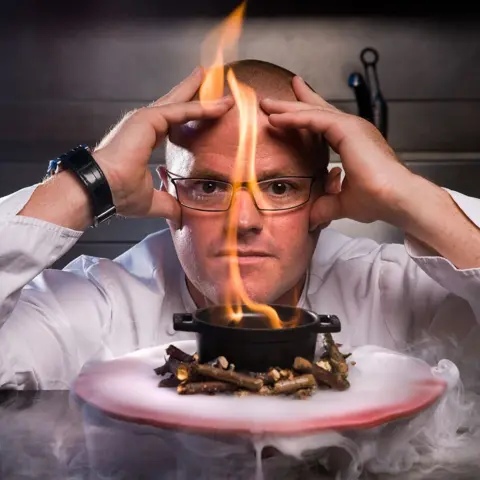 Dropout
“We just wanted a relaxing conversation with our father and we could not have it,” said Jack Blumenthal. “It was horrible. And it was constant.”
The raw pain is engraved on the face of Jack’s father while he finally realizes how his unmatched mental illness – and his erratic manic behavior – hurt the most.
In a new BBC documentary, the famous chef Heston Blumenthal speaks to his son for the first time in the way he became impossible to live.
“We plan three weeks in advance, preparing just to see you for half an hour,” said Jack, who is now running a restaurant itself. “And I couldn’t do anything to help you.”
Heston wipes a tear. “I’m sorry,” he said.
‘Wired differently’
At the height of its fame in the 2000s, Heston Blumenthal was a culinary icon. Known for ice cream with bacon and egg, snail porridge and theatrical meals, it was a big brand worth large dollars. But behind molecular gastronomy and Michelin stars, his mind was more and more in disorders.
For years, he thought he was simply “wired differently”.
Heston has long believed that his upper emotional ups and downs were part of who he was – part of the creative chaos who fueled his culinary genius. In the early years, his imagination ran a riot in a positive way, he said.
But gradually, depression has worsened. The ups have become higher and the stockings much darker.
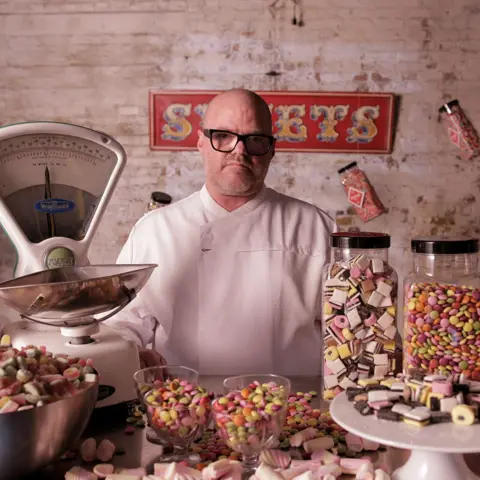
He remembers having “lengthened on the ground to face” when filming a kitchen program several years ago. At one point, he had the impression that his new ideas were like thousands of candies falling from the sky – and he could only catch a few.
But at the end of 2023, a maniac episode turned into psychosis. Heston hallucinated weapons and had become obsessed with death.
He was admitted to the hospital for the first time – and finally diagnosed a bipolar disorder. “How did I arrive at 57 before being diagnosed?” he asks.
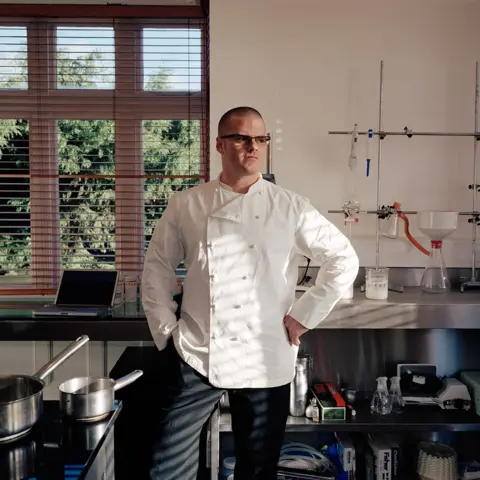 Peter Dench / Getty images
I recently sat with the world’s renowned psychiatrist, Professor John Geddes, to watch the documentary on which I collaborated – “Heston: My Life with Bipolar”.
In the program, there is a Heston clip interviewed by the BBC in 2020 on the use of robots in the kitchen. He uses surrealist and absurd metaphors: “I want to put the shadow back to the sun, I want to put the inside outside outside … I want to put the being back in humans.”
Looking at the interview, Professor Geddes says it is clear that Heston was “in the middle of Mania” at the time. “If I had seen this, I would have immediately thought:” he is a sick man “,” he said.
The environment of the head of celebrities in Haute Octane has enabled his erratic behavior to prosper. His eccentricity was not only accepted, but celebrated. His brand prospered, nourishing capricious genius, and he was supported by a team that made him work. But at home, there was not such an infrastructure – not such a buffer.
Bipolar UK’s research suggests that for each person with bipolar disorder, five other family members – such as Heston Jack’s son – is deeply affected.
“Families collapse because of mania more than depression,” said Professor Geddes.
Lithium line
During six months of shooting, Heston psychiatrists got up with the cocktail of pills that were prescribed after his visit to the hospital, and he was transferred to stabilizing mood medicine, lithium.
It is not an easy process. The change of drugs can often trigger extreme reactions, so doing it on the camera is courageous.
Initially, Heston is moderate. He says antipsychotics and antidepressants make him feel “zombified” and that his memories are darkened.
But over time, his mood rises, his energy comes back and he finds part of his old boastful. Lithium works for him – and you are starting to recognize the heston of past years.
Towards the end of the shooting of the documentary, Heston wishes to ask me questions about my own research on bipolar care in the United Kingdom.
The man to whom I speak is definitely still Heston – obsessed with the ratio of perfect pepper grains – but now he is calm, concentrated and self -aware.
Professor Geddes is not surprised.
“Lithium is the stallion for care, but in the United Kingdom, we don’t use it enough,” he said. “This requires careful management of general practitioners and psychiatrists. In the NHS, the system simply cannot follow – this is probably one of the reasons why the use of lithium falls in the United Kingdom, when it should increase.”
The United Kingdom has a striking shortage of psychiatrists and mental health professionals, so patients are facing expectations that have often extended over the years. On average, someone is needed for more than nine years to be diagnosed with a bipolar disorder from the first contact with a general practitioner.
During my numerous interviews on the disorder, I heard psychiatrists describe bipolar patients as “ghosts in the system”, “those who have fallen through the meshes of the net” and simply as “forgotten” or “disappointed”.
The use of lithium and appropriate access to psychiatrists are both directly linked to a reduction in suicidal thoughts in people with bipolar disorder. In the United Kingdom, suicide death increases for people living with the disease. This massages all other trends downwards suicide.
Learn to live with fire
The diagnosis of Heston only came after having become a danger to himself – hallucinations, paranoia and ultimately his wife’s call for emergency services.
Despite the weeks spent in a mental health clinic, and a year of medication and reconstruction of his mind, given the choice, Heston says that he would not extinguish his bipolar disorder if he could. That’s part of him. This answer captures the essence of his trip – to learn to live with fire, not to turn it off.
“Someone living with bipolar cannot be separated from this – his personality is fully and intrinsically connected to the condition,” said Professor Geddes. “The treatment does not erase it, but it makes the mood changes manageable and helps a person to operate in their ecosystem – with their family, friends and work.”
Heston’s journey reflects that of many: the mood swings badly understood, the delayed diagnosis and the long path to balance. But it is also a story of identity, resilience and the power of clarity after chaos.
The culinary world has once masked his illness. Now it gives him a platform to express himself – and he uses it.
Heston: My life with bipolar will be broadcast on Thursday June 19 at 8 p.m. on BBC Two and will also be available on BBC IPLAYER
If you have been affected by problems with this report, help and support are available to BBC Action Line.


