Major clean power plant serving L.A. goes fully online in Kern County

Mojave, California – One of the largest solar and battery power plants in the United States is currently providing Los Angeles and Glendale in Kern.
Local leaders and clean energy experts gathered on Tuesday under a flamboyant desert sun to mark the initiation of the complete production of 1.36 million solar panels and 172 batteries of lithium iron phosphate which make up the electricity project Eland Solar-Plus-Storage. It is also important that 13 Dodger stadiums, parking lots included and will generate 7% of electricity for the whole city of Los Angeles, largely at a record price.

The largest solar storage and storage factory of the battery of the Ministry of Water and the Power of Los Angeles, the Eland solar and storage center in the Mojave desert of Kern on Monday, November 25, 2024 near California City, California.
(Brian van der Brug / Los Angeles Times)
“This is the biggest project for LADWP with regard to solar energy and battery, and it is a huge success for us, because it takes away the fear of making more – and we need about 10 others to achieve our objectives,” said Janisse Quiñones, Director General of the Ministry of Water of Los Angeles and Energy. The city has committed to 100% clean energy by 2035.
With the power of Eland which now flows into its network, the is almost two thirds of the track: the project pushed the total food of the city to 64% clean energy, said Quiñones. Other sources of energy in the Los Angeles portfolio include hydrogen, natural gas, biomass, geothermal energy, nuclear and coal, which the city aims to disconcert by the end of this year.
The ELAND $ 2 billion project has been developed by Arevon Energy, based in Arizona, and will also provide solar electricity to Glendale Water and Power.
Although Eland’s tentacular solar panels are catchy, it is the unpretentious batteries – which resemble rows of large white shipping containers – which are the real node of the project.

Battery energy storage units at the largest solar storage and battery storage plant in Los Angeles Department of Water and Power, Eland solar and storage center in the Mojave desert of Kern on Monday, November 25, 2024 near California City, California.
(Brian van der Brug / Los Angeles Times)
The location of batteries with solar energy or the wind allows them to recharge clean energy, then return it to people’s houses after sunset or the wind stops blowing. At the end of 2023, there were nearly 469 “hybrid” clean plants in the United States, according to a recent Lawrence Berkeley National Laboratory report.
In California, almost all new solar projects waiting to be connected to the electricity network included batteries.
All scenarios to effectively approach the call for climate change for the use of storage.
The Eland project is also online because the Trump administration slows the transition to clean energy with dozens of measures that promote electricity made from coal and natural gas. The so-called major bill of the president puts an end to federal tax credits for wind and solar energy over the next two years.
But in California and a number of other states where the fight against climate change is compulsory, the transition should continue.
“I spent 12 years at DC, and to be at home, where it is not a controversy – there is no controversy on climatic objectives and solar and renewable energies – it is an exciting day,” said the mayor of Los Angeles, Karen Bass, Times.
Eland “represents an important step to achieve our climatic objectives, and it also strengthens our stature to direct the country in terms of renewable energies and to head towards clean energy objectives,” said Bass.
Kevin Smith, chief executive officer of Arevon, said that Solar combined with the storage of batteries is currently the cheapest source of energy “with or without tax credits” and the fastest to deliver on the market. The Eland project has taken about two years once the first shovel was in the ground, compared to nuclear or natural gas projects that can take several more years, he said.
Smith also cited the sudden increase in the planned electricity needs for data centers. “If we do not respond to this request, it means that the future of AI will be won by the Chinese, because they build more solar energy in a month than we build in a few years.”
Two -thirds of all the renewable energies installed worldwide in 2024 were in China, which strongly encouraged construction.
In the United States, these projects must either start construction next July, or be put into service by the end of 2027 in order to receive a federal tax credit from.
But a large part of Eland’s success will depend on DWP, which has embarked on a $ 1.5 billion contract over 25 years for its power, with options to buy facility from the 10th year, according to company officials.
Eland marks the first solar project and battery integrated on the scale of DWP public services. Its two combined installations – the first phase opened last year – will generate 758 solar energy megawatts and store up to 1,200 megawatts of energy origin, which can all be sent during the peak request in the evening or at night.
DWP officials said that Eland is the cheapest project of their portfolio, the cost of generation and the storage of an average of around 4 cents per kilowatt. Energy should be neutral or even a cost economy for taxpayers, company officials said.

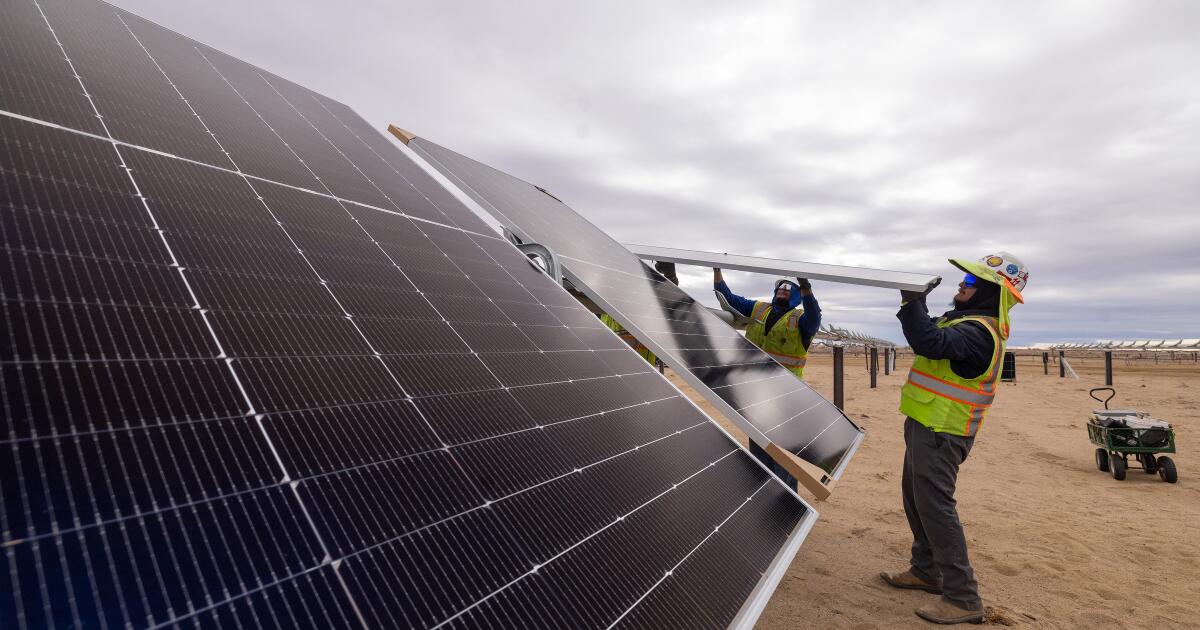
Workers install solar panels for the largest Los Angeles solar and battery factory Department of Water and Power, the Eland solar and storage center in the Kern Mojave desert on Monday, November 25, 2024 near California City, California.
(Brian van der Brug / Los Angeles Times)
This is partly because DWP was able to contract power before the problems of pandemic and supply chain of COVID-19, and long before the new market uncertainties linked to prices, according to Quiñones.
Experts say that such projects cannot happen early enough. Last year was the warmest of the earth, with an increase in global temperatures drawn mainly by fossil fuel emissions. The ELAND project alone should avoid programs equivalent to around 120,000 cars, according to company officials.
“When the city of Los Angeles continued the renewable power for the first time about twenty years ago, it did it for moral reasons. It was” the right thing to do “to reduce the greenhouse gas emissions of the city,” said Jonathan Perfrey, executive director of non -profit climate resolution, in a press release. “Flash forward today – and solar energy is now the right thing to do economically, producing electricity at a lower cost than that of coal, natural gas and nuclear energy.”
On Tuesday, around 75% of state energy came from renewable energies, according to the operator of the independent California system.
With Eland, DWP is on the right track to reach its 100% clean energy goal by 2035, although Quiñones said that 3% to 4% will be the most difficult.
But a project like Eland – the largest DWP has ever made – “demonstrates our commitment to our renewable and clean energy transition,” said Quiñones. “We don’t retreat from that.”