Spotify-like AI helps discover never-before-seen supernova as greedy star attempts to eat a black hole


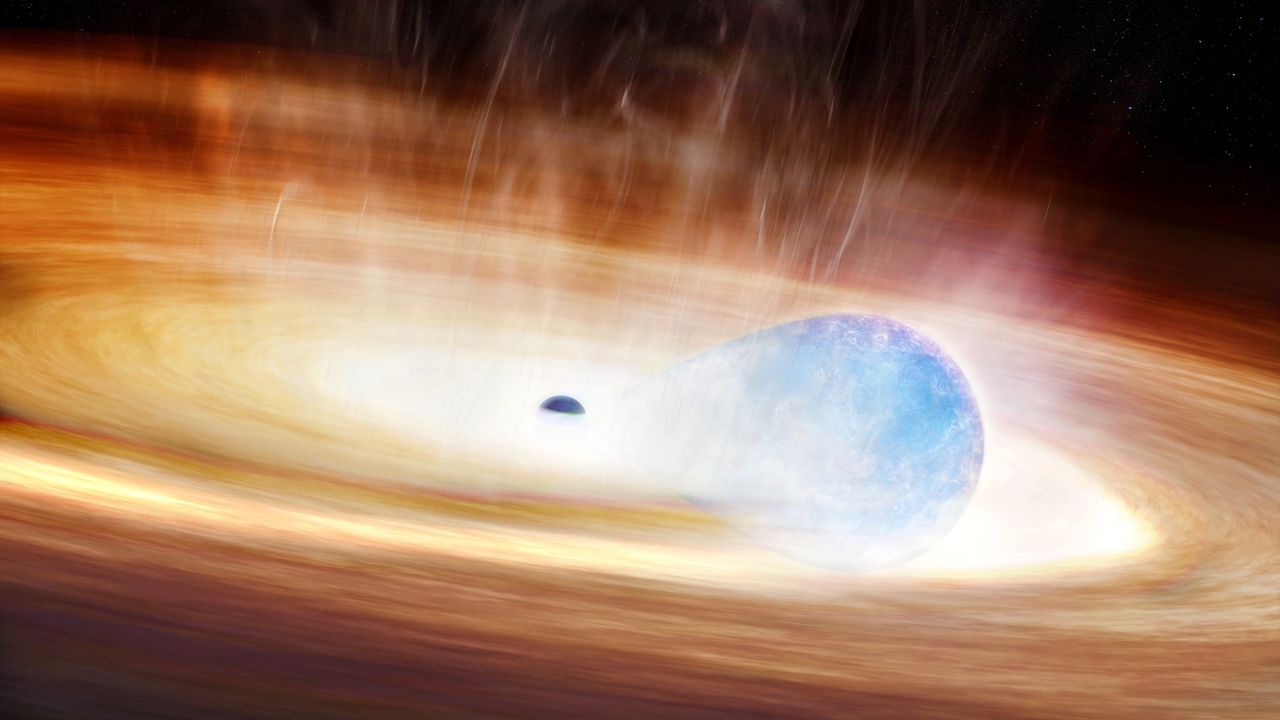
Scientists may have spotted a kind of supernova without sight, after using a Spotify artificial intelligence (AI) To scan the sky for a strange activity.
The AI developed signs of what could have been an enormous star exploding just as it was trying to gloch a black hole nearby.
The stellar explosion, nicknamed SN 2023ZKD, was spotted in July 2023 with the transitional installation of Zwicky, a complete astronomical survey based in the Palomar Observatory in California. But Zwicky did not find the explosion by chance. Rather, it was guided in the right place using an optimized algorithm to find a strange night sky activity.
Identifying the signs of a supernova early is essential to catch how supernovas start, evolve and then disappear – giving an overview of how these explosions work.
In this case, the AI found unusual clarifications of the months before the explosion occurred, the authors of co-leaders in the study Alex Gaglianopostdoctoral researcher at the Institute of AI and fundamental interactions, and Ashley VillarA supernova researcher and assistant professor at the Harvard-Smithsonian Center for Astrophysics, told Live Science in an email.
This fast alert has enabled a number of large observatories to participate in the action and provide observations through a large spectrum of wavelengths.
In relation: 2 “new stars” exploded in the night sky at the same time – potentially for the first time in history
Although there are some ideas about what these telescopes have really seen, scientists behind the new study say that the explosion probably came from a huge orbit star around the black hole. As these two objects are pulled against each other, separation between them decreased. Finally, the star tried to consume the black hole and exploded in the process, due to the gravitational constraint.
Alternatively, it could have been that the black hole shred down the star via a process known as “spaghettification“Providing the explosion, but the data does not suggest that, too strongly,” said Gagliano.
Looking at the chemical composition of the massive star, the team also found that it had not lost all its most outside material before exploding.
“This suggests that binary interaction is much more disorderly than astronomers,” said Gagliano. “Upcoming events will tell us how the explosions of massive stars are shaped by companion interaction, which is very difficult to model.”
Gagliano warned that no one had seen enough of these explosions to fully predict how a huge star and a black hole could interact. The data, however, is “very difficult to explain without binary system”, which means that a black hole and a star were most likely involved in one way or another.
IA assistance
The AI used in the discovery is called identification and search for similarity on the lightcurve anomaly (lease). AI astronomy is based on the spotify algorithmSo Laish recommends astronomical observations in the same way as Spotify users are guided to songs that they can appreciate.
The last explosion drew Lais’s attention light years of the earth. The characteristics of SN 2023ZKD were “compared to an important reference data for objects known to identify the aberrant statistical values,” said Gagliano. “Abnormal signals may indicate rare or previously invisible phenomena.”
Once Laish finds something interesting, a bot in Slack, an instant messaging service, signals the candidates and publishes them in a dedicated channel, allowing the team members to check the results in real time.
“This rationalized system allows astronomers to quickly target the most promising and unusual discoveries,” said Gagliano.
After the explosion, the light pattern of SN 2023zkd has become very strange. At the beginning, he lit as a typical supernova, then refused. But astronomers have really started to be careful when he cleared up again. Archives data have shown a stranger behavior: the star, which has been a coherent light for some time, has gradually became brighter during the four years preceding its explosion.
Astronomers think that the light comes from the excess of material that the star was losing. At first, it became brighter while the shock wave of the Supernova has plowed in low density gases in the region. Another peak of brightness came later while the shock wave continued in a cloud of dust.
As for the presence of the black hole, astronomers deduced it from both the structure of gas and dust, as well as the strange stellar clarification in the years preceding the explosion.
Laish helped astronomers see all these additional details. “If we had waited for a human called 2023zkd, we would have missed the first signatures of the surrounding disc and the existence of a black hole companion. AI systems like Laish regularly help us find rare explosions, without counting on luck, and early enough to discover their origins,” said Gagliano.
The results were published on Wednesday August 13 The astrophysical newspaper.
Black Hole Quiz: What is the supermasse that your knowledge of the universe?


