Oops! Earendel, most distant star ever discovered, may not actually be a star, James Webb Telescope reveals


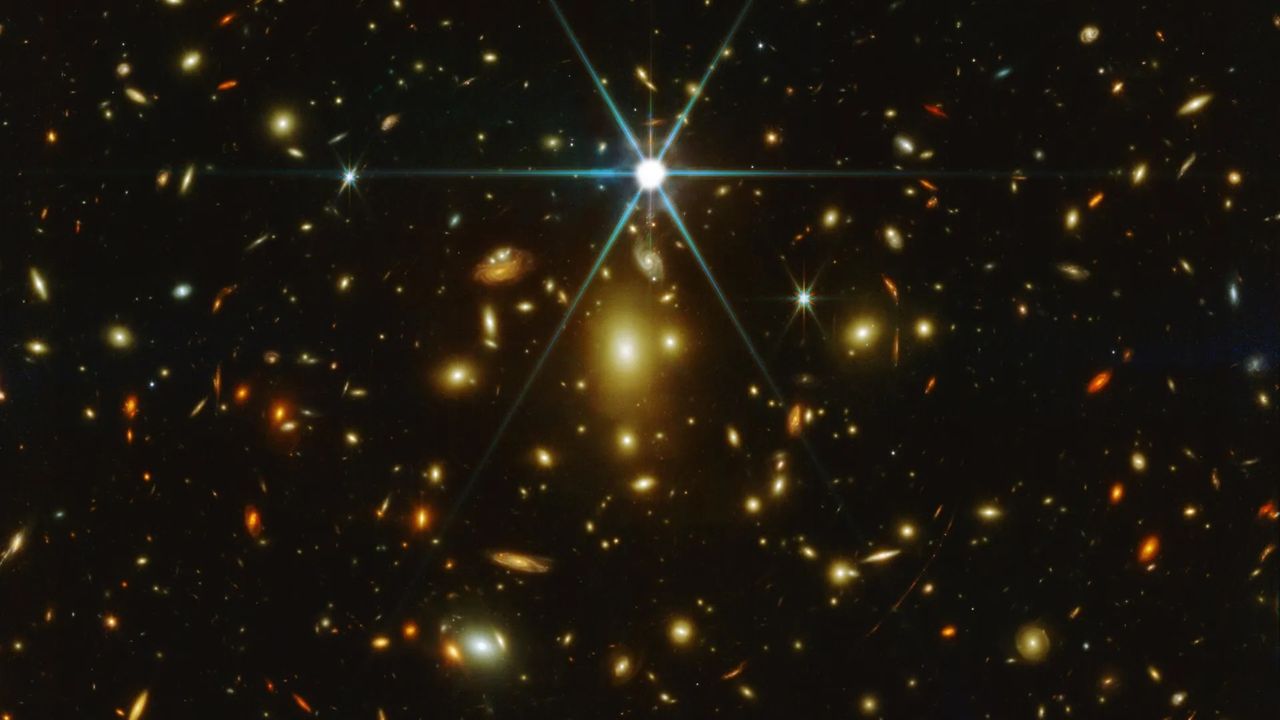
The most distant star ever discovered has been poorly classified: instead of being a single star, the object – nicknamed Eartendel of the old English word for “Morning Star” – can be a group of stars, a group of stars linked by gravity and formed from the same cloud of gas and dust, suggest new research.
Discovered by the Hubble space telescope in 2022, Eartendel was considered a star who was only formed 900 million years after the Big Bang, while the universe was only 7% of its current age.
Now in a study published on July 31 The astrophysical newspaperastronomers used the James Webb space telescope (JWST) To take a look at Eartendel. They wanted to explore the possibility that Eartendel is not a single star or a binary system as previously thought, but rather a cluster of compact stars.
They found that the spectral characteristics of Eartendel correspond to those of globular clusters – a type of star cluster – found in the local universe.
“What is reassuring in this work is that if Eartendel is really a cluster of stars, it is not unexpected!” Massimo PascaleA doctoral student in astronomy at the University of California in Berkeley and the main author of the study, told Live Science in an email. “”[This] The work notes that Eartendel seems quite coherent with the way in which we expect globular bunches that we see in the local universe would have looked in during the first billions of years of the universe. “”
Ancient object
Eartendel, located in the Sunrise Arc Galaxy, 12.9 billion light years of us, was discovered through a phenomenon known as the gravitational lens, a phenomenon predicted by the theory of Einstein of the general relativity in which massive objects fold the light that passes through them. A group of massive galaxies located between the Earth and Eartendel is so large that it deforms the fabric of space-time, creating a coarse effect which allowed astronomers to observe the light of Eartendel, which would be too low to detect. Studies indicate that the star appears at least 4,000 times greater due to this gravitational lens effect.
This extension power is the strongest in certain special regions. If a star or a galaxy is right next to one of these regions, its image can be amplified hundreds or thousands of times brighter than normal. Eartendel seems to sit extremely close to one of these “sweet points”, which is why we can see it even if it is at nearly 12.9 billion light years. These almost perfect alignments are incredibly rare, which made astronomers considered alternative explanations beyond a single star.
In relation: Giant, cosmic, “ Eye of Sauron ” broke we look directly at a superb accelerated photo of 15 years
After Discovery of Eartendel in 2022The researchers analyzed the object using the data from the infrared imaging close to JWST (Nircam). By examining his brightness and size, they concluded This Eartendel could be a massive star more than twice as hot than the sun and about a million times brighter than our star. In the color of Eartendel, astronomers also found a hint of the presence of a cooler companion star.
“After some recent works have shown that Eartendel could (but it is not necessarily) much bigger than it previously thought, I was convinced that it was worth exploring the scenario of star cluster,” said Pascale.
Using spectroscopic data from JWST, Pascale and Team’s Nirspect instruments have studied age and the metal content of Eartendel.
The team examined the spectroscopic continuum of Eartendel, which essentially shows how its brightness gently changes through different light wavelengths. This pattern corresponded to what would be expected from a cluster of stars and, at the very least, corresponded to the combined light of several stars.
“The new part of this study is the Nirspec spectrum, which provides a little more details than what was possible with Nircam data,” said Brian WelchPostdoctoral researcher at the University of Maryland and at the NASA Goddard space flight center who managed the team that discovered Eartendel in 2022 but was not involved in the new study.
But Welch does not think that the new data is sufficient to confirm that Eartendel is a star cluster.
“To the spectral resolution of the Nirspec [instrument]The spectrum of a Lensée star and a star cluster can be very similar. It is therefore important to take into account all the data available during the attempt to classify these highly enlarged objects, “Welch at Live Science told an email.
The researchers explored only the possibility of “star cluster”. They did not investigate all possible scenarios, like Eartendel being a single star or a system of multiple stars, and compare the results.
“The measurement is robust and well done, but in just the hypothesis of the star cluster, the study is limited in the scope,” noted Welch.
Pascale and Welch have agreed that the key to resolving the mystery of Eartendel is to monitor microlensage effects. Microlensage is a subtype of gravitational lens in which an object which passes temporarily deforms the image of a remote object when a closer object is pink before him when he passes. The brightness changes due to the microlensage are more visible when the remote objects are small – like the stars, the planets or the star systems – rather than much larger stars.
“It will be exciting to see what future JWST programs could do to further demystify the nature of Eartendel,” said Pascale.