Natural History Museum to display rare dog-sized dinosaur


Scientific correspondent

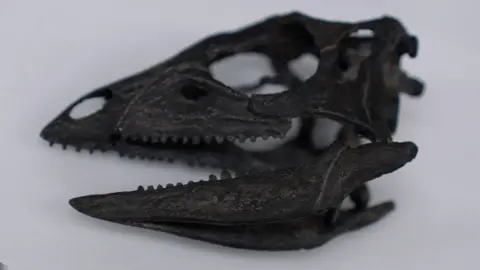 Gwyndaf Hughes / BBC News
Scientific videographer
A dinosaur of the size of the Labrador was wrongly classified when found and is in fact a new species, scientists discovered.
His new name is Enigmacursor – which means a confusing runner – and he lived about 150 million years ago, flowing around the feet of famous giants like the Stegosaurus.
It was initially classified as a nanosaurus, but scientists now conclude that it is a different animal.
On Thursday, he will become the first new dinosaur to be exhibited at the Natural History Museum (NHM) in London since 2014.
BBC News went behind the scenes to see the dinosaur before it was revealed to the public.
The discovery promises to shed light on the evolutionary history which saw the first small dinosaurs become very large and “bizarre” animals, according to Professor Paul Barrett, paleontologist at the museum.
When we visit, the designer of a special glass window for Enigmacursor makes last -minute checks.
The new dinosaur house is a balcony in the impressive museum’s land room. Below, Steph the Stegosaurus also lived in the Morrison formation in the western United States.
Enigmacursor is tiny in comparison. 64 cm high and 180 cm long, it is roughly up to a Labrador, but with much larger feet and a tail “probably longer than the rest of the dinosaur”, explains Professor Susanna Maidment.
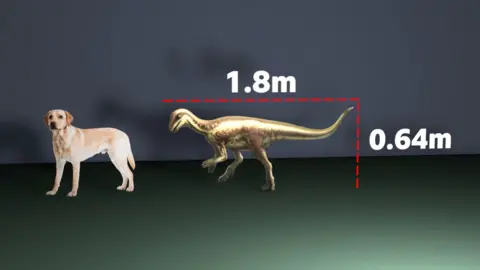
“He also had a relatively small head, so it was probably not the most brilliant,” she added, adding that he was probably a teenager to his death.
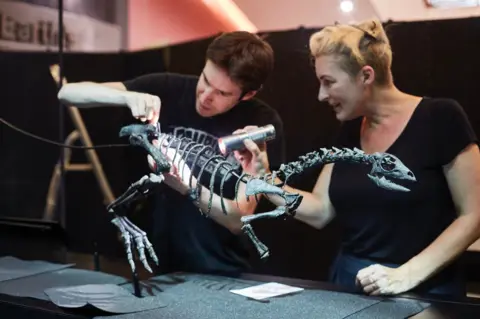
With the fossilized remains of his bones in their hands, the conservatives read Allington-Jones and Kieran Miles assemble the skeleton on a metal frame.
“I do not want to damage it at this stage before it is revealed to everyone,” said Ms. Allington-Jones, conservation manager.
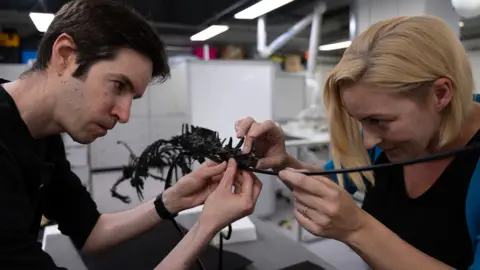 Gwyndaf Hughes / BBC News
“Here you can see the solid dense hips showing you that it was a quick dinosaur. But the front arms are much smaller and away – he may have used them to shove the plants in his mouth with his hands,” explains Mr. Miles.
These are clues in the bones that led NHM scientists to conclude that the creature was a new species.
“When we try to identify if something is a new species, we are looking for small differences with all other closely linked dinosaurs.
When the dinosaur was given to the museum, it was appointed Nanosaurus, like many other small dinosaurs appointed since the 1870s.
But scientists suspected that the categorization was false.
To find out more, they went to the United States with analyzes of the skeleton and detailed photographs to see the original nanosaurus which is considered to be the specimen of the archtype.
“But he had no bone. He’s just a rock with bone impressions. It could be any number of dinosaurs,” said Professor Maidment.
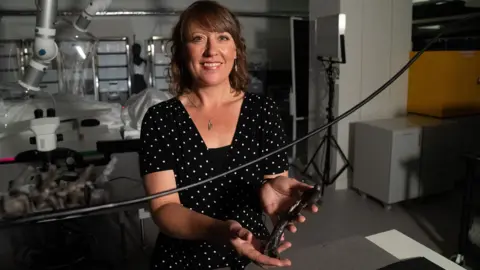 Gwyndaf Hughes / BBC News
On the other hand, the specimen of the NHM was a sophisticated and almost complete skeleton with unique characteristics, including its leg bones.
It is essential to disentangle this mystery around names and categorization, say paleontologists.
“It is absolutely fundamental for our work to understand how many species we really have. If we were wrong, everything else collapses,” explains Prof Maidment.
Scientists have now officially erased the entire category of Nanosaurus.
They believe that other small specimens of dinosaurs of this period are probably also distinct species.
The discovery should help scientists understand the diversity of dinosaurs at the end of the Jurassic.
Small dinosaurs are “very close to the origins of large groups of dinosaurs who become much more important later,” said Professor Barrett.
“Specimens like this help to fill some of these shortcomings in our knowledge, showing us how these changes gradually occur over time,” he adds.
Watching these first creatures helps them to identify “the pressures that finally led to the evolution of their more bizarre and gigantic descendants”, explains Professor Barrett.
 Natural History Museum
Scientists are delighted to have a complete skeleton so rare from a small dinosaur.
Traditionally, the big dinosaurs’ bones were the greatest price, so there was less interest in digging smaller fossils.
“When you are looking for these very great dinosaurs, it is sometimes easy to forget the smallest living by their side. But now I hope that people will keep their eyes close to the ground in search of these little ones,” explains Professor Barrett.
The conclusions on the Mollyborthwickae enigursor are published in the journal Royal Society Open Science.


