How much power and water does AI use? Google, Mistral weigh in


To what extent does AI harm the environment? We now have answers to this question because Google and Mistral have published their own self-assessment of the environmental impact of an AI request.
In July, Mistral, which published its own AI models, published a self-assessment of the environmental impact of training and questioning its model in terms of quantity of carbon dioxide (CO2) produced, the amount of water consumed and the amount of material consumed. Google has adopted a slightly different approach, publishing the amount of energy and water that a gemini request consumes, as well as the amount of CO2 it produces.
Of course, there are warnings: each report was self-generated and not made by an external verifier. In addition, the formation of a model consumes many more resources than inference, or daily tasks, users affect a chatbot each time they question it. However, reports provide a certain context for the quantity of environmental tax, even if they exclude the effects of AI training and inference by OPENAI and other competitors.
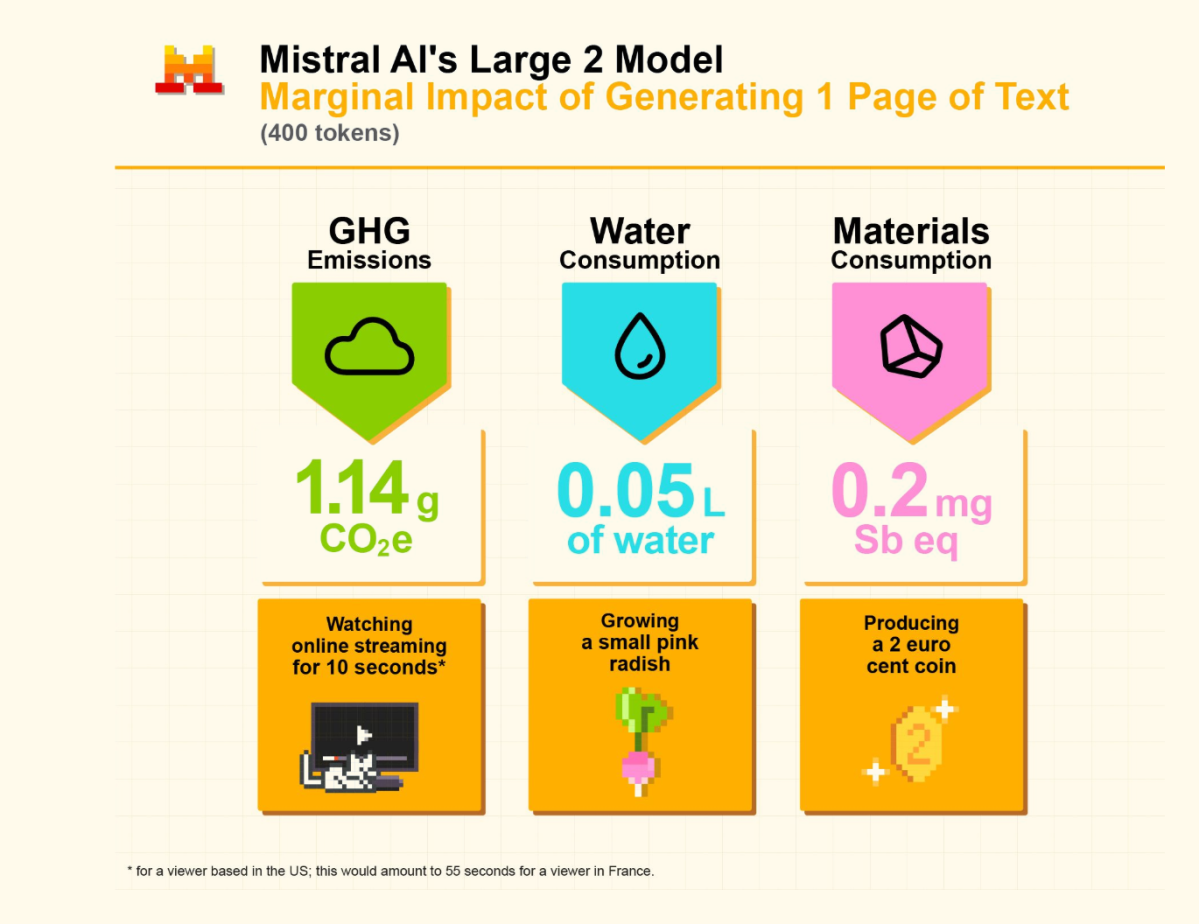
Thursday, Google said that its estimate of the resources consumed by a “median” gemini request consumes 0.24Wh of energy and 0.26 milliliter (five drops) of water, and generates the equivalent of 0.03 grams of carbon dioxide – the 9 -second equivalent of television. Mistral’s report was slightly different: for a “cat” response generating a text page (400 tokens), Mistral consumes 50 milliliters of water, produces the equivalent of 1.14 grams of carbon dioxide and consumes the equivalent of 0.2 milligram of non -renewable resources.
Google said “comparative models” are generally a little more indulgent and only look at the impacts of active consumption of TPU and GPU. In other words, the median gemini text prompt uses 0.10 Wh of energy, consumes 0.12 ml of water and emits the equivalent of 0.02 grams of carbon dioxide.
Google has not published any evaluation of the impact of the training of its Gemini models. Mistral did: in January 2025, the formation of its large model 2 produced the equivalent of 20.4 kilotons of carbon dioxide, consumed 281,000 cubic meters and consumed 650 kilograms of resources. This represents approximately 112 Olympic water consumption pools. Using the EPA estimate that an average car produced 4.6 metric tonnes of carbon dioxide per year, which also corresponds to the annual CO2 production of 4,435 cars.
Environmental impact assessments assume that energy is produced via means that actually produce carbon dioxide, such as coal. “Clean” energy, like solar energy, lowers this value.
Similarly, the amount of water “consumed” generally supposes the use of evaporation cooling, where the heat is transferred from the chip or the server (possibly also cooled by water) to what is called an evaporation cooler. The evaporative cooler effectively transfers heat, in the same way that your body cools after training. When you sweat, humidity evaporates, an endothermic reaction that pulls the heat from your body. An evaporative cooler fulfills the same function, which evacuates the heat of a farm of servers, but also the evaporation of this water in the atmosphere.
Google said it uses a holistic approach to energy management, such as more effective models, optimized inference, although models such as flash-lite, tailor-made TPUs, effective data centers and effective idling of processors that are not used. Clean energy production – as a planned nuclear reactor – can also help reduce impact numbers.
“Today, while AI is more and more integrated into each layer of our economy, it is crucial for developers, decision -makers, businesses, governments and citizens to better understand the environmental footprint of this transformative technology,” adds the own report of Mistral. “At Mistral IA, we believe that we share a collective responsibility with each player in the value chain to approach and mitigate the environmental impacts of our innovations.”
How much water and electricity consume the Chatppt?
Mistral and Google reports were not duplicated by other companies. Epochai believes that the average GPT-4O request on Chatgpt consumes approximately 0.3 WH of energy, depending on its estimates of the Openai servers used.
However, the quantity of resources consumes AI can vary considerably, and even the energy scores of AI are at best rudimentary.
“In reality, the type and size of the model, the type of output you generate, and countless variables independent of your will – like the energy network connected to the data center to which your request is sent and at what time of the day it is processed – can make a question of thousands of times more to energy and to the production of emissions than another.” MIT review of MIT technology Study found. Her estimates of 15 requests per day plus 10 images plus three 5-second videos would consume 2.9 kWh of electricity, she found.
However, the authors of the Mistral study note that his own estimates open the way to a “rating system” where buyers and users could use these studies as a means of choosing models of AI with the least environmental impact. He also called other manufacturers of AI models to follow his example.
The question of whether the AI is “bad” for the environment is always to be discussed, but the reports of Google and Mistral provide a base for a more motivated discussion.


:max_bytes(150000):strip_icc()/Health-stain-remover-recall-eaa586ac41b84791b098e8412a89df3a.png?w=390&resize=390,220&ssl=1 "1.5 Million Bottles of Stain Remover Recalled Nationwide Due to Bacteria Contamination")
