Newly-Discovered Freshwater Turtle Species Survived Dinosaur Extinction


Paleontologists have described a new genus and species of rod -to -mouth turtles using complete fossilized shells and an associated material found in the early formation of the Denver Paleocene in Colorado.
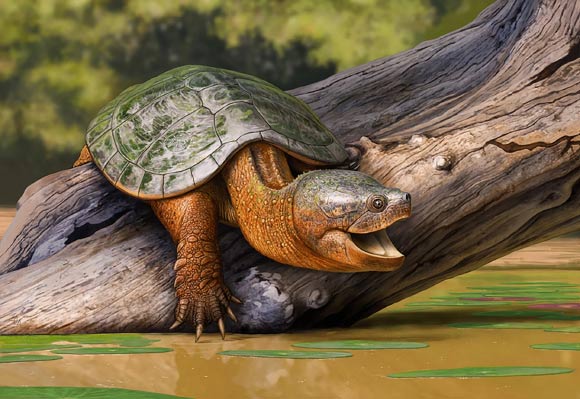
A reconstruction of Tavachelydra Stevensoni Having a log in a pond water environment. Image credit: Andrey Atuchin.
Tavachelydra Stevensoni lived in what is the United States now in the first era of the Paleocene, between 66 and 65 million years – just after the final mass extinction.
The species belongs to Chelydridae, a family of freshwater turtles which includes at least seven living genres and two living genres.
“The clade of existing Chelydrid turtles (Chelydridae) includes five endemic species to the new world and whose combined geographic ranges extend from northern South America to southern Canada,” said Dr. Tyler Lyson of the Denver Museum of Nature & Science and his colleagues.
“Although this is not a diversified turtle, Chelydrid turtles are a common component of most North American freshwater ecosystems.”
“The Total group of Chelydrides (i.e. Pan-Chelydridae) is found throughout Laurasia, but the fossil remains are notoriously fragmentary.”
Fossilized shells and skulls of two Tavachelydra Stevensoni Individuals were found in the study area of Corral Bluffs, which is located in the County of El Paso in the South Center of Colorado, east of Colorado Springs.
“With a straight -up shell length of almost 50 cm, Tavachelydra Stevensoni is one of the largest turtles at the start of the Paleocene (PURC) in the Denver Basin, “said paleontologists.
“Interestingly, two Pan-Chelydrid turtles are present at the start of the paleocene of Corral Bluffs, Tavachelydra Stevensoni And Denverus Middletoni. “”
“The two differ considerably in size, with Tavachelydra Stevensoni be at least four times larger than Denverus MiddletoniThis probably helped to reduce competition between two chelydrides with overlapping geographic ranges. »»
We know little about the paleoenvironnement of the only known specimen of Denverus MiddletoniBut the yellow sandstone of mustard with fine to medium grain in which it was found was initially interpreted as representing a channel filling.
The two partials Tavachelydra Stevensoni On the other hand, skeletons have been found near the other in staggering water or a deposit of distal crevasse bursts, so it is reasonable to deduce that Tavachelydra Stevensoni Water bench water deposits inhabited pond.
“Although nothing can be said about the diet Denverus Middletoni As his skull is not preserved, Tavachelydra Stevensoni Had a large skull with large crimpsy -sided cross -sided surfaces of a durophagus diet (eating behavior of animals that consume organisms with hard or exoskeleton shells, such as corals, molluscs or dissected crabs), “said researchers.
“It therefore seems plausible that Denverus Middletoni And Tavachelydra Stevensoni occupied different ecological niches, with Tavachelydra Stevensoni Prefecting staggering environments and a durophagus diet. »»
“Interestingly, turtle species with a durophagus diet have higher survival in the end-cutter mass extinction compared to turtles with a non-durophagus diet.”
“In addition to durophages food preferences Tavachelydra StevensoniSeveral of the most common reptiles described from Corral Bluffs are also interpreted as Durophages, including the Crocodylian to teeth cf. WANNAGANOSUCHUSand baenide turtles Palatobaena knellerorum,, Saxochelys GilbertiAnd Cedrobaena Putorius. “”
“This suggests that Durophagy was an important life of life for freshwater vertebrates during the first Paleocene in North America.”
The discovery of Tavachelydra Stevensoni is described in an article published in the journal Swiss Paleontology Journal.
_____
TR LYSON and al. 2025. A new Pan-Picedride turtle, Tavachelydra Stevensoni Gen. And sp. Nov., From the study area of the lower Paleocene (Danian, Puerci), in the Denver basin, Colorado. Switzerland J Palaeontol 144, 46; DOI: 10.1186 / S13358-025-00375-4


