Big Surprise—Nobody Wants 8K TVs


The first 8K TV was revealed in 2012, and this would be the next logical step after the 4K UHD sets. However, more than a decade later, 8K screens have completely failed to make breakthroughs with regard to the market share.
Sony’s television division indicates that the market has no interest in 8K. The main manufacturers do not bother to develop new 8K television models, and the 8K TV market has peaked in 2022 and has been declining since then. So, in other words, no one wants these televisions – but why?
The 8K promise
The larger numbers are always easy to market. Customers have no problem understanding that more thumbs are better, that more bits are better, or that more gigabytes are better. They do not always understand how much the decreasing yields are, but if the new thing has a larger number than the old one, it is better, right?
4K UHD (the real 4K is in fact 4096 x 2160) is a right quadrupling of the number of pixels compared to the “complete” HD. By doubling the number of pixels on each axis, you go from around two million pixels to eight million.

While 1080p already seems fairly clear, 4K offers a significant increase in sharpness. At least, it does with the right type of content, such as documentaries of the nature of video games using high -end PC equipment.
8k takes 4k and doubles the pixels again on each axis to roughly 33 million pixels. This means that for a given display size, the pixels become four times smaller compared to a 4K screen. Think about how a 4K image is detailed on your current TV or monitor, then consider something with this detail – quite amazing solids four times, right?
Verification of reality: 4K is “quite good”
The problem is that 4K is already quite detailed. When is the last time you looked at the 4K content and you thought yourself “I can see the pixels” or that the image seemed grainy in one way or another? I’m talking about native 4K content here, of course, so most of your console games would not count.
Now, if you’ve seen an 8K TV in person, you will know that there is in fact a visible difference in the detail of the image comparing the two. No one can claim that 8K televisions have not obviously have more details than 4K. Of course, I have never seen 8K difficulties in exhibitions and in department stores where 8K in large format televisions are demo. Here you can see this difference when you are much closer to the screen that you would never have used in real life.
The visualization distance is the key factor here, because at normal visualization distances, it can be difficult to collect the differences between 1080p and 4k, much less 8k.

The main thing is that most people, most of the time, in most practical situations, will see no difference between the 4K and 8K displays that count.
The content problem

This is, of course, assuming you can find any 8K content. While Hollywood films are regularly shot by resolutions greater than 4K, the objective is not to produce final content at higher resolution than that. It is to have the freedom to crop and manipulate raw images without harming the 4K finals.
8K content would cost a lot, a lot More than 4K to pull, store, edit and distribute. Returning CGI to four times the current standard resolution is likely to make films which are already too expensive completely impassable.
So, if you buy an 8K TV today, you will have nothing to look at unless you do it yourself with an extremely expensive PC or high-end 4K content for intermediate results.

- Brand
-
Hisense
- Display resolution
-
4K
The Hisense U7k strikes above its weight category by offering a 144 Hz screen, a LED mini-lighting and two HDMI 2.1 ports. The TV also supports all popular HDR formats.
Cost and practice
8K starts to make a practical difference with large screen sizes, but what is the size? There has been a trend towards increasingly large televisions over the years, and it seems that these days, the 55-inch TV is declining, with 65 inches becoming the balanced popular choice. 98 -inch televisions are also more popular, affordable and expensive models of this size are relatively common now.
Even about 100 inches, at normal vision distances, the difference between 4K and 8K is not so obvious, unless you have literally two televisions side by side. But, we do not watch television side by side and therefore, in the end, it does not matter. In addition, for most people, even a 100 -inch TV is just impractical, even if the price of the TV would not be a problem. So, go above 100 inches to justify 8K meetings yet another point of friction.
- Color
-
Black
- Mounting type
-
Standard tripod connector
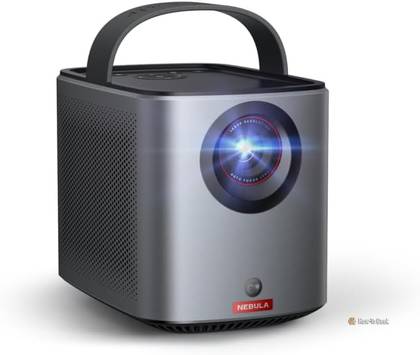
The Mars 3 air nebula seems to be the part of a premium portable projector and sounds well, but has performance problems with its integrated Google TV applications and lacks enough light for use outside of very dark environments.
A solution looking for a problem
But cost East A factor for most people and the price difference between a 4K and 8K TV of the same size is so important that any perceived improvement in loyalty does not seem to be worth it. Add to this that current 8K televisions are quite out of date with regard to features and performance in all other areas of image quality, and 8K is a particularly difficult sale.
In the end, no one was suffering for more resolution. Instead, people appreciate higher cooling rates, better movement handling, perfect black levels, high maximum brightness and precise reproduction of colors.
What is the problem that 8K televisions are trying to solve then? The answer, for the moment, is that there is no traditional need for 8K.
Where 8K makes sense

Beyond very There are a few other places that I can see 8k being really useful. One of them is at the cinema, where you have to look at something between 700 and 1500 inches. It is true that films in the theater look softer than on my OLED 4K, so obtaining the resolution four times. However, someone has to make films in 8K, and as we have already covered, it will probably not happen for a while, if ever.
Home Projection is another area where it makes sense. The cheapest and easiest way to get an image up to 200 inches at home is to use a projector. An 8K projector certainly makes sense, but it will be expensive and difficult to implement. Although the use of pixel shift technology can be the best compromise. Like the JVC DLA-NZ8 of $ 16,000 (!) Which rebuilds an 8K frame by quickly shift a native 4K frame.
Finally, I think that 8K monitors could be a good solution for certain types of computer work at an office. You have effectively four 4K -free 4K screens, so if you work with a lot of data or if you create 4K or more content, there is practical use for all this resolution. After all, we on a computer on our eyes on work monitors when we work, if not when we play.
However, I do not think 8K is never one thing because it is not just a case of cheap technology so that 8K is trivial on all the accounts to be produced. The limiting factor here is human biology. So, unless we are going to upgrade (and I am absolutely for that), we are already at or near SweetSpot for the display resolution.


