Total abortion ban in Dominican Republic has cost women’s lives, social media campaign warns


With a birthday cake in hand, the well -known actor of the Dominican Republic Carlos Sánchez told in an Instagram post how Winifer Núñez Beato, aged 25, died in 2021 after the doctors of the island refused to put an end to his high -risk pregnancy because of the total ban on the abortion of the country.
Núñez Beato left a husband and a young girl. In the video, Sánchez said that the cake is not for his birthday, but rather to mark another year when he asks women not to die because of a law that prevents doctors from saving their lives.
Sánchez told NBC News that he felt forced to use his platform to raise awareness because “it is a barbarism that a mother must endanger her life for a risky pregnancy that could be over, but the law prohibits doctors from doing so.”
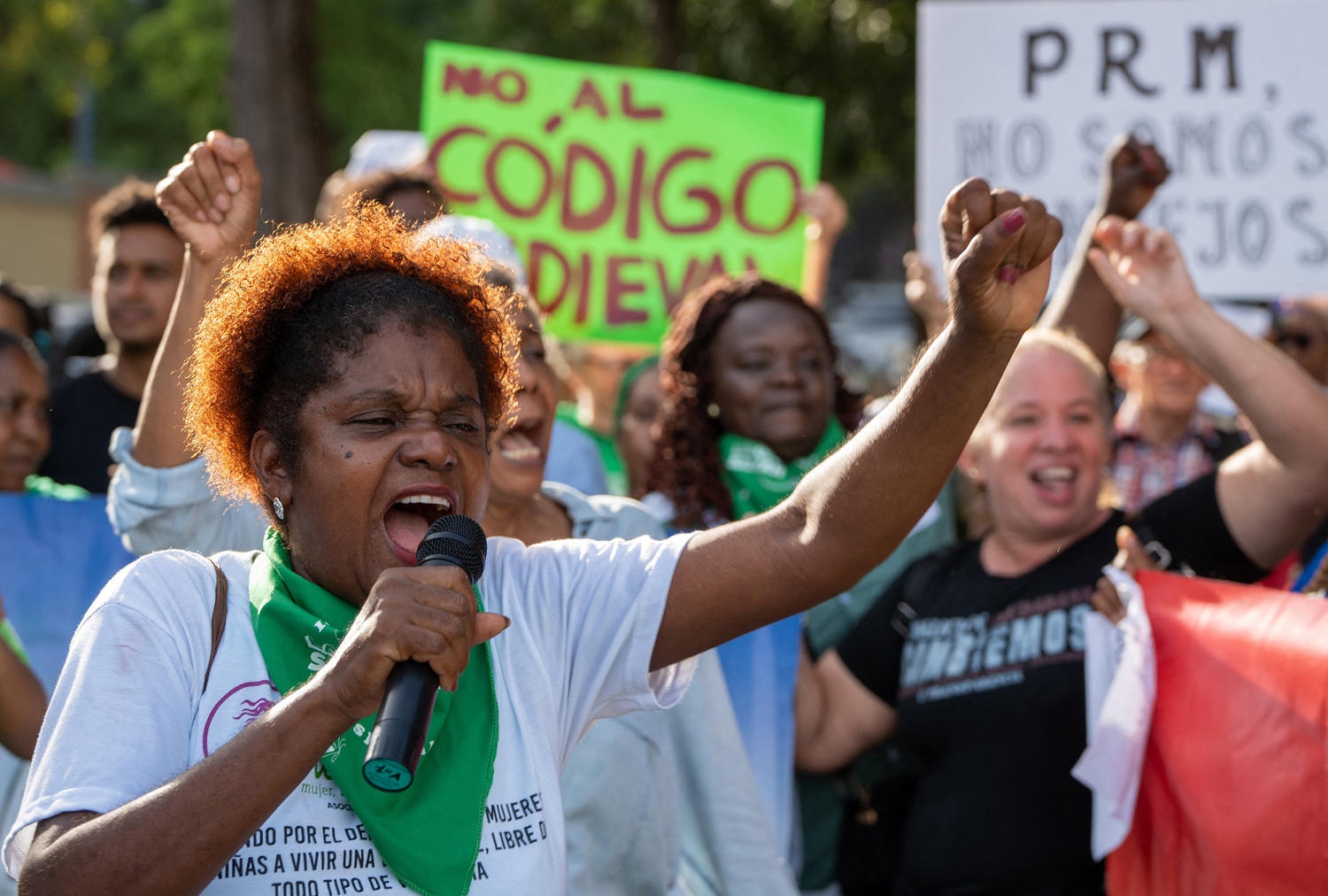
Sánchez is one of the many artists and activists of the Dominican Republic who participates in a campaign on social networks in order to modify a recently adopted penal code which maintains a complete prohibition of abortion. Many artists have used their platforms to tell the stories of Dominican women who lost their lives in conditions related to pregnancy.
On Instagram, the singer and actress Techy Fatule tells the story of Damaris Mejia, who went to three different hospitals when she started to feel sick and had a strong fever. According to Fatula, medical staff did not know what to do with the high risk pregnancy of Mejia. She was sent home with pain relievers and died that night. Fatula says that doctors could not save it because of the ban and ends with words: “Life is full of exceptions”.
The Dominican Republic is a conservative country which presents the Bible on its flag. The country signed a concordat, or agreement, the Vatican in 1954 making Catholicism the religion of the State, although the Constitution authorizes freedom of worship.
The Catholic Church of the country supports the ban on abortion, as well as evangelical groups. But Alianza Cristiana Dominicana, a group trained in 2017 by women of different Christian confessions, put pressure for the penal code included what is known in the region like the “very causal”, or three causes or circumstances where the end of pregnancies should be authorized: when women’s life is at risk, in the case of rape or incest, and when fetal malformations are incompatible with life. The “very causal” are used in other countries of Latin America which have attenuated the total abortion prohibitions.
Alianza Cristiana Dominiana has teamed up with artists to share the stories.
Until now this year, there have been 100 maternal deaths documented in the Dominican Republic. Natalia Mármol, from the coalition for life and the rights of women, thinks that these lives could have been saved if the abortions were legal.
“This is a fight to guarantee minimum protection for life, health and dignity for girls and women,” said Mármol. “We ask for minimum protections, so that women do not die on a hospital bed. Thus, a 13 or 15 -year -old girl is not obliged to continue with a pregnancy which is the product of rape. And so a woman can decide when a pregnancy is not viable. ”
The previous Penal Code of the Dominican Republic had been in place since 1884 and the efforts to reform have failed for decades. The new penal code has been approved by legislators and recommended by President Luis Abinader.
Abinader had previously expressed his support to make exceptions to the ban on abortion, but after winning a re -election, he did not push changes.
After the vote, abinader said that the penal code, which covers many types of crimes, “is not ideal but that it is the best possible, because among others, it replaces legislation which dates back to 1884.”
Mármol said that the new penal code includes points that the group has recommended, such as the classification of femicide, the intentional murder of a woman or a girl, as well as an increase in the gravity of the punishment for sexual assault.
She said that the new penal code did not come into force until August 2026 and that it is time to modify the law to include the three exceptions.
The coalition for the life and the rights of women and other groups has pushed for years to include the three exceptions, even by erecting a camp in 2021 in front of the National Palace to put pressure on the Parliament.
In the Dominican Republic, women risk up to two years in prison for abortion and doctors and midwives can receive five to 20 years to end a pregnancy.
Four other countries in Latin America and the Caribbean maintain a total ban on abortion, notably Haiti, Nicaragua and Salvador. Most of Latin America and the Caribbean authorize abortion in limited cases.
The singer and composer of the Caribbean, Isabel de Dios, said that she had been active in the feminist movement throughout her adulthood, often participating in the demonstrations. His first song, entitled “Colonizado”, or “Colonized”, explains how society expects people to stay in established roles and turn their eyes to many situations.
She called the “crazy”, “dictatorial” and “feudal” penal code.
“What kind of society do we build?” She said.


