New congressional maps will test the Latino vote in the 2026 election


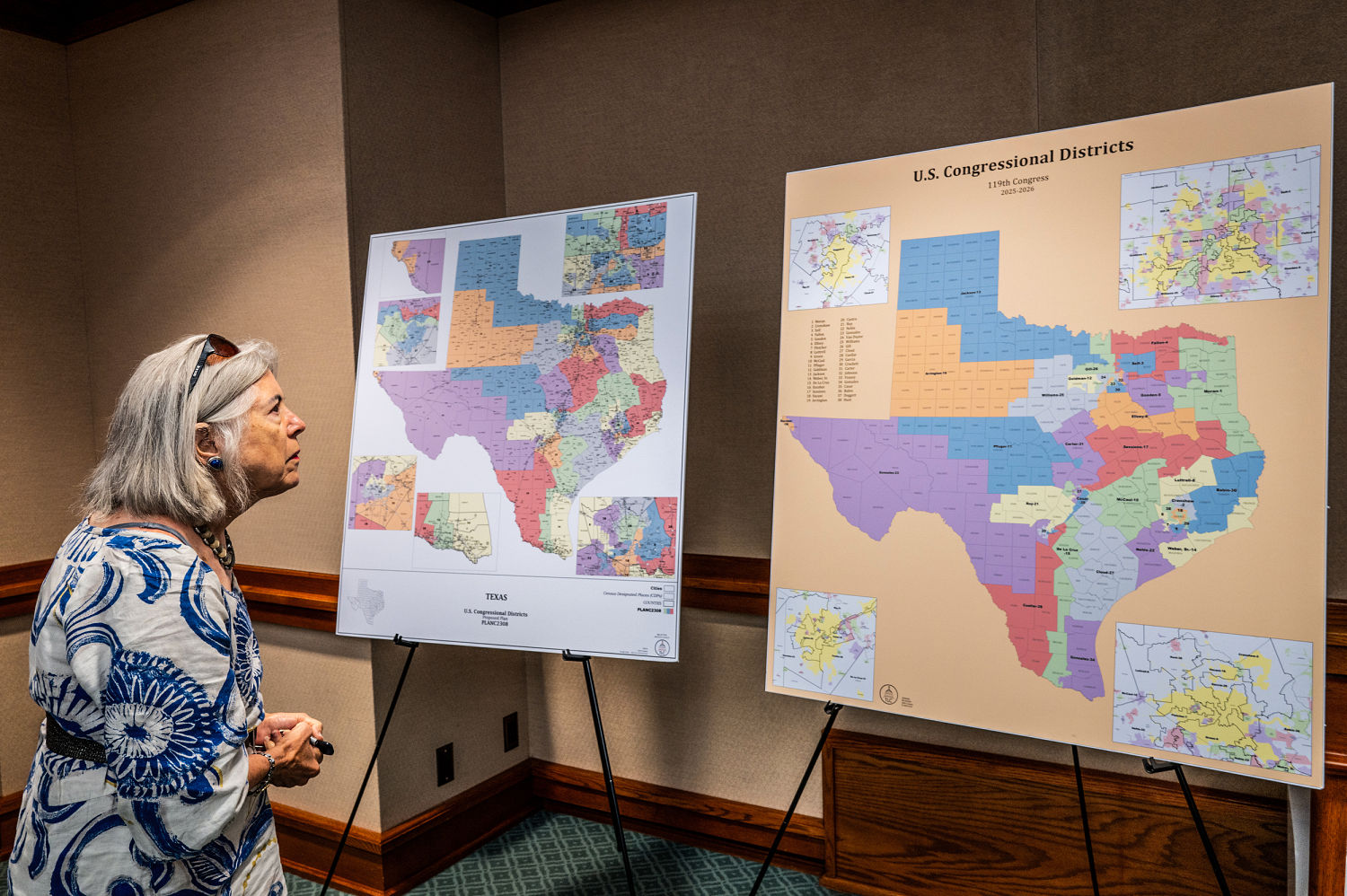
As a wave of redistribution of mid-December who sweeps away the country, politicians on both sides of the aisle are unusually frank on their end of game: political power.
With only a little more subtlety, the Republicans of Texas and the Democrats of California also indicate where they think that the trends in the Latin vote take place – and how they think that these voters will help them to acquire power in 2026 and beyond.
The big change from Latinos to the Republicans was one of the main changes in American policy during the Trump era. From now on, the sustainability of these GOP gains – and if the vice -president Kamala Harris in the main states of Swing and the swing districts represents a low -water brand for democrats or a Waypoint on the worse trends in the future – are key questions that will determine how the districts of the newly attracted congress take place for the parties that attract them.
“These cards were fired by assuming that the results of 2024 and, to a lesser extent, will provide the strongest indication of what will happen in 2026 for both parties,” said Erin Covey, non -partisan electoral analyst who is the chief editor of the house at Cook Political Report with Amy Walter.
“The Republicans are betting on their earnings with Hispanic voters that they have made in South Texas in particular, not only in 2024, but in the past eight years. … It is somehow the whole game of them if they want to keep the house,” added Covey.
The Republicans of Texas have gone big on Hispanic voters
The optimism of the Republicans with regard to their improvement with Hispanics is a clear line in their card of the Congress of Texas.
While mapmakers were trying to improve the chances of the GOP to destroy the Democratic representative Henry Cuellar, a long -standing hard opponent despite an act of federal corruption, they have pushed his district limits further east, creating a district that Donald Trump would have won by more than 10 points in percentage in 2024 (Trump won the old Cuellar district by more than 7 points). In doing so, they transformed a Hispanic district of 73% in 91% Hispanic, a clear bet that political upheavals in the Rio Grande Valley, in particular among the Hispanics moving towards the Republicans, will continue.
On the other side of southern Texas, the 34th district, represented by the Democratic representative Vicente Gonzalez, has become less Hispanic, but its 2024 putative margin for Trump also increased.
The most spectacular changes occurred in the districts held by democrats in the main metropolitan areas of Texas. The new 9th district, now a district of Ruby-Red in eastern Houston and the surrounding area, is 62% Hispanic, and Trump would have won almost 20 points last fall.
And then there is the new 35th district east of San Antonio, an area which is 57% Hispanic that Trump would have won 10 points in 2024.
Throughout the redistribution process, republican legislators have repeatedly stressed that their only objective to restart the cards was political – pushing democratic accusations and prosecution of external groups, alleging that the restarting equivalent to a gerrymaler based on the unconstitutional race. But they pointed out that most of the districts where they hope that gains have Hispanic majorities.
“The underlying objective is that this plan is simple: to improve republican political performance,” said the GOP state representative Todd Hunter, earlier this month during the debate on the bill, adding that the main changes to the State Congress are “focused on only five districts for partisan purposes”.
He continued by noting that “four of the five new districts are mainly minority Hispanic” by the citizen population of the voting age, before adding: “Each of these newly drawn districts now tends to be republican in political performance. Although there is no guarantee of electoral success, he added.
Partly because of Latin American voters on the right, no republican president in Texas will represent a district that Trump has gained less than a two-digit margin, and the five potential republican microphones wear this same floor.
But some of these districts were more competitive in previous elections – in particular the 28th and 34th districts held by Democrats, as well as potential republican targets in the 9th and 35th districts.
Brendan Steinhauser, former campaign director for American Republican Senator John Cornyn of Texas, told NBC News that “the key element” before 2026 is whether the Republicans did not name Trump could reproduce his performance with the Hispanics.
“It is a very plausible scenario that it is durable, but if not, we could have competitive seats to defend,” he said.
Steinhauser then noted that Cornyn performed well with the Hispanics on the path of re -election in 2014, and he declared that there were nuanced differences between Latin American voters – as between southern Texas and the rest of the state, between male and female voters, and differences based on education and income levels. He added that his “intestine” told him that Trump’s Hispanic vote will probably be a “high water brand” for the next republican cycle, “and we will work to get as close as possible”.
But the supporters do not agree, on various degrees, on the lessons to be learned from previous elections, in particular since these republican seats were more competitive when the Democrat Beto O’Rourke narrowly lost her candidacy for the Senate to Senator Gop Ted Cruz in 2018.
Steinhauser said he thought that these margins “more to do with Beto O’Rourke than anything else” and that the Democrat “captured lightning in a bottle”.
The Texas Democrats told NBC News that they had seen many evidence in recent cycles of democrats outperforming the presidential ballot.
Manny Garcia, a democratic strategist who was previously the executive director of the State Party, made the district changes heard as a racial gerrymander which drowned the Hispanic areas with low reversal with higher white areas (echoing the arguments presented against the restart in court). He added that if the Republicans really thought that the movements among the Hispanics were durable and widespread, they would have made different choices around urban areas.
“When you deepen what is going on, it is the republican party that hopes and convinces itself that the unique phenomena that have occurred with Donald Trump and a ribbon of the Latin American population, in particular rural Latin men, that this relationship will take place on the boxes and for many years to come,” he said. “Republicans are making a bad bet.”
The success of the cards could be based on the question of whether the Democrats have already made a substance
In California, the Democrats drew a card designed to counter Texas by creating up to five microphones at home for their party.
But Covey noted that they had started from a different point from that of the Texas Republicans – California had much more competitive seats in its card, which was fired by an independent commission, than the previous Texas card, drawn by republican legislators in 2021 and designed to consolidate the republicans incumbent instead of maximizing the potential gop.
Covey added that if the Democrats “could have drawn a more aggressive card which gave them up to seven pick -up opportunities” because of the way in which the Californian republicans spread are geographically, the card drawers have also taken steps to help isolate a handful of democratic holders who could have been vulnerable at a given moment, according to the national mood.
Retraimations intervene after an election that saw Trump not only sweep the main states of swing, but gain ground compared to its 2020 margins in each state, even when, in some cases, the main democratic candidates on the ballot of voting surpassed the top of their ticket.
The dynamics raises an important question when considering new cards: did national democrats reached a hollow in 2024, in particular given the historical trend of the out-of-power party which gains ground in a subsequent mid-term? Or 2024 and the realignment of important voters who propelled it pointed out that the old hypotheses are no longer on the table?
Paul Mitchell, a data consultant including the firm of Redecoupage partners, helped make new California Democrats, told NBC News that he believed that the Republicans planning their political future around the “artificial and high number” of 2024 could be a “real trap”, even if he added that his party was “nursing” unexpected unexpected.
“Let’s say that this trend is permanent, we did not want to have bitten, so we were too cautious. They did not seem to worry about it,” he added.
Rob Pyers, the director of research of California Target Book, told NBC News that he thought that the Democrats had not adopted a “maximalist approach” less out of strategy and more because they feared running constitutional concerns, after the independent state commission pulled the cards in 2021 to add more districts. And while key and potentially vulnerable democratic seats have been plotted in removal, he noted that certain democratic districts previously safe [got] much more competitive.
“There is an obvious bet that the trend to the right in a number of these districts will stop,” he said.
But it also raised another potential wrinkle, which makes California replay less simple than Texas: the state primary system of the State, where candidates present themselves in primary coverage and the two main candidates pass to a general election, whatever the party.
“When the Republicans represent 20% to 30% of the vote, the chances of a crowded democratic field producing a R-Versus-R runoff are distant. When Republicans represent 40% or more of the vote, things can be perilous,” he said.
“Take into several younger progressives in the same district, all seeking to eliminate rooted geriatric members,” he added, “it is not difficult to imagine things that happen laterally.”


