1.8 million-year-old jawbone may be earliest evidence of Homo erectus outside Africa


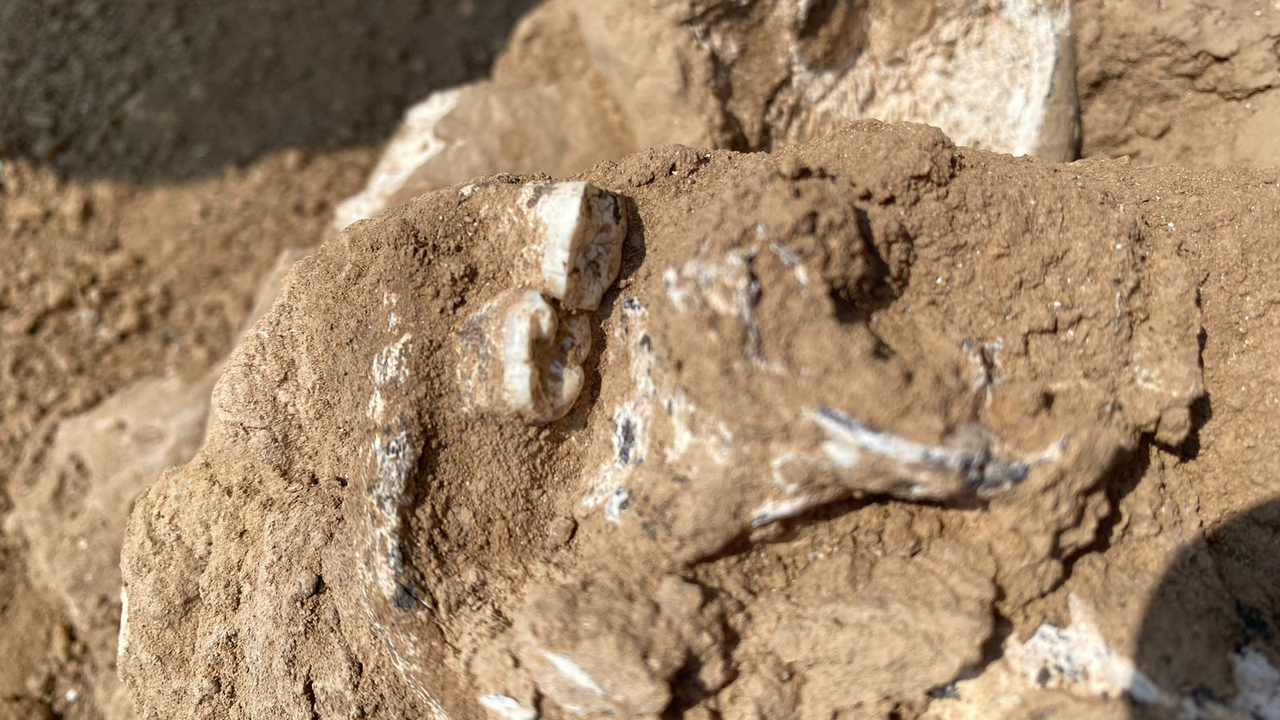
A child of about 1.8 million Homo erectus Jawbone discovered in the Republic of Georgia may be proof of one of the first human groups to live outside Africa.
The discovery, announced on July 31 by the National Georgian Agency for the Preservation of Cultural Heritagethrow new light on the evolution of our genre, HomoAnd “should reveal the reasons for the migration of the first hominines outside Africa”, ” Giorgi bidzinashviliAn archaeologist at the State University of Ilia in Tbilissi, told Live Science in an email.
Bidzinashvili led a excavation At the first site of the Orozmani Stone Age, about 60 miles (100 kilometers) south of Tbilisi, the capital of Georgia, since 2020. In these first excavations, the researchers discovered stone tools near the bones of old animals, as well as a unique tooth Since H. erectusthat they uncovered in 2022.
H. erectus evolved approximately 2 million years ago in Africa. It was the first human ancestor to leave Africa and explored certain parts of Europe, Asia and Oceania. The first fossil evidence of this trip come from the site of Dmanisiwhich is only 12 km (19 km) from Orozmani.
In a 2011 studychemicals dating Lave flows on DManisi and Orozmani have shown that the sites are roughly contemporary. Both date from 1.825 million and 1.765 million years.
The excavations in Dmanisi in the past three decades have revealed more than 100 fossil bones, including five skulls. These skeletons showed that the first hominins to leave Africa were significantly shorter and had smaller brains that Homo sapiens. DManisi skeletons initially received the name of the species Homo GeorgicusBut they are now generally considered to be the first known H. erectus individuals in Eurasia.
In relation: The fingerprints of 1.5 million million fingerprints reveal that our Homo Erectus ancestors lived with a 2nd proto-human species
So far, the fossils of Orozmani, which include a single tooth and a partial jaw, are not as numerous as those of Dmanisi. “Since we have not yet cleaned the jaw,” said Bidzinashvili, “it has not been compared to the orozmani tooth of 2022.”
But the discovery of fossils in Orozmani suggests that Dmanisi was Not a unique site. Several first human groups may have settled in the Caucasus shortly after leaving Africa.
“Perhaps we find that this movement in Georgia was not an isolated incident, but perhaps there was a broader distribution of Homo erectus In this period, ” Karen BaabAn biological anthropologist at Midwest University in Glendale, Arizona, which was not involved in research, told Live Science.
The research team tries to determine if one site is older than the other.
“Until we have new dates, we cannot confirm or deny that the human fossils of Orozmani are older than Dmanisi or Contemporane,” said Bidzinashvili. “At the end of the year, we will know.”


