Two Extraordinary Fossils of Immature Pterosaurs Killed by Catastrophic Storm Found in Germany


Paleontologists from the University of Leicester examined the fossilized skeletons of 150 million 150 million Antiquus pterodactyl Individuals with broken wings of Solnhofen limestones in southern Germany. Their results show how these creatures have been tragically struck by powerful jurassic storms which also created the ideal conditions to preserve them and hundreds of fossils of others like them.

The impression of an artist of a tiny Antiquus pterodactyl A newborn baby struggling against an unleashed tropical storm, inspired by fossil discoveries. Image credit: Rudolf Hima.
“The limestone deposits of the Jurassic Solnhofen Superior of Bavaria, in southern Germany, dating from 153 to 148 million years, are renowned for their exquisite and preserved fossils, including many specimens of pterosaurs, the flying reptiles of the Mesozoics,” said the University of the Paleontologist of Leicester Rab Smyth and colleagues.
“However, here is a mystery: while Solnhofen gave hundreds of fossils of pterosaurs, almost all are very small, very young, perfectly preserved.”
“On the other hand, larger adult pterosaurs are rarely found, and when they are, they are represented only by fragments (often isolated from skulls or members).”
“This model goes against expectations: larger and more robust animals should have a better chance of fossilization than delicate juveniles.”
In the new study, the authors analyzed the fossilized skeletons of two immature pterosaurs of the Solnhofène limestone.
The two individuals belong to Antiquus pterodactylA kind of pterosaur that lived in what is now Germany during the Kimmeridgian era of the late Jurassic era.
With wings under 20 cm (8 inches), these newborns are among the smallest of all known pterosaurs.
The two show the same unusual injury: a clean and tilted fracture in the humerus.
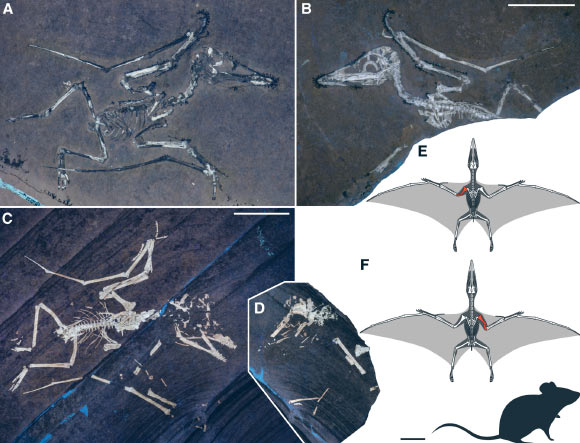
Neonatal examples of Antiquus pterodactyl Solnhofen limestones, Germany. Scale bars – 20 mm. Image credit: Smyth and al., DOI: 10.1016 / J.Cub.2025.08.006.
The left wing of an individual and the right wing of another were both broken in a way that suggests a powerful torsion force, probably the result of powerful gusts of wind rather than a collision with a hard surface.
Cattrophically injured, the pterosaurs plunged on the surface of the lagoon, drowning in the waves trained by the storm and quickly crisscrossing towards the seabed where they were quickly buried by very beautiful movies moving by the storms of death.
This rapid burial allowed the remarkable preservation observed in their fossils.
Like the two pterosaurs studied, which only had a few days or weeks at their death, there are many other very young little pterosaurs in Solnhofen limestones, kept in the same way, but without obvious proof of skeletal trauma.
Unable to resist the strength of storms, these young pterosaurs were also thrown into the lagoon.
This discovery explains why the small fossils are so well preserved – they are the direct result of the storms – a common cause of death for the pterosaurs who lived in the region.
“For centuries, scientists thought that Solnhofen’s lagoon ecosystems were dominated by small pterosaurs,” said Dr. Smyth.
“But we now know that this point of view is deeply biased. Many of these pterosaurs were not at all from the lagoon. ”
“Most are inexperienced juveniles who probably lived on the neighboring islands which were unfortunately taken in powerful storms.”
An article on results has been published today in the journal Current biology.
_____
Robert Sh Smyth and al. Mortal accidents in neonatal pterosaurs and selective sampling in the fossil assembly of the Solnhofène. Current biologypublished online on September 5, 2025; DOI: 10.1016 / J.Cub.2025.08.006