Paleontologists Identify Multiple New Species of Fossil Coelacanths


Several new coelacanths species that lived at the end of the Triassic period, about 200 million years ago, were identified from museum specimens barely barely in the United Kingdom.
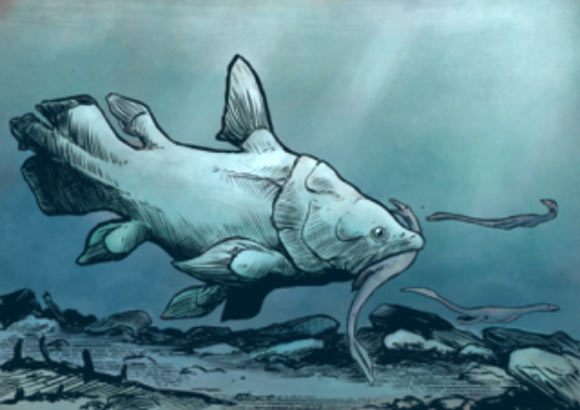
The reconstruction of an artist of a great coelacanth Mawsoniid from the British Rhaetian. Image credit: Daniel Phillips.
The coelacanths are evolutionary unique lobe fish which appeared for the first time in the record of fossils in the time of the beginning of the Devonian, about 419 million years ago.
More than 175 species of fossil coelacanth are known to the eras of the paleozoic and the mesozoic.
During the mesozoic, they diversified considerably, certain species developing unusual body forms.
However, at the end of the Cretaceous period, about 66 million years ago, they mysteriously disappeared from the fossil record.
It was alleged that the Coelacanthes had been swept away as a victim of the final mass extinction event. But in 1938, the first specimen of living species Latimeria chalumnae was taken fortuitously in South Africa.
“Our team has realized that many fossils previously assigned to the small sea reptile Pachystrophy Coelacanth came in fact, “said Professor of the University of Bristol, Mike Benton, principal author of the study.
“A lot of Pachystrophy And Coelacanth fossils have strange similarities, but above all, we then left to look at collections across the country, and we found the same mistake on several occasions. »»
“It is remarkable that some of these specimens have been seated in museum storage facilities, and even in public exhibitions, since the 1800s, and have apparently been ignored or identified as lizards, mammals and everything that is intermediate,” said the University of Bristol Paleontologist Jacob Quinn, principal author of The Study.
“Only four previous reports from Coelacanths from the British Triassic, we now have more than fifty.”
Paleontologists have made X -ray scans many specimens to confirm the identifications.
The specimens mainly belong to an extinct group of Coelacanthes, the Mawsoniidae, but closely linked to living fish.
“Although the material that we identify occurs as isolated specimens, we can see that they come from individuals of ages, sizes and variable species, some up to a meter long, and suggesting a complex community at the time,” said Universidad de la REPUública de Uruguay Paleontologist Pablo Toriño, co-author of the study.
“The Coelacanth fossils all come from the region of Bristol and Mendip Hills, which in the Triassic was a small islands archipelago in a shallow tropical sea,” said the co-author of Dr David Whiteside, paleontologist at the University of Bristol.
“Like the modern coelacanthes, these big fish were probably opportunistic predators, hiding in the seabed and eating everything they encountered, including these little ones Pachystrophy The marine reptiles, which are ironic since their fossils have been confused with those of the coelacanths for decades. »»
The study appears in the Journal of Vertebrate Paleontology.
_____
Jacob Quinn and al. 2025. Coelacanthiforms from the British Rhaetian. Journal of Vertebrate Paleontology 45: E2520921; DOI: 10.1080/02724634.2025.2520921


