Supreme Court will weigh in on Trump’s tariffs. Here’s what to know about the case : NPR

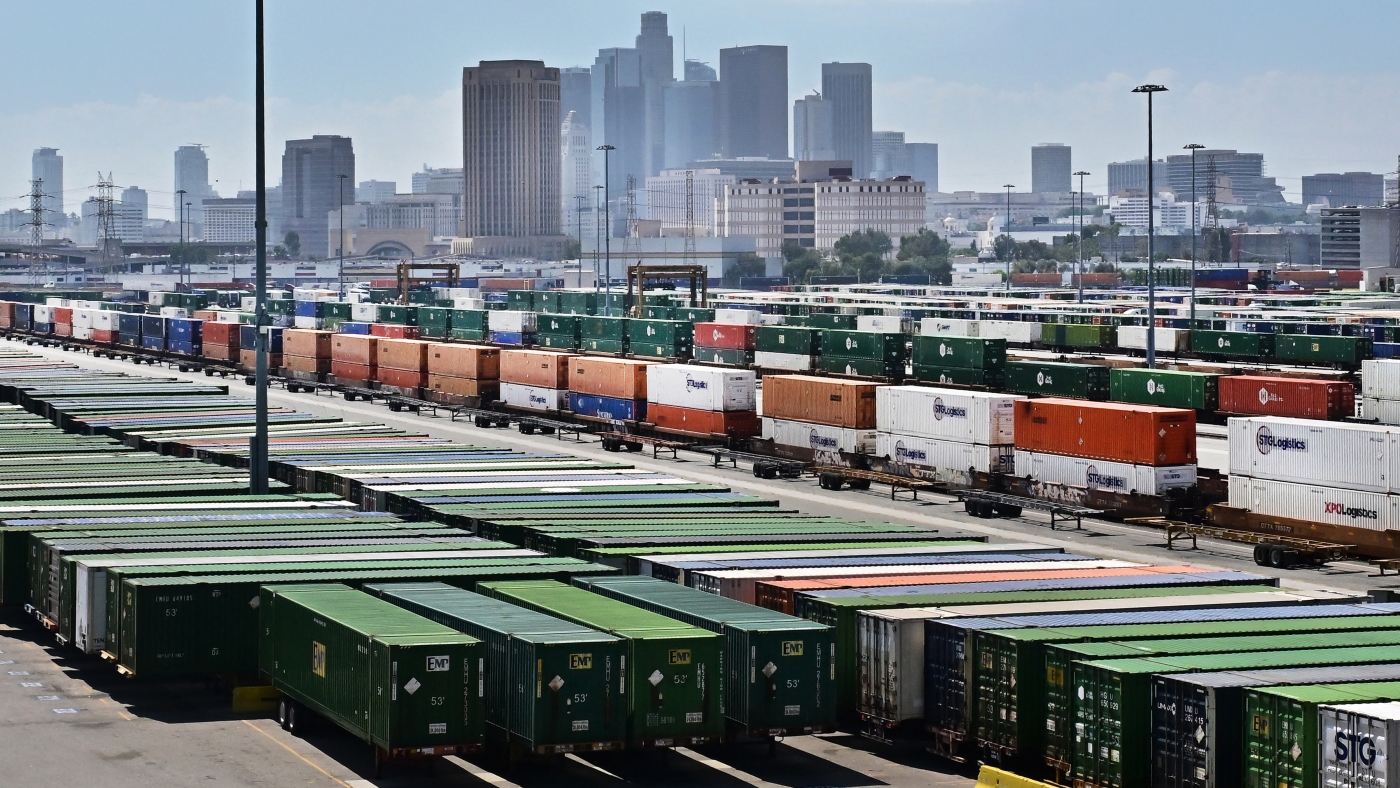

Shipping container in a Los Angeles railway site on September 2, 2025, the day the President Trump said he would ask for a quick decision from the Supreme Court on his prices.
Frederic J. Brown / AFP
hide
tilting legend
Frederic J. Brown / AFP
The Supreme Court said on Tuesday that it would examine if President Trump acted legally when he used emergency powers to apply radical rates to a wide range of countries, a centerpiece of his economic program.

Earlier this year, a federal commercial court and a federal court of appeal concluded that some of Trump’s prices had violated the law. The White House appealed to the Supreme Court, and now the High Court has agreed to examine the appeal.
The court said that it would make arguments in the first week of November.
What rates are in question?
This case concerns the prices imposed using emergency powers under a law called the international law on economic powers, or IEPA. This law gives the president a range of economic powers, including imports and exports, “to face any unusual and extraordinary threat, which has its source in whole or substantial outside the United States, national security, foreign policy or the economy of the United States, if the president declares a national emergency with regard to this threat.”

Trump used the powers of the IEEPA for prices on individual countries announced for the first time in April in a Rose Garden event where he organized large tables detailing the rates of tariff he would impose on goods from different countries. Since then, Trump has also announced these prices via letters published on social networks. Many prices entered into force last month.
This case also concerns prices on Canada, China and Mexico related to the stopping of fentanyl traffic that Trump announced earlier this year.
But the case does not affect Trump’s sectoral prices on products such as steel and aluminum. These prices are often called “prices of article 232” after the article of the 1962 law on commercial extension authorizes them.

President Trump has a table of prices offered in the Garden Rose at the White House on April 2, 2025.
SOMODEVILLA CHIP / GETTY Images North America
hide
tilting legend
SOMODEVILLA CHIP / GETTY Images North America
What will the court envisage?
Two separate prosecution against the prices were brought by a group of small businesses and a group of prosecutors general. In May, the Federal International Trade Court judged that the IEEPA had not authorized the prices

In August, the Court of Appeal of the Federal Circuit agreed, noting in its opinion that “the basic power of the Congress to impose taxes such as the prices is acquired exclusively in the legislative power by the Constitution”. The court added that the ieepa does not explicitly give the president the power to impose prices, and that it “seems unlikely” that the congress intends to give the president “unlimited authority” to do so.
The White House appealed, asking the Supreme Court to answer if the IEEPA actually authorizes the prices that Trump has imposed – and if this is the case, if this law “delegates the legislative authority to the president unconstitutionally”.
What could the court decide?
The court could see that the ieepa authorizes these prices – in which case, they could remain in place, and Trump could continue to use the ieepa to impose more prices.
Or, the court could see that the prices are entirely illegal and end them.
But there are a range of other possibilities. This could rule on the fact that some of Trump’s prices are legal and some are illegal. Or it could determine more specifically what types of prices – if applicable – are authorized under the ieepa.
“The Supreme Court could say that these types of specific prices are not authorized, but other IEPA prices are authorized,” said Kathleen Claussen, professor of law at the University of Georgetown. “So there is a question of scope here.”
What happens if the court notes that the prices are illegal?
Experts say Trump could find other ways to use prices. “He would not be able to reproduce the vast general nature of the prices he has imposed,” said Doug Irwin, professor of economics at Dartmouth College. “But it would be able to hit many different countries and hit many industries with prices using different parts of the tariff code.”
For example, the prices of article 232 on special goods would remain in place, and there are other laws that Trump could use. However, all these laws would not allow Trump to impose prices as quickly or as largely as in the ieepa. Some limit the way the prices can be high, or how long they can be imposed.
What would happen to the price income already collected?
The Trump administration has collected billions of dollars in IEPA prices, which raises the question of whether this money should be returned if the prices were deemed illegal.

If the court addresses the issue of reimbursements, it is not clear to what extent its appeal could be narrow or wide, according to Claussen. For example, they could only make reimbursements only for the handful of companies involved in this case.
In this case, it is possible that other companies should go through their own legal processes to obtain reimbursements, which could be logistically difficult, taking into account the volume of money and the companies involved.
The secretary of the Treasury, Scott Bessent, said that the government would reimburse money prices


