Webb Detects Methane Gas on Dwarf Planet Makemake


Using the NASA / ESA / CSA James Webb space telescope, astronomers have found proof of gas methane on the remote dwarf planet. Reported in an article in the Astrophysical newspaper lettersThis discovery questions Makemake’s traditional vision as a frozen body at rest and only does it the second trans-Neptunian object, after Pluto, where the presence of gas has been confirmed.
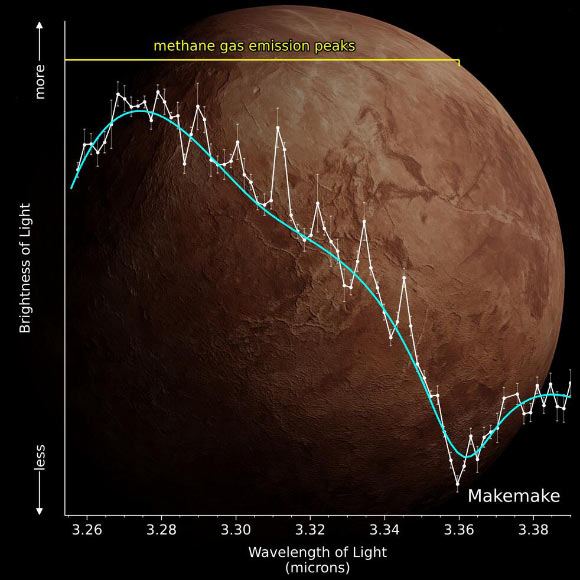
Protopapa and al. Webb observations used (white) to detect methane gas on Makemake; Net emission peaks nearly 3.3 microns reveal methane in the sparkling phase above the surface of Makemake; A continuum model (Cyan) is bunk for comparison; The gas emission peaks are identified when the observed spectrum rises above the continuum. Image credit: S. Protopapa / I. Wong / Swri / STSCI / NASA / ESA / CSA / Webb.
Makemake, also known as 2005 FY9 and (136472), was discovered in 2005 by a team of astronomers from California Institute of Technology led by Mike Brown.
This dwarf planet is located in a region beyond Neptune which is populated by small solar system bodies.
It has a radius of about 715 km (444 miles) – just a little smaller and more gradator than Pluto.
It takes about 305 years of earth for this dwarf planet to make a trip around the sun.
Previously observed stellar occultations suggest that Makemake did not have a substantial global atmosphere, although a slim cannot be excluded.
Meanwhile, infrared data from the dwarf planet alluded to confusing thermal anomalies and unusual characteristics of its methane ice cream, which raised the possibility of hot spots located through its surface and potential exceeding.
“Makemake is one of the largest and most brilliant glacial worlds beyond Neptune, and its surface is dominated by frozen methane,” said Dr. Silvia Protopapa, astronomer of the Southwest Research Institute.
“Webb revealed that methane is also present in the sparkling phase above the surface, a discovery that makes Makemake even more fascinating.”
“This shows that Makemake is not an inactive remaining of the external solar system, but a dynamic body where methane ice is still evolving.”
The spectral emission with observed methane is interpreted as a fluorescence excited by solar, which is the re -engagement of sunlight absorbed by methane molecules.
According to the team, this could indicate either a tenuous atmosphere in balance with ICE surface – similar to Pluto – or to a more transient activity, such as cometary type sublimation or cryovolcanic plumes.
The two scenarios are physically plausible and consistent with current data, given the noise level and the limited spectral resolution of the measurements.
“Although the temptation to link the various spectral and thermal anomalies of Makemake is strong, the establishment of the mechanism stimulating volatile activity remains a necessary step towards the interpretation of these observations in a unified setting,” said Dr. Ian Wong, an astronomer from the Space Telescope Science Institute.
“Future webb observations to a higher spectral resolution will help determine whether methane comes from a thin -linked atmosphere or a pastor similar to a plume.”
“This discovery raises the possibility that Makemake has a very tenuous atmosphere supported by the sublimation of methane,” said Dr. Emmanuel Lellouch, astronomer of the Paris Observatory.
“Our best models indicate a gas temperature of around 40 k (less 233 degrees Celsius) and a surface pressure of about 10 picobars-that is to say 100 billion times below the atmospheric pressure of the earth, and a million times more tenuous than that of Pluto.”
“If this scenario is confirmed, Makemake would join the small handle of the bodies of the external solar system where the exchanges of surface atmosphere are still active today.”
“Another possibility is that methane is released in panache explosions,” said Dr. Protopapa.
“In this scenario, our models suggest that methane could be released at a rhythm of a few hundred kilograms per second, comparable to vigorous water plumes on the moon of Saturn and much superior to the light vapor observed at Ceres.”
_____
Silvia Protopapa and al. 2025. JWST detection of hydrocarbons and methane gas on Makemake. Apjlin press; Arxiv: 2509,06772


