Civilians in Ukraine’s eastern strongholds struggle as Russia advances

Donetsk Region, Ukraine (AP) – Russian advance deeper in the Donetsk region, the air in the last bastions of Ukraine is thick of terror and the future for civilians who remain increasingly uncertain.
In Kostiiantynivka, which houses 67,000 people, there is no regular supply of energy, water or gas. The bombardment intensifies, the drones fill the sky and the city has become unbearable, causing the last remaining civilians.
Kramatorsk, on the other hand, still shows signs of life. Only 25 kilometers (15 miles) in the north, the pre-war population of 147,000 has decreased, but restaurants and cafes remain open. The streets are mainly intact. Although the city has undergone several strikes and is now dominated by the army, daily routines persist in a way that is no longer possible in neighboring cities.
Once the industrial heart of Ukraine, Donetsk is regularly reduced in rubble. Many residents fear that its cities will never be rebuilt and, if the war hangs out, Russia will eventually swallow what remains.
“The region (Donetsk) has been trampled on, torn, transformed into dust,” said Natalia Ivanova, a 70 -year -old woman who fled Kostiantynivka in early September after a missile struck near her house. Russian President Vladimir Putin “will go to the end … I’m sure. I have no doubts that more cities will be destroyed. ”
Despair and destruction
Kostiantynivka is now on a narrowing plot of the territory held by the Ukrainian, stuck just west of Bakhmut occupied by Russia and almost surrounded on three sides by the forces of Moscow.
“They still drew,” said Ivanova. “You would be there … and all you would hear was the whistle of the shells.”
She had two apartments. One was destroyed and the other damaged. For months, she watched the buildings disappear in an instant, while swarms of buzzing drones “like beetles” filled the sky, she said.
“I never thought I would leave,” she added. “I was a solid soldier, who holds the upper hand. I am a retiree and it is (the house) was my comfort zone. ”
For years, Ivanova had seen the cities of the region fall: Bakhmut, then Avdiivka and others. But war, she said, still felt far away, even if she closed to her door.
“I felt for these people,” she said. “But it was not enough to make me leave.”
An explosion near his building finally forced her to get out. The explosion leaning her windows so much that she could not close them before fleeing. His apartment remained wide open. She has left Kostiiantynivka all her life, the city where she was born.
“Please stop,” she pleaded, leading her call to world leaders when she was sitting in an evacuation center shortly after her escape. “It is the poorest people who suffer the most. This war is insane and stupid. We die like animals – to dozens. ”
Live together
Olena Voronkova decided to leave Kostiantynivka earlier, in May, when she could no longer lead her two companies: a beauty salon and a coffee.
She and her family moved to Kramatorsk nearby, which is so close, in many ways, far, because she is no longer able to enter her hometown. It was not the first loss that she had suffered since the start of the war. In 2023, a rocket strike from a multiple launch system seriously damaged their house.
The move to Kramatorsk was not by choice, she added, but “because the circumstances left us no other option.”
Compulsory evacuation orders came. Then, a curfew so strict that they could only move in the city four hours a day. Then came the remote -controlled drone floods.
“We are used to life in the Donetsk region. We feel good here. Kramatorsk is familiar. Many people in our city have moved here – even local municipal workers, “said Voronkova.
Shortly after her arrival in Kramatorsk, she opened a coffee almost identical to the one she left. She said the space had just looked like. He has high white walls and ornate mirrors she has brought from her beauty salon, which is now in the combat zone.
Coffee has since become a refuge for others who have also fled Kostiiantynivka.
“At the beginning, there was hope that perhaps houses would survive-that people could return,” she said. “Now we see that it is unlikely that anyone who has everything that remains. The city is transformed into another Bakhmut, Totretsk or Avdiivka. Everything is destroyed. “
She described mood as “heavy” because “people lose hope” and it seemed easier in Kramatorsk because everyone shared the same loss, which created a feeling of connection and mutual support.
“No one really knows where to go afterwards. Everyone sees that Russia does not stop. And that’s where despair is starting. No one has any direction. Uncertainty is everywhere,” she said.
Seize the day
The war slowly exhausts the life of Kramatorsk, as if it is the next city to be reduced in rubble.
Daria Horlova always remembers it as a lively place where, at 9 p.m., life in the central square was just beginning. Now it is deserted at every hour and 9 p.m., it is when a strict curfew begins. The city is regularly bombed thanks to its proximity to the front line about 21 kilometers (13 miles) to the east.
“It’s always terrifying – when something flies over his head or strikes nearby, especially when he knocks the city,” said the 18 -year -old. “You want to cry, but there are no more emotions. There is no strength.”
Horlova studies remotely in a local university that has moved to another region and works as a nail artist. One day, she hopes to open her own living room. For the moment, she and her boyfriend are stuck in the limbo, not knowing what to do then.
“It is terrifying that most of the Donetsk region is occupied-and that Russia has attacked,” she said. “This is why he has the impression that everything could change at any time. Look at Kostiiantynivka – not long ago, life was normal. And now …”
To distract herself from the anxiety and the difficult decision that she may soon have to take to leave, Horlova tries to focus on what brings her joy in the moment.
She has already been evacuated from Kramatorsk once, earlier in war, and does not want to repeat it.
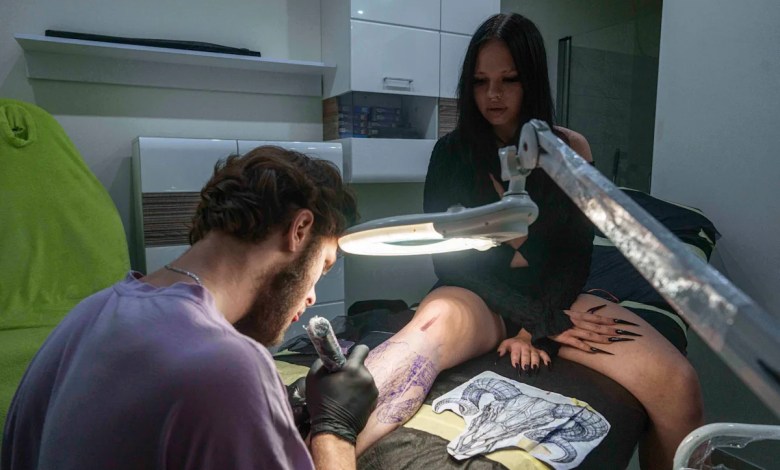
Instead of dwelling on what the future could hold, she asked her boyfriend, a tattoo artist, ink a large tattoo of a goat skull on her right leg, which she had dreamed for years.
“I think you just have to do things-and do them as soon as you can,” she said. “Being here, I know that this tattoo will be a memory of Kramatorsk, if I end up leaving.”
___
Vasilisa Stepanenko and Yehor Konovalov contributed to this report.


