Trump faces major headache with incidents in Qatar and Poland


Paul AdamsDiplomatic correspondent
In the two large foreign policy arenas, a large part of the Trump administration and efforts are two major challenges in less than 24 hours.
Israel’s air raid on Hamas’ offices in Doha and a Russian drone incursion deeply in Polish airspace represents two massive headache for the White House.
And, no doubt, two main agrees to the authority of the president.
After all, they are conflicts – Ukraine and Gaza – US President Donald Trump said he would take care of and decisively.
In each case, a leader whom he considers as a natural ally, although problematic – Russian president Vladimir Putin and Israeli Prime Minister Benjamin Netanyahu – threw a huge key into the peace wheels in the White House.
Consider timing. The Doha Raid occurred just two days after the Trump administration delivered its last proposals to end the war in Gaza.
On social networks, Trump told Hamas that it was a last chance.
“I warned Hamas of the consequences of not accepting,” he wrote on Truth Social on Sunday. “This is my last warning, there won’t be another!”
In Doha, the senior management of Hamas met to consider their answer, but Israel did not wait to hear it. The attack has not only exploded the latest American proposals, it may have destroyed all the delicate architecture of Gaza diplomacy, on which the Trump administration had strongly.
The debate swirls on how and when the United States discovered the Israeli raid and if that could have done more to stop it. The presence in Qatar of one of the most important American air bases in the world has led a lot to conclude that it is inconceivable that Washington has not seen the Israeli jets approaching.
But if there was no Washington green light – and many assume that there were – what is said about Mr. Trump’s ability to influence Benjamin Netanyahu’s actions?
Over the past two years, following the humiliation suffered in the hands of armed men in Hamas on October 7, 2023, Israel has faltered its military muscles through the Middle East, mainly with the tacit or explicit approval of the United States.
Israel has established itself as the hegemon not dissuasive by the region, capable of attacking countries at will as distant as Yemen and Iran.
But in these two cases, the United States was also involved and shared the objectives – interrupting the Houthi attacks against Israel and shipping in the Red Sea and thwarting the nuclear ambitions of Iran.
An attack on Qatar, a key American regional ally, is another thing.
Donald Trump said he felt “very badly” about it. According to the account of the events of the White House, the news of the Israeli raid arrived too late to offer the Qatar a significant warning.
“The unilaterally bombing in Qatar, a sovereign nation and an ally close to the United States which works very hard and courageously take risks with us to negotiate peace does not advance the objectives of Israel or America,” said the press secretary of the White House, Karoline Leavitt, to journalists.
It will not be enough to repress the suspicions of American complicity, but it looked like real anger.
For his part, Mr. Netanyahu wanted to emphasize that it was a “totally independent” action.
In the Washington Post, David Ignatius wrote that what the Israelis have nicknamed “Operation Summit of Fire” came in spite of us and Israeli insurance that Hamas leaders would not be targeted in Qatar.
For such insurance, if they have been given, having been so blatant aside will inevitably be considered in the Gulf as a sign of American weakness.

 EPA
EPAThen there is Poland.
Less than a month ago, Trump welcomed Putin at an Alaska summit, deploying the red carpet, warmly embracing the war architect in Ukraine and, in a hot moment a few days later, telling the Emmanuel Macron in France that Putin “wants to agree for me … like that.”
But far from progress towards an agreement, the weeks that followed made an escalation. Russian drone and missile attacks more record against Ukraine, and now, for the first time, a blatant foray into NATO airspace.
This is not the first time that the Russian projectiles have landed in Poland, but the previous episodes were close to the border and apparently accidental.
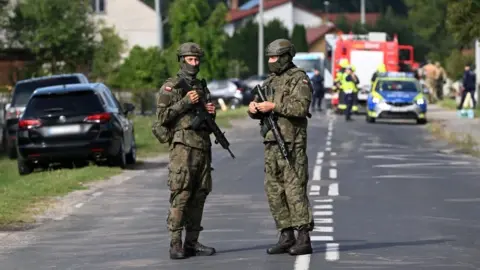
But the incursions early Wednesday morning were anything but accidental. Polish officials reported 19 Russian drones, some flying steering wheel in Poland.
Prime Minister Donald Tusk told Parliament that it was “the closest that we were to open the conflicts since the Second World War”.
Despite the Russian refusals, there is an almost universal consensus that it was a deliberate effort from Moscow to test the determination of NATO.
And since the United States remains the most powerful member of the Alliance, this also means testing Donald Trump’s determination.
The president’s apparent reluctance to respond – unlike his comments on Doha’s attack – has not gone unnoticed.
“An astonishing silence of the White House welcomed an NATO ally for the first time engaged and shot down the Russian military assets,” wrote the newspaper Kyiv Post.
 EPA
EPAAn article on Truth Social finally – and inevitably – came.
“What is Russia violating Poland’s airspace with drones?” The president wrote, adding, somewhat ambiguously, “let’s go!”
But his initial silence, associated with his apparent reluctance to continue his own threats to impose new sanctions on Russia, leave the Western allies of Ukraine where they have always been: wonder where the heart of Donald Trump is located.
This could be about to change, European officials working with their American counterparts on a coordinated set of sanctions, the first since Trump returned to the White House.
But given the president’s previous ambivalence about NATO, members of the Alliance want to reassure that when the sovereignty of an ally is threatened, Washington can be invoked to respond.
A recent agreement to allow NATO members to buy US military equipment for Ukraine, as well as members’ commitment to spend more for their own defense, has done a lot to improve relations within the Alliance, and Trump abandoned the kind of hostile rhetoric towards NATO which characterized its first mandate.
For their part, European NATO members have generally recognized that they had to do more to deal with their own security. Poland’s airspace is a good example.
But the American, military and political power, is still the foundation on which the alliance is built, and the questions persist on the will of this president to handle it.
Two days, two conflicts and two puzzles. For Trump, a leader who does not like or expects to be disputed, it was tested the experience. Everyone is waiting to see if he goes up on occasion.


