A Baby Macaque Has Gone Viral with His Plushie — What Punch Tells Us About Social Hierarchies


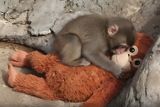
Meet Punch, one of the most unlikely heroes of 2026. The baby Japanese macaque won hearts (and the internet) after being rejected by his fellow monkeys and bonded to a stuffed orangutan.
The young monkey resides at the Zoological and Botanical Gardens in Ichikawa City, near Tokyo, Japan, and was born in July 2025. According to an update from the zoo, published on X (formerly Twitter), Punch was hand-reared by zoo staff after being abandoned.
Although he has lived with the troop since his reintroduction to the compound on January 19, 2026, his journey has been eventful, to say the least. Fans around the world have watched Punch’s various attempts to fit in with the group, with online clips documenting the ups and downs.
The story of Punch, the baby Japanese macaque
According to the Japanese newspaper, The Mainichi, Punch was born to a first-time mom, who may have abandoned her baby due to exhaustion. No macaques in the enclosure adopted Punch as one of their own, so the team took matters into their own hands, hand-rearing the baby macaque.
That’s when he discovers his favorite stuffed toy. Young monkeys often cling to their mothers, but without a mother for Punch to cling to, zoo staff had to find alternatives. There was an obvious winner: a stuffed orangutan, larger than Punch himself, who not only provided him comfort during those early months but, more recently, as he tried to fit in with the rest of the troop.
“It’s likely that Punch, on a physiological level, feels a need for social support and comfort, and he gets some of that from his toy,” said Patrick Tkaczynski, a lecturer at Liverpool John Moores University and a council member of the Primate Society of Great Britain. Discover.
Learn more: Non-invasive sound therapy helps target Alzheimer’s plaques in monkeys — Could it one day help humans?
Reintegration into the group
Integrating into the group was not easy. Although there were clips of older macaques grooming Punch – an activity associated with social bonding, according to a study published in the American Journal of Primatology – a video that went viral showed an aggressive encounter.
According to a statement released by the zoo, the incident occurred after Punch approached a baby, and the growling monkey was likely the baby’s mother. Punch responds by running to his orangutan for comfort, but he was back to his old self by lunchtime.
Social hierarchies and attachment
Japanese macaques live in large groups that can contain more than 160 individuals, according to the Lincoln Park Zoo. They also exhibit strict dominance hierarchies, Tkaczynski told Discover“meaning that dominant individuals at the top of society can attack others at will and with little means for lower-ranking individuals to fight back. »
It is therefore essential to understand the social dynamics of the group, as well as which monkeys to avoid and which to befriend.
“For young Japanese macaques who don’t have at least their mother’s support early in life, this makes the learning curve even steeper and formidable,” Tkaczynski told Discover. “That said, orphaned Japanese macaques have been observed in the wild and in captivity, and some manage to fully integrate socially even without their mothers.”
Punch’s story and his bond with his stuffed animal highlight the importance of attachment. Primates are vulnerable when they are young: “We need to quickly attach to caregivers to survive,” Tkaczynski told Discover.
This was highlighted by an (ethically controversial) study published in the 1950s by psychologist Harry Harlow, which found that baby macaques formed attachments with cloth surrogate mothers (much like Punch’s toy) even when those mothers were unable to provide for the child.
As for Punch, updates from the zoo reveal that he’s “playing with the other baby monkeys” and “gradually integrating into the group.”
Learn more: Primates’ climbing techniques may have helped shape their evolutionary success
Article sources
Our Discovermagazine.com editors use peer-reviewed research and high-quality sources for our articles, and our editors review the articles for scientific accuracy and editorial standards. See the sources used below for this article: