A century ago, the Palm Beach Hotel hosted a film star, and was a star

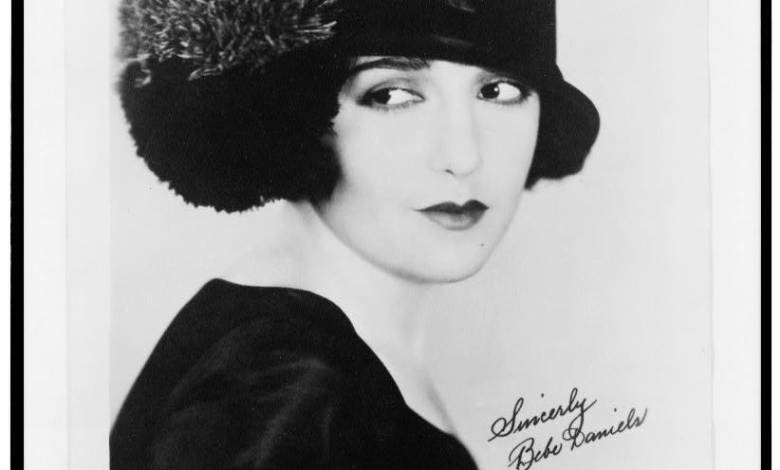
A century ago this month, Palm Beach was abuzz during the last gasp of the silent movie era: One of Hollywood’s biggest starlets of the era — she’d starred opposite box office stars like Rudolph Valentino — was camping out at a local hotel.
With a film crew as the crew filmed scenes for a movie called “The Palm Beach Girl,” the ravishing Bebe Daniels – a movie star since childhood – not only assaulted the cameras; she became a sought-after social guest on the island during her stay.

Silent film star Bebe Daniels was a popular guest on the island in the 1920s.
Although the annual winter social season waned in March, Daniels coyly told her Palm Beach admirers “there’s still a lot of fashionable people here and all the cool places are still open. But I think I’ll be here for a while…Soon things will calm down. So what am I going to do?”
Strict rules apply in Palm Beach today regarding commercial filming, but in Bebe’s era, city leaders and wealthy winter residents were fascinated by the new technology and saw its value in promoting the then relatively undeveloped island. And as the Palm Beach company well knew, filming on the island was fun.
After all, in 1916, the winter dwellers starred in a fictional silent film called “Happiness Island.” More than 25 members of Palm Beach society made up the cast in a plot twist and turns, including a socialite knocked unconscious, kidnapped and taken to a beached wreck.
Like the wayward Hollywood stars before and after them, the company’s leaders collectively clamored for their participation.
“New York filmmakers have been trying for two weeks to circumvent this crowd (of the Palm Beach company) for commercial purposes… (but) the company would not be filmed for a blind audience,” reported the New York Times in 1916. “Eventually the offer was accepted to show [Isle of Happiness] only in Palm Beach at $3 per ticket, half of which will go to [France’s] American Ambulance Corps.
A sequel was filmed the following year.

Baby Daniels
By the time Bebe Daniels arrived in early March 1926, two theaters on the island had become entertainment mainstays.
The Paramount was not yet open on North County Road, but another hot spot for movies was in a now-defunct lakeside mall opened in 1916 (near today’s Biltmore Condominium).
Also popular: a theater opened in 1921 in a building now housing a bookstore and other businesses on the east end of Royal Poinciana Way, then known as Main Street.
When Bebe Daniel was in town in 1926, the theater on Main Street, called the Garden Theater, was showing “Rainbow Riley” starring silent film actor Johnny Hines.
Daniels and her “The Palm Beach Girl” film crew filmed scenes in various locations, including those associated with late Standard Oil partner and famed Palm Beach developer Henry Flagler.

A poster for the 1926 silent film “The Palm Beach Girl.”
Among them: Flagler’s lakefront mansion in Palm Beach, completed in 1902, which in 1925 became a hotel (in 1960 it would find new life as a museum).
Another scene was filmed in a dancing tea room next door in a coconut grove of Flagler’s lakeside Royal Poinciana Hotel, built in 1894 and now defunct, once located where the Palm Beach Towers are today.
No known copies of “The Palm Beach Girl” are believed to exist today.
In this film, Daniels plays a young woman from a small town who travels by steam train to Florida to visit her aunts in Palm Beach. When soot from the train falls on her face, she is forced into a racially segregated passenger car. Once in Palm Beach, she witnesses smugglers; wins a boat race; and falls in love, among other things.

The original Palm Beach Hotel, opened in 1902, sits on the lake.
Daniels and the cast of “The Palm Beach Girl” were staying at a hotel that had opened weeks before: the New Palm Beach Hotel on Sunrise Avenue, which a decade before had been nothing more than a dirt road flanked by cabins.
The hotel was a sensation in itself because it revived an old hotel – at least in name – that was a beloved lakefront property opened in 1902 and opened by revered pioneer Sydney Maddock.
After that hotel succumbed to a devastating fire in 1925, the new version located just to the west, at 235 Sunrise Ave., debuted on January 9.
Anyone walking past the new four-story hotel that evening would be forced to look skyward. Emanating from its roof – accented by twin domed towers – was the sound of revelry: music and laughter from a rooftop gala, where the Strauss Orchestra played Jazz Age classics while straight-haired men danced with women wearing waist-length strands of pearls.

The New Palm Beach Hotel in the 1930s.
“They must have felt like they were dancing on top of the world,” wrote the late Judge James R. Knott, former director of the Palm Beach County Historical Society.
The developer of the New Plam Beach Hotel, Thomas A. Clarke, was also a New York developer-builder. He had invested in properties elsewhere in and near Palm Beach; after all, there was a land boom here.
Clarke tapped prominent New York architect Mortimer D. Metcalfe for the new 320-room Spanish-style hotel on Sunrise Avenue. When completed, the upper floors of the “new” Palm Beach Hotel offered views of Lake Worth to the west and the ocean to the east. Many varieties of plants and trees filled the hotel gardens.
Contemporary news reports put the cost of building the hotel at around $2 million; a block to the west, another hotel opened in 1926, the 12-story Alba, was estimated to cost $5 million to $7 million to build. This former luxury hotel is now the Biltmore Condominium.
The annual Christmas festivities welcomed winter season guests to the New Palm Beach Hotel, which housed a popular restaurant. New Year’s Eve galas followed.
“Last night a brilliant gathering of Palm Beaches filled the roof of the New Palm Beach Hotel dancing the old year with high-spirited merriment,” reported a local newspaper on New Year’s Day in 1931. “…A hundred yellow, red, blue and green balloons floated above the revelers, enhancing the festive appearance of the scene. Tap dancers, blowers and stylish paper hats added to the hilarity… The parties that started earlier in the evening ended on the roof and the hotel orchestra played hour after hour as the dancers moved on the dance floors and in the garden under the stars.
The hotel also became known for hosting a fad of the 1920s and 30s: golf on the clock.
Tournaments involved a putting hole surrounded by a large circle from which players took turns putting a golf ball from 12 locations arranged similarly to the numbers on a clock face.
After Clarke’s death in 1935, the property passed through several hands and by the 1950s it had become a retirement home.

Palm Beach Hotel on Sunrise Avenue in the early 1960s.
Later, financial and other slip-ups surfaced in what appeared to be a brighter horizon when a new owner in 1981 sought to resurrect the property.
The failure of a financial bid to sell it to Radisson Hotels led owner John Tracy to implement new plans that led to notable renovations and the hotel’s reclassification as a condominium hotel.
This meant that rooms and suites could be purchased individually, then renovated and lived in – or rented through a rental pool managed by building management.
Transition problems occurred along the way, but in 1990 the Palm Beach Hotel Condominium Association reported that all units were sold or reserved for the winter; the first floor shopping arcade spaces associated with the building have been sold or leased.
Today, Palm Beach Hotel Condominium amenities include a pool, concierge, gym (currently closed for renovations, management said), recreation room, bike storage, laundry, library and more.
In 2000, the hotel’s fourth floor became part home to the New Synagogue established by Daniel Agraham, a World War II veteran and billionaire creator of the Slim Fast brand, who died in 2025.
Renovated several times in recent years, the Palm Beach Hotel Condominium was designated a city landmark in 2008 and added to the National Register of Historic Places in 2010.
This article was originally published on Palm Beach Daily News: A century ago, the Palm Beach Hotel hosted a movie star and was a star.


