A ‘cosmic clock’ in tiny crystals has revealed the rise and fall of Australia’s ancient landscapes

When you purchase through links on our articles, Future and its syndication partners may earn a commission.

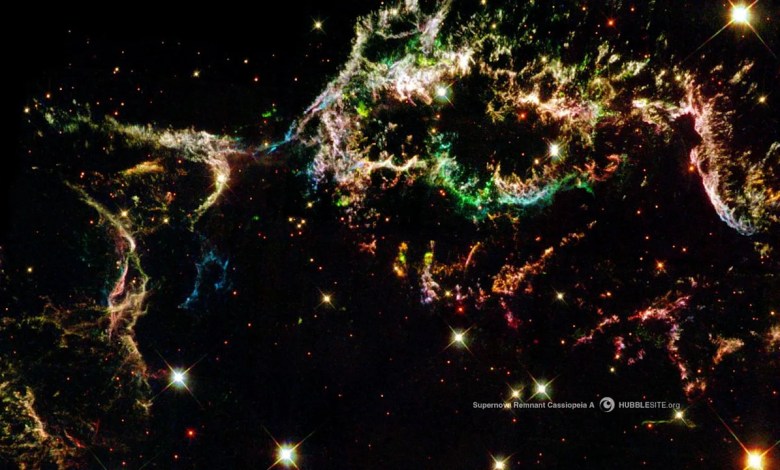
This stunning space wallpaper shows our galaxy’s youngest known supernova remnant, located 10,000 light years away in the constellation Cassiopeia. Light from this explosive star first reached Earth in the 1600s. Credit: NASA and The Hubble Heritage Team (STScI/AURA) / Acknowledgments: R. Fesen (Dartmouth) and J. Morse (Univ. of Colorado)
This article was originally published on The conversation. The publication contributed the article to Space.com Expert voices: opinion pieces and perspectives.
Australia’s iconic red landscapes are home to Aboriginal culture and have been recorded in songs for tens of thousands of years. But other clues to the antiquity of this landscape come from well beyond. Earth: cosmic rays which leave telltale fingerprints inside minerals on the Earth’s surface.
In our new studypublished in the Proceedings of the National Academy of Sciences, we show how this “cosmic clock” discovers the evolution of rivers, coasts and habitats.
This also shows how mineral deposits shape. Products from these deposits are found in everyday ceramic objects – but carry a hidden landscape history.
Looking through deep time
The Earth’s surface is constantly changing due to the opposing forces of erosion and uprising compete for sculpt the landscape that surrounds us – an example is the elevation of mountains, then their wear and tear by bad weather.
To understand current environments and predict their response to future changes, we need to know how landscapes behaved through time, millions or even billions of years ago.
Until now, directly measuring the evolution of ancient landscapes represented a major challenge. A new technique finally gives us a window into the distant past of the Earth’s surface.
By drilling directly underground, we have recovered samples which reveal ancient beaches bordering the Nullarbor Plain in southern Australia.
Now located more than 100 kilometers from the ocean, these buried shores bear witness to extraordinary transformations of the landscape. It was once a seabed, later a forest with giant tree kangaroos and marsupial lions, and today it is one of the flattest and the driest places on earth.
These ancient beaches contain unusually high amounts of zircon, a mineral favored by geologists because it is a sturdy time capsule. Inside these tiny crystals, the width of a human hair, lies a cosmic secret.

What secrets does the Australian landscape hold? | Credit: Tim Johnson/Curtin University
In search of cosmogenic krypton
Earth is constantly bombarded by cosmic rays – high-energy particles from space produced when stars explode. Unlike the biggest meteorites that hit our planetcosmic rays are smaller than atoms. But when they strike mineral atoms near the Earth’s surface, the microscopic “explosions” produce new elements, called cosmogenic nuclides.
Measuring these nuclides is a popular way to determine how quickly landscapes are changing. But many nuclides have a very short lifespan, making them unsuitable for understanding ancient landscapes.
For our measurements, we used cosmogenic krypton stored inside natural zircon crystals. This technique has only recently become possible thanks to technological advances. This works because krypton does not decay but preserves information for tens or even hundreds of millions of years.
To unlock this “cosmic clock”, we used a laser to vaporize several thousand zircon crystals and measured the krypton released. The more krypton a grain contains, the longer it must have been exposed at the surface before being buried in younger layers of sediment.

Simplified sketch showing how cosmogenic krypton is produced and trapped inside a zircon crystal. | Credit: Maximilian Dröllner via the Conversation
Remarkably stable ground
The results show that around 40 million years ago, when Australia was hot, humid and covered in lush foreststhe landscapes of southern Australia were eroding extremely slowly – less than a meter per million years.
This is much slower than in mountainous regions like the Andes in South America or the Southern Alps in New Zealand. However, this rate of erosion is similar to that of some of the most stable regions on Earth today, such as the Atacama Desert or the Dry Valleys of Antarctica.
We calculated that it took zircon-rich beach sands about 1.6 million years to move from where they were eroded to their final burial site on the coast. During this very slow transport of sediment, many less durable minerals were gradually degraded or dissolved by weathering. What remains are the most resistant minerals, such as zircon, which gradually concentrate.
Over time, this natural filtering process produced beach sand deposits very rich in zircon and other stable minerals of economic value.
The results also reflect a turning point in the changing landscape of the region. After a period of relative stability, climate change, Earth movements and sea levels triggered more rapid erosion. The sediment also began to move faster.
A new crystal clock
This “cosmic clock” helps explain the mineral wealth located around the Nullarbor Plain, including the the largest zircon mine in the world: Jacinth-Ambrosia. This mine produces about a quarter of the world’s zircon supply.
Much zircon is used in making ceramics, so chances are many of us have already come into contact with these minerals that have remained on the Earth’s surface far longer than our own species has existed.
By reading cosmic ray fingerprints in zircon, we now have a new geological clock to measure ancient processes on the surface of our planet.
The study of modern landscapes, where surface processes can be measured independently, will help refine and expand its use, but the potential is enormous. Because krypton and zircon are stable, the technique can be applied to periods in Earth’s history hundreds of millions of years ago.
This opens the possibility of studying landscape responses to some of the most important events in Earth’s history, such as the rise of land plants around 500 to 400 million years ago, which transformed the planet’s surface and atmosphere.
To do this, we could analyze zircon crystals preserved in river sediments from this era, which would likely allow us to measure the extent to which the arrival of terrestrial plants changed erosion, sediment transport and landscape stability.
Earth’s landscapes are home to memories trapped in minerals formed by cosmic rays. By learning to read this “cosmic clock,” we found a new way to understand the history behind iconic landscapes. Perhaps more importantly, it provides a blueprint for the changes that may lie ahead.


