A Dangerous and Consistent Misreading of Trump’s Appeal


March 23, 2026
Trump didn’t win by moderating. He won by attacking a system millions already believed was broken.

There is a dangerous and increasingly dominant misreading of Trump’s appeal inside Democratic politics. Matthew Yglesias, Harvard grad and New York City native, has made a career as the working-class soothsayer to the elite. He tells corporate Democrats what working-class Americans think. And, because it’s what they want to hear, they listen. His latest theory: The party is too woke, too ideologically rigid, and if candidates would just moderate on a handful of cultural issues, the working-class voters they’ve lost would come back. It sounds reasonable. It has charts. It cites academic survey experiments.
It also happens to be wrong. And the people most harmed by that misdiagnosis are exactly whom Yglesias and the “moderates” claim to be channeling.
Both Yglesias and the editors of The New York Times treat Donald Trump’s victories as evidence that moderation works, pointing to positions he walked back on Medicare cuts, the Iraq War, opposition to gay and lesbian soldiers serving openly. That reading fundamentally misunderstands what Trump did. He didn’t win by meeting us halfway on policy details. He won by going to war with the institutions we blamed for our decline. Both parties, the media, the donor class, the trade deals that gutted manufacturing, the consensus that had governed Washington for 30 years. None of that is moderation. That is a frontal assault on the status quo. What he quietly dropped were the positions that most obviously signaled he was working for the same donor class as everyone else.
The moderation crowd calls this “angry centrism.” I’d call it a con that worked, because it addressed a real grievance.
The deeper problem is the narrowness of their imagination. They talk constantly about supermajorities and winning back the center, but never look at what actually produced supermajorities. Yglesias has written that if AI advances on the current timeline, “America is cooked.” That fatalism is revealing. It means the moderation argument isn’t really about how to win. It’s about how to lose more slowly while keeping the existing economic architecture intact. Moderating on affirmative action while accepting permanently unaffordable healthcare and housing as facts of nature is not a governing vision. It is a smaller version of the same failure that created this crisis in the first place.
The Times holds up Obama as a model of winning moderation. I can speak to that from personal experience. Al Gore was my first election. I was 20 years old. I didn’t vote again for eight years, until Obama ran. He didn’t just inspire me to vote. I drove to Asheville to see him speak. I raised money for him from family members. I had a watch party on election night. I was genuinely all in, because I believed he was ready to take down a system that had been crushing my region for decades, to rebuild a Democratic Party more like FDR’s or LBJ’s than Bill Clinton’s.
Current Issue

I didn’t vote again for seven years, until Bernie Sanders came along in 2015. And Bernie didn’t just inspire me to vote either. I sold my business and started volunteering for the campaign until I got enough attention that I was hired onto it.
In my life I have voted four times: Al Gore, Barack Obama, Bernie Sanders twice. Every single one of those votes required someone to genuinely inspire me, to make me believe they were ready to actually fight the system rather than manage it. I told that to Michelle Goldberg, a columnist at the Times, when I was in New York recently, and she was mortified. Just mortified that I’d only voted four times. The question she didn’t ask was why. The question she didn’t ask was what it would take. The question she didn’t ask was what kind of candidate or party could turn someone like me into the person who sold his business and gave everything he had to a political campaign.
That’s the voter the moderation crowd doesn’t have a theory of. They have a theory of the persuadable suburban moderate who needs to feel comfortable crossing over. They have no theory of the tens of millions of us who have checked out entirely, who will move mountains for the right candidate and stay home for everyone else. We aren’t waiting for a Democrat who’s tougher on the border. We’re waiting for someone who’s ready to actually fight.
What caused the collapse, the wipeout of 2010 and everything after, wasn’t Obama’s presence on the ticket. It was his moderation once in office. A month before the 2008 election was even decided, a Citigroup executive had already e-mailed John Podesta a near-complete list of Obama’s future cabinet, and it came true almost entirely. That a Citigroup executive could preselect a cabinet before a single vote was cast tells you everything about how the system filters candidates before they ever reach us. He passed Romneycare instead of a public option. We noticed, across Tennessee, West Virginia, and the Rust Belt. Not because he was insufficiently tough on transgender issues. Because the help that was supposed to come never came.
The Working Class Project, 39 focus groups, 400 voters, 21 states, found that we perceive Democrats as “too focused on social issues and not nearly focused enough on the economic issues that impact everyone, every day.” Yglesias reads that and concludes: less woke. Stop talking about trans people. Find a candidate who sounds more like a regular guy. That is exactly the wrong lesson.
What we are describing is not an excess of cultural liberalism. We’re describing a party that spent 30 years presiding over the destruction of our economic lives and filled the void with culture war positioning because it had nothing real to offer. The frustration was never that Democrats cared about gay marriage. It’s that gay marriage was all they had the courage for. FDR could afford to be plenty progressive on social questions because he was also electrifying your farm and hiring your neighbor. When the structural ambition disappeared, all that was left was the culture.
As a white working-class man from Appalachia, I know what drove me away from the Democratic Party, and it was not wokeness. It was watching a party that claimed to represent working people become indistinguishable, on the things that actually mattered to my region, from the Republicans they were supposed to be fighting. The uniparty of war and free markets and neoliberal consensus that shipped our jobs, let our towns rot, looked the other way while the Sacklers poisoned our communities, and then showed up every four years to tell us the market would eventually sort things out.
The multiracial numbers confirm it. Latino working-class men went from 22 percent Trump support in 2020 to 55 percent in 2024. Black working-class men went from 17 percent to 22 percent. If this were a story about wokeness driving people away, you would not see those numbers. What you see is a class-based revolt against a party that stopped fighting for us.
The United States spent $5.3 trillion on healthcare in 2024, $15,474 per person, roughly double the OECD average, and ranks last among wealthy nations in outcomes. One hundred and forty-six rural hospitals have closed since 2005. The answer from Yglesias is always more subsidy, more guardrails, more money poured into the same broken private system. If that approach could fix American healthcare, $5.3 trillion a year would have already done it. Most of us say government has a responsibility to ensure healthcare. A wealth tax polls at 74 percent. There is no gap between us and bold policy. There is a gap between us and a political class unwilling to champion it.
Popular
“swipe left below to view more authors”Swipe →
If the Democratic Party absorbs the Yglesias prescription and shifts right on culture while leaving the economic architecture of extraction untouched, it will have done nothing to address the conditions that made Trump possible. It will have produced a cleaner-looking version of the same failure. And eventually that produces something worse than Trump: a better fascist. A more capable leader who can articulate a genuine structural vision without the chaos and the corruption. Someone who names the same enemies Trump named but means it and has the discipline to follow through.
The Working Class Project asked us what we wanted. We were clear: “Democrats shouldn’t be afraid to acknowledge we need big, bold, aggressive changes, across the board.” The people running the study heard: Be less woke. That gap—between what we are saying and what the political class is capable of understanding—is the whole problem in a single data point. The Democratic leadership cannot deliver what’s needed. Not because they lack the votes but because they cannot see past the class interests and donor relationships that filter everything they hear. The work now is not convincing them. It is replacing them.
Even before February 28, the reasons for Donald Trump’s imploding approval rating were abundantly clear: untrammeled corruption and personal enrichment to the tune of billions of dollars during an affordability crisis, a foreign policy guided only by his own derelict sense of morality, and the deployment of a murderous campaign of occupation, detention, and deportation on American streets.
Now an undeclared, unauthorized, unpopular, and unconstitutional war of aggression against Iran has spread like wildfire through the region and into Europe. A new “forever war”—with an ever-increasing likelihood of American troops on the ground—may very well be upon us.
As we’ve seen over and over, this administration uses lies, misdirection, and attempts to flood the zone to justify its abuses of power at home and abroad. Just as Trump, Marco Rubio, and Pete Hegseth offer erratic and contradictory rationales for the attacks on Iran, the administration is also spreading the lie that the upcoming midterm elections are under threat from noncitizens on voter rolls. When these lies go unchecked, they become the basis for further authoritarian encroachment and war.
In these dark times, independent journalism is uniquely able to uncover the falsehoods that threaten our republic—and civilians around the world—and shine a bright light on the truth.
The Nation’s experienced team of writers, editors, and fact-checkers understands the scale of what we’re up against and the urgency with which we have to act. That’s why we’re publishing critical reporting and analysis of the war on Iran, ICE violence at home, new forms of voter suppression emerging in the courts, and much more.
But this journalism is possible only with your support.
This March, The Nation needs to raise $50,000 to ensure that we have the resources for reporting and analysis that sets the record straight and empowers people of conscience to organize. Will you donate today?
More from The Nation
The cult of Mueller foolishly prioritized legal prosecution over political organizing.
Obituary
/
Jeet Heer
And other essential news of the week—including new legislation on prediction markets and a threat to the critically endangered Rice’s whale.
Elie Mystal

Trump’s coalition is splintering over nationalism and Israel.
Jeet Heer
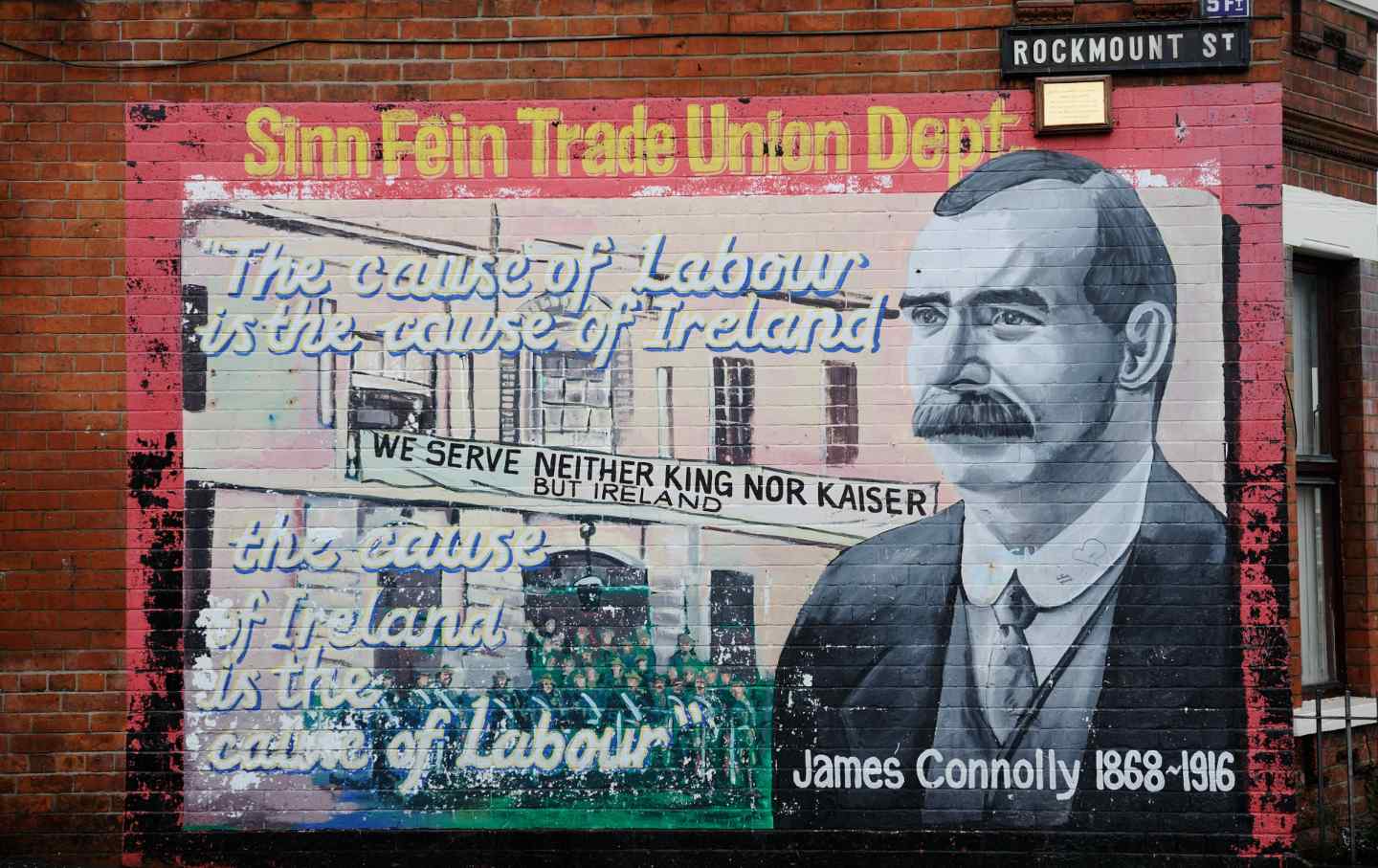
Why Zohran Mamdani and Claire Valdez are quoting James Connolly.
John Nichols


