A mystery object is dimming a distant star. Could it be a massive exoplanet, or a ‘failed star’?

When you purchase through links on our articles, Future and its syndication partners may earn a commission.

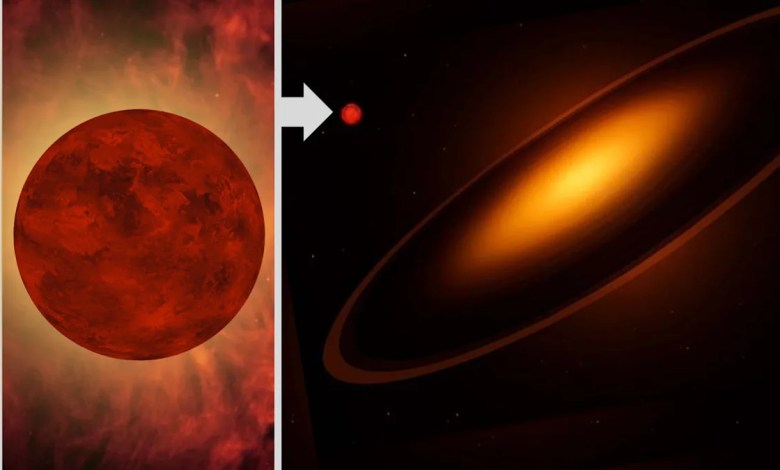
(Main) illustration of a dimming event caused by a mysterious object (Box) A brown dwarf “failed star”, one of the candidates for this object. | Credit: S. Shah et al./Robert Lea created with Canva
Scientists investigating the puzzling, long-lasting and extreme dimming of a distant star have narrowed the suspects down to a so-called “fail star” brown dwarf or a truly massive super-Jupiter exoplanet.
The dramatic disappearance of this star, located about 3,200 light-years away in the constellation Monoceros, was first observed in late 2024. The dimming came as a surprise, because the star, designated ASASSN-24fw and measuring about twice the size of the sun, was previously known to be stable. The stellar obscuration was one of the longest ever observed, lasting about 200 days. It was also extreme, with the ASASSN-24fw’s brightness reduced by 97%. Such extreme, long-lasting dimming events are incredibly rare.
Astronomers inferred that this dimming was caused by the saucer-shaped rings stretching 15.8 million miles (26 million kilometers), or about half the distance between the sun and its closest planet, Mercury. The big question is what does this ring system revolve around? The main suspects now are a brown dwarf or a massive extrasolar planet, or exoplanet, several times larger than Jupiter, the largest planet in the solar system.
“Various models by our group show that the most likely explanation for this dimming is a brown dwarf – an object heavier than a planet but lighter than a star – surrounded by a large and dense ring system. It orbits the star at a greater distance with the ring,” said team leader Sarang Shah, Inter-University Center for Astronomy and Astrophysics (IUCAA), India. said in a statement. “Long-lived dimming events like this are exceptionally rare because they require very perfect alignments. The dimming began gradually because the outer parts of the rings are thin and only became evident when the densest regions passed in front of the star.”
Little failed star or giant planet?
Brown dwarfs receive the unfortunate nickname “failed stars” because, like stars, they form from the collapse of clouds of gas and dust, but fail to gather enough material from what remains of that native cloud to accumulate the mass needed to trigger the fusion of hydrogen into helium in their core. This is the process that defines what a main sequence star is.
The line between brown dwarfs and massive gas giant planets is blurred in terms of mass. The lower limit of the mass of brown dwarfs is considered to be about 13 times the mass of Jupiter, with the upper limit separating the heaviest brown dwarfs and the lightest stars being about 80 Jupiter masses, or about 0.08 times the mass of the sun. Currently, a ringed brown dwarf is the prime suspect in the ASASSN-24fw dimming event.
However, because the team cannot yet determine the mass of the dark body, beyond determining it to be greater than three times the mass of Jupiter, they still cannot rule out the possibility that the culprit is a super-Jupiter exoplanet.

A diagram shows a brown dwarf in relation to Earth, Jupiter, a low-mass star and the sun. | Credit: NASA
What is more certain is the fact that ASASSN-24fw itself is tightly surrounded by fragments of gas and dust, which appear to be the remains of previous planetary collisions. This is something that is common around young stars that have turbulent and violent environments, but is rare for stars as old as ASASSN-24fw, estimated to be around 1 billion years old.
“Large ring systems are expected around massive objects, but they are very difficult to observe directly to determine their characteristics,” said team member Jonathan Marshall, an independent postdoctoral researcher affiliated with Academia Sinica in Taiwan. “This rare event allows us to study such a complex system in remarkable detail. In fact, while studying this attenuation, we also discovered by chance that ASASSN-24fw also has a red dwarf star nearby.”
The team now intends to measure the temperature, age and chemical composition of ASASSN-24fw, as well as determine what stage of evolution it is in. Collecting additional data on this star from the Very Large Telescope (VLT) in the Atacama Desert region of northern Chile and the James Webb Space Telescope (JWST) should help better reveal how planetary systems like this evolve.
However, astronomers will have to wait a little longer to get a new glimpse of the extreme dimming of ASASSN-24fw. The team expects the mysterious object to impact the star’s brightness again within 42 to 43 years.
The team’s results were published Thursday February 12 in Monthly Notices of the Royal Astronomical Society.


