A new problem throws four astronauts’ impending moon journey into uncertainty

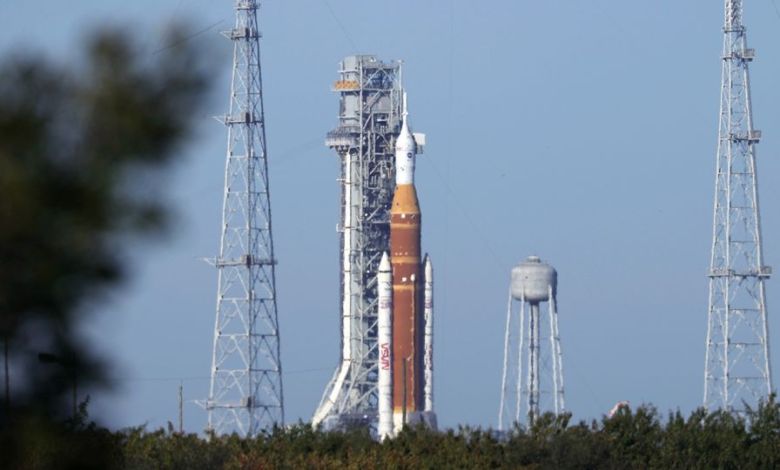
Efforts to get NASA’s historic mission to the Moon off the ground are once again stalled, as engineers face a new problem with the rocket intended to propel four astronauts on an unprecedented trajectory.
The agency announced Saturday that it had detected a problem with the flow of helium, a gas used to pressurize fuel tanks and clean propellant lines, in the upper portion of the Space Launch System, or SLS, moon rocket. Now the space agency must move the rocket back from the launch pad and into the nearby Vehicle Assembly Building, or VAB, for servicing as early as Wednesday — a move that effectively eliminates the possibility of a March launch date.
The decision represents a sharp turnaround from Friday, when agency officials — on the heels of a refueling test called a wet dress rehearsal — expressed confidence in the possibility of a March 6 liftoff. NASA leaders called the test, which ended Thursday, a success, saying launch controllers appeared to have resolved a series of hydrogen leaks that occurred during an earlier rehearsal in early February.
The helium problem was a surprise, coming after NASA completed the last wet dress on Thursday. And launch controllers still don’t know exactly what caused the jam, although NASA Administrator Jared Isaacman said that in any case the problem had to be resolved off the launch pad.
NASA is now aiming to launch the Artemis II mission no earlier than April.
“Expediting work to begin preparations for the rocket and spacecraft return to the VAB potentially preserves the April launch window, pending the outcome of data results, repair efforts, and how the schedule plays out in the coming days and weeks,” the space agency said in a blog post published Monday.
NASA had previously identified April 1, 3, 4, 5, 6 and 30 as potential launch days, but during a press conference last Friday, agency officials revealed they were also evaluating potential dates in May and June.
When the mission takes off, it is expected to take NASA’s Reid Wiseman, Victor Glover and Christina Koch, along with Canadian Space Agency astronaut Jeremy Hansen, on a 10-day journey around the Moon, marking the first time humans will travel to deep space since the end of the Apollo program in 1972.
One problem disappears, another appears
Many questions remain open about the feasibility of an April mission launch date.
Are there other hidden problems in the data that engineers haven’t discovered yet? How long will it take to find and solve the helium problem? And will rolling the rocket back and forth make NASA’s notorious hydrogen problems worse?
NASA officials on Friday seemed to think they had the SLS rocket’s hydrogen leaks under control, a notorious problem that has plagued the Artemis program since pre-launch testing for an uncrewed 2022 test flight called Artemis I. Since hydrogen is the lightest element in the universe, it tends to leak out of anything intended to contain it. And after hydrogen seepage affected Artemis II’s first wet dress rehearsal in early February, the space agency worked to replace two seals around the rocket’s propellant lines to try to better confine the fuel.
Those efforts appeared to pay off as NASA began the second wet dress rehearsal on Thursday.
Still, NASA said that even though it had fixed the hydrogen problem, officials weren’t sure why there was some unexpected moisture near the seals that technicians replaced.
“Where that came from, I’m not entirely sure,” Charlie Blackwell-Thompson, Artemis’ launch director, said at Friday’s press conference. And she said hydrogen leaks more generally still remained a headache.
“We didn’t have anything that we could point to where we said this was absolutely it,” Blackwell-Thompson said of the issue. “We helped with a number of things, but changing the seals definitely solved the problem because we performed absolutely amazingly.”

NASA’s Artemis II Space Launch System, or SLS, rocket and Orion spacecraft, attached to the mobile launch vehicle, are seen inside the Vehicle Assembly Building Jan. 16 at NASA’s Kennedy Space Center in Florida. -Joel Kowsky/NASA
Then the helium problem brought mission teams back to the drawing board. Helium gas was not circulating in the upper rocket. And no one really knew why.
Helium plays an important role. It is ideal for cleaning fuel lines and pressurizing tanks because it remains gaseous even at the very cold temperatures of rocket propellants – liquid hydrogen and liquid oxygen – and helium is inert, meaning it will not cause any volatile chemical reactions.
But the helium problem forced engineers to use “a backup method” to keep the rocket in a safe configuration because it eliminates explosive cryogenic fuels. As of Monday, NASA had not yet revealed why the gas suddenly stopped flowing.
A path strewn with pitfalls for the launch
NASA Administrator Jared Isaacman said in a social media post that potential causes of the helium problem included a faulty filter located between ground equipment and the rocket, a misbehaving valve on the rocket, or a problem with a “quick disconnect umbilical,” which is a line designed to quickly detach from the rocket during liftoff. The last two scenarios, however, might be the most likely, as such problems have already arisen. A valve, Isaacman noted, led to helium problems ahead of Artemis I’s uncrewed test flight in 2022.
“Regardless of the potential failure, accessing and resolving these issues can only be done within the VAB,” Isaacman said.
However, getting the rocket off the launch pad and back to the VAB also raises a new set of questions about how the hardware will perform during the 8-mile round trip, which takes hours each way.
Launch officials have previously said the process of getting the rocket into position could be the cause of some hydrogen leaks. The slow but grueling deployment procedure involves placing the 3.5 million-pound rocket and spacecraft on a “track” or moving platform and can put pressure and strain on the enormous vehicle.
“This deployment environment is very complicated,” NASA associate administrator Amit Kshatriya said at a Feb. 3 news conference.
Even after the helium problem is resolved, NASA may have to put the SLS rocket through another wet dress rehearsal.
In an email Monday, a NASA spokesperson said launch controllers would review what additional testing might be needed after the rocket returns to its launch pad.
Whether during the next wet dress rehearsal or on launch day, mission controllers must once again keep hydrogen leaks under control – if the recently replaced seals begin to show their characteristic fickleness after returning to the launch pad.
If additional issues arise during any of these stages, it could also eliminate potential April launch windows. And a delay of several months would not be uncommon. Notably, ahead of the 2022 Artemis I mission, the SLS rocket was removed from the launch pad three times and finally launched approximately eight months after its initial deployment.
NASA’s Artemis program is sending humans into deep space for the first time in more than five decades. Sign up for the Countdown newsletter and receive updates from CNN Science on extraordinary expeditions as they unfold.
For more CNN news and newsletters, create an account at CNN.com


