A New Side of the Black Forest—From Designer Cuckoo Clocks to Revitalized Bathhouses

All products featured on Condé Nast Traveler are independently selected by Condé Nast Traveler editors. However, when you buy something through our retail links, Condé Nast may earn an affiliate commission.

Jerome Galland
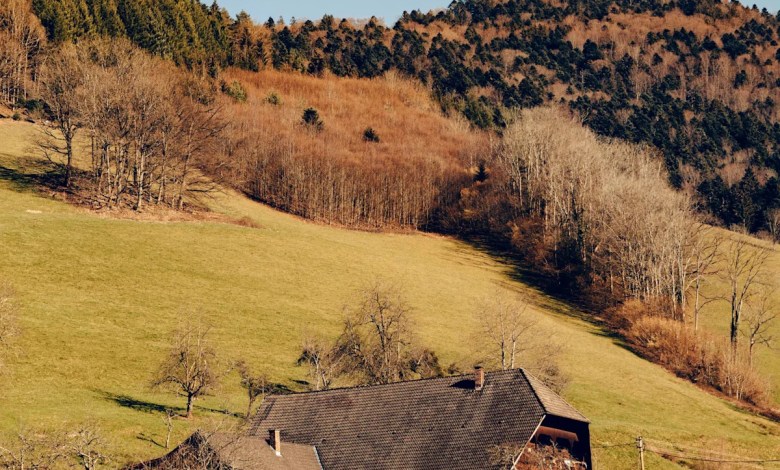
When the Romans pushed over the Alps 2,000 years ago into the forested mountain range running through Germany’s southwestern tip, they named it the silva nigra—black forest—after its moody glades of deciduous trees and firs. In many ways, though, the Schwarzwald, as the Germans call it, isn’t dark at all. From the terrace of the Romantik Hotel Spielweg in the Southern Black Forest, I gaze up at the white vapor trails left by planes crisscrossing a swatch of sky so vibrantly blue it could be an Yves Klein canvas. Below, the slopes undulate in gently rolling waves of intense green.
In the popular imagination the Black Forest is a place of extraordinary natural beauty and the wooded realm of sinister fairy tales. But many contemporary German city dwellers often consider the 23,000-acre region an antiquated and provincial backwater, a place where oma and opa (granny and grandpa) go on their holidays to hike the marked trails, which run for about 15,000 miles. One of the oldest, the Westweg, which celebrates its 125th anniversary this year, goes from Pforzheim to Basel and takes 48 hours on foot. Another, the Geniesserpfade, winds through Baden wine country, passing its traditional inns.

Morning mist on the rolling hills between the towns of Sankt Peter and Sankt Märgen in the Black Forest.
Jerome Galland
A drive around the Hochschwarzwald, or High Black Forest—literally the highest part of the area—fulfills every cliché: remote houses with drooping roofs that seem to almost touch the ground; medieval towns like St. Blasien; crisp mountain lakes such as Schluchsee; and the constant baaing of sheep. This is the Germany of the Heimatfilm escapist movies produced in the 1950s, the period of Germany’s postwar travails, which sentimentalized the country’s rural idylls (and were criticized for their avoidance of the recent Nazi past). Another reason oma and opa love the Black Forest is for the neighborliness of the people. The Hochschwarzwald region launched the local Schellsch Halt Mol (“Just ring the bell”) campaign in 2024, encouraging hikers to freely knock on people’s doors for help or advice. In the village of Menzenschwand, I do just that and meet 60-something Elisabeth Kaiser, who immediately invites me into her 450-year-old home. Over coffee she tells me about a tourist who once turned up on her doorstep searching for her missing husband. He was a glider pilot, she said, and Kaiser found him at a nearby flight school.
In the early years of the 21st century, visitor numbers plummeted and younger residents began moving out. The Black Forest’s quaint cottagecore appeal was beginning to dull. In 2010, Gallus Strobel, the mayor of Triberg, home to one of Germany’s highest waterfalls, was emphatic about the region’s need to play tourism catch-up, describing his town as sleepwalking into the future. But in the last few years, a young-blood cohort of chefs and designers have been moving in—or coming home, in some cases—and putting modern spins on the region’s culinary and craft heritage. Hotels big, small, and historic have gotten new coats of paint as they attempt to entice today’s travelers who, much like their forebears, are seeking wellness by getting closer to nature. The Black Forest National Park was created in 2014 to protect the region from unchecked development and make swaths of woodland more accessible to tourists. It all seems to be working: In 2024 the Black Forest welcomed roughly 9.2 million overnight travelers staying at commercial establishments (not counting couch surfers and friends in guest rooms), up from 6.3 million in 2007.

Chef Viktoria Fuchs at her family’s Romantik Hotel Spielweg in Münstertal
Jerome Galland
The Black Forest has a long-standing and highly acclaimed history of haute cuisine: The region has 40 Michelin stars spread among 31 restaurants. But while gastronomic excellence is not new here, traditional menus are becoming increasingly progressive. At Romantik Hotel Spielweg in the valley of Münstertal, in the Southern Black Forest, the chef is Viktoria Fuchs, whose family has run the inn since 1861. Only 35, Fuchs is already a culinary star in Germany. After training under Douce Steiner at the two-Michelin-starred restaurant Hirschen in Sulzberg, she honed her skills in kitchens throughout Europe, including Luce d’Oro (now Ikigai) at the famed hotel and retreat Schloss Elmau in the Bavarian Alps. But she describes herself as “the homesick type,” so eventually she returned to Münstertal. A few years ago, when her sister began managing the Romantik, Fuchs and her husband, Johannes Schneider, took over the restaurant.

Fuchs’s signature wild boar dim sum
Jerome Galland

The dining room at Romantik Hotel Spielweg’s restaurant
Jerome Galland
“We don’t want to wander too far from the path of tradition,” Fuchs tells me. We’re sitting in a parlor that still looks much as it did 100 years ago, at a creaky old table where her family often gathers after work and plays cards. Fuchs and Schneider serve Black Forest classics—black pudding brägele; sauerbraten, a marinated meat roast; a dish of fried potatoes—alongside creations that throw out the rule book, like dim sum made with wild boar sourced from the hotel’s hunting grounds. “But we’re also eager to try something new,” she says with a smile.

Twee chocolate pine trees at Chocolaterie Lisa
Jerome Galland
Elsewhere, other entrepreneurs are flipping the narrative on the region’s once staid claims to fame, like the namesake Black Forest gâteau. At Chocolaterie Lisa in the small town of Titisee-Neustadt, baker and TV host Lisa Rudiger plays with the gâteau’s customary presentation, largely unchanged for a century: layers of chocolate chiffon brushed with kirsch brandy and sandwiched between whipped cream and kirsch-soaked cherries. Rudiger’s versions are topped with small forests of mini pine trees fashioned from liquid chocolate piped onto parchment paper; the sides are covered with “bark” constructed out of flakes of chocolate. I am delighted by how the gâteau is simultaneously rich and light on the palate, fresh and familiar. It’s a modern work of art even oma would love.
The cuckoo clock has also gotten a refresh. Though precise origins of the legendary German timepiece are hazy, it was developed and popularized in the Black Forest in the 18th century. The town of Schonach is home to the largest in the world, big enough for a person to walk inside and shaped like a house with a 10-foot face. In the early aughts the town had about 1,000 clockmakers, but by 2015, Schonach was in the cuckoo clock doldrums, stymied by competition from cheap pieces made by manufacturers in Asia that retail at a tenth of the price (the handmade beauties here can sell for more than $3,000).

Modern cuckoo clocks by Selina Kreyer (née Haas) and Andreas Kreyer at clockmakers Rombach & Haas in
the town of Schonach.
Jerome Galland
Rombach & Haas, a family-owned clock manufacturer since 1894, has been elegantly fighting back. Among its wares are elaborate carved timepieces that rotate on a one- or eight-day schedule, combining cuckoo calls with “The Happy Wanderer” and “Edelweiss,” but the daughter of the family, Selina Kreyer (née Haas), is taking the company in a new direction. A graphic designer by trade, Kreyer was tasked during her studies to develop a marketing concept for a fictitious company. “I used Rombach & Haas and gave it a more modern look,” she says. Out of that, Selina Haas Design was born.
As she leads me through her workshop, I see how the past and present collide. The drawers of the wonky cupboards are piled with the carved parts of clocks, miniature ballet dancers, and crimson birds, but the modern clocks are painted lime green or neon yellow, or papered with comic art. One sleek piece has a bright red cardinal—or rather, a minimalist impression of one—living inside a jet-black house. Though the pieces are contemporary in style, their internal mechanics look as they would have 250 years ago. Kreyer’s goal is to keep this kind of legacy craftsmanship alive: “How can we bring the Black Forest back to the forefront?” she says. “That’s always been my focus.”
When Ernest Hemingway came to soak up the High Black Forest in 1922, he stayed for 22 days. Unfortunately, a century later, the average stay is just two and a half days. But an extended holiday is all the more alluring at the area’s new, revamped lodgings. The sustainable hospitality company Stuub has snapped up unused and rundown buildings in 11 rural spots around Titisee-Neustadt and transformed them into simple yet elegant retreats. When I checked in at the location in Staufen, I found guest rooms dressed in calming grays, taupes, and other earth tones. As the Stuub website promised, there was “no cherry cake, no lace doilies, and no Bollenhut,” referring to the region’s signature hat topped with woolen pompoms.

The exterior of Brenners Park-Hotel & Spa
Jerome Galland

Inside Oleander Bar at Brenners Park-Hotel & Spa
Jerome Galland
Meanwhile, in Baden-Baden—famous for its ornate bathhouses, elderly repeat visitors, and grandiose Art Nouveau and Baroque character—the Belle Époque–style Brenners Park-Hotel & Spa, built in 1834 on the edge of the Lichtentaler Allee park and arboretum, has gotten a facelift: The façade, balcony floors, and 79 rooms and suites have been carefully stripped back and reimagined. “The revitalized Brenners symbolizes the changes taking place in the Black Forest,” says hotel director Stephan Boesch as he leads me through the hotel, pointing out all-new interior fabrics and preserved details like historical staircases, doors, and window frames. “We are renewing ourselves without forgetting the good old traditions.”

Nadine Berger, a ranger at Black Forest National Park
Jerome Galland

An interpretation of Black Forest gâteau by Lisa Rudiger at Chocolaterie Lisa in Titisee-Neustadt
Jerome Galland
The environment itself, too, is being nurtured by a mindful young vanguard. Nadine Berger is one of 10 rangers at the Black Forest National Park, where the woodland is “getting wilder again.” Through their efforts, “we are allowing nature to be itself,” she says. A naturally diverse mix of species—spruce and fir and beech—is thriving, and fallen trees are left to nourish the ecosystem. Endangered and near-extinct species are back: adders, garden dormice, three-toed woodpeckers, and wood grouse; fungi such as lemon yellow Trametes and fountain-like Hericium flagellum, or “white icicle.” Dense mosses carpet the trunks of this dappled green world, which feels almost tropical. Veering off the narrow path is not advised—not because of the witches the Brothers Grimm warned of but to protect this precious wilderness. “Climate determines how we live,” Berger says. “A diversity of species determines if we live.” The fairy tale is getting a modern update, but in the best possible way.
Translated from the German by John Oseid

The façade of the hotel Rainhof Scheune in Kirchzarten
Jerome Galland

A guest room at Stuub Hinterzarten
Jerome Galland
Stay
The Black Forest’s marquee hotels reflect the region’s posh history as a European R&R destination. Leading the pack is Brenners Park-Hotel & Spa (from $810) in Baden-Baden, part of Oetker Hotels, which has been revitalized after a two-year redesign. Its wellness experiences range from high-tech diagnostics and holistic therapies to Augustinus Bader facials and forest-bathing experiences. Nearby, the Steigenberger Icon Europäischer Hof Baden-Baden (from $525) reopened this year with The Vault Spa & Suites, a 14,000-square-foot wellness sanctuary situated in a former bank vault. Near Freiburg, the wellness-focused Luisenhöhe–Gesundheitsresort Schwarzwald (from $685) has a bar and restaurant rooted in the slow-food philosophy; the spa has five saunas and an 80-foot-long outdoor pool; and the view from the terrace stretches as far as France’s Vosges mountains. Rainhof Scheune (from $235), in charming Kirchzarten, was a station for stagecoaches in the 19th century; today it’s a 16-room boutique hotel with a restaurant, a health food shop, and a spa. At the Fritz Lauterbad (from $207) in Freudenstadt, the original 1896 building has a handsome modern extension that houses pools, saunas, and a fitness center. And Stuub’s 11 renovated flats and hotels throughout the Black Forest are excellent rest options for road-tripping in the region.

Wild-caught pike perch, spinach spaetzle, and kohlrabi at Ponyhof Stammhaus
Jerome Galland

Hannes Schmidt, CEO of Boar Distillery, a gin maker in Bad Peterstal-Griesbach in the valley of Renchtal
Jerome Galland
Eat and drink
In Baiersbronn, a small town in the Northern Black Forest, you’ll find two of Germany’s three-Michelin-starred restaurants: Restaurant Bareiss, which serves Schwarzwald specialties including roe deer from the hunting grounds at Hotel Bareiss; and Schwarzwaldstube at the hotel Traube Tonbach, where the principles of French cuisine inspire plates like Alsatian pigeon breast with dandelion honey. The seasonal menu at Romantik Hotel Spielweg, devised by chef Viktoria Fuchs (whose family has owned the place since 1861), touts dishes like berries preserved in rum and sugar and Münstertal venison. At the family-run Ponyhof Stammhaus in Gengenbach, chef Tobias Wussler whips up turbot with mushrooms and fried spaetzle. Badisch-French Schwarzer Adler, the restaurant at the winery Franz Keller, pairs pike perch with the vintner’s Weissburgunder (a.k.a. Pinot Blanc). For more booze, try the wine bar Kurz & Kork in Freiburg, where oenologist Linda Kurz serves bottles from organic vineyards that are no larger than 35 acres. Or go to the Renchtal valley, where more than 1,100 distilleries, like Boar Distillery, are branching out from the fruit brandies of old to make gin. For souvenirs (edible and otherwise), seek out Chocolaterie Lisa in Titisee-Neustadt, where cookbook author and TV baking show host Lisa Rudiger sells chocolates, Bollenhuts, and creative cuckoo clocks.
This article appeared in the January/February 2026 issue of Condé Nast Traveler. Subscribe to the magazine here.
Originally Appeared on Condé Nast Traveler
Trending Travel Destinations


