A single DNA cassette tape could store billions of photos


The cassette. A basic food of walkmans, car stereos and sappy mixtapes from the 80s and 90s. It seemed that this piece of technology formerly suspended may have followed the Dodo path. However, the cassette could offer a new way to store our ever -increasing quantity of digital data – with a biological touch.
DNA (deoxyribonucleic acid) is an ultimate hard drive of nature because it is dense, compact and durable. To exploit this storage power, Xingyu Jiang at the University of the South Science and Technology in China and its colleagues use this genetic equipment to create experimental DNA cassettes. Science fiction results are detailed in a study recently published in the journal Scientific advances.
DNA can contain huge amounts of data for an apparently infinite amount of time, all without electricity or the use of precious energy. In theory, DNA contained in a human cell can store approximately 3.2 data gigabytes (around 1,000 songs). The challenge in the exploitation of DNA potential as a storage solution has been to create a system that we can easily use. The humble cassette could offer a solution.
In this new study, the team created a physical band using a mixture of polyester and nylon. Then, they printed barcode patterns on the band, making millions of tiny sections similar to files on a personal computer. In this way, the system can identify exactly where the data is stored.
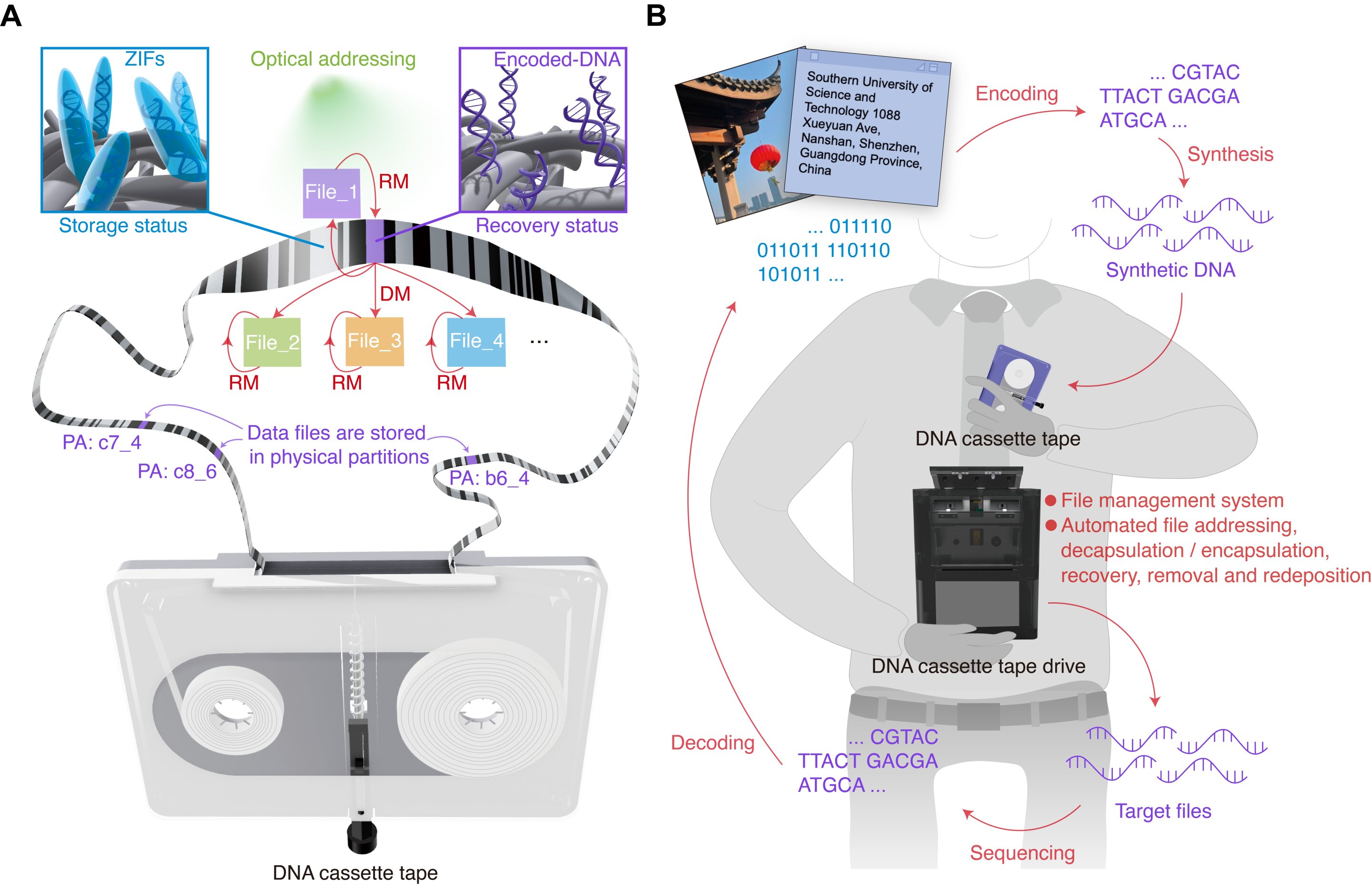
In order to archive a file, digital data is initially translated into a DNA sequence. To do this, the four constituent elements of DNA – Adenine (A), Guanine (G), Cytosine (C) and Thymine (T) – are transformed into a code similar to the combination of zeros and those that computers use. The ribbon was also covered with a crystal layer to prevent DNA connections from decomposing.
To prove that the system worked, they converted a digital image to DNA. Then they quickly recovered the image from the band.
A traditional cassette contains about 10 to 12 songs on each side, but 328 feet of this DNA cassette could contain the same amount of data in more than 3 billion songs. The total capacity of the prototype is 36 data petacts, of the same size as 36,000 hard teraoctet discs.
[ Related: This app recreates the magic of VHS tapes and home movies with your iPhone videos. ]
Do not try to put this organic cassette in this old boomox collecting dust in the attic. He has DNA molecules, not sound waves, and has none of the magnets necessary to have it play. The co-author of the Jiankai Li study said New scientist“Our strip bears DNA molecules. In other words, it would be like trying to play a photo in a Disque turning – the formats are incompatible.”
If it works, DNA tapes could offer a solution for large data centers currently confronted with the main storage and energy constraints. A study of the 2023 MIT estimated that 4.4% of all electricity in the United States was consumed by data centers and that this number should only increase more technological companies focus on AI. According to a report of The New York TimesThe electricity bill for a typical Ohio household increased at least $ 15 per month in June, largely due to AI data centers.
A future solution like this DNA cassette could offer an evolutionary and more sustainable solution to major data centers, without sacrificing data from the world.

More offers, reviews and purchasing guides


