A Solution to the CIA’s Kryptos Code Is Found after 35 Years


October 16, 2025
3 min reading
Solution to CIA’s Kryptos code found after 35 years
After decades of speculation, two authors discovered the answer to the final cipher of the Kryptos code
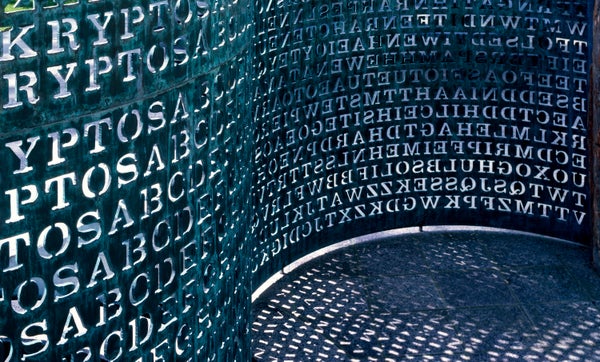
Kryptos, a work of art composed of encrypted code, sits on the grounds of CIA headquarters in Virginia
Buyenlarge/Contributor/Getty Images
After 35 years of searching, the final solution to a famous puzzle called Kryptos has been found. Two writers have discovered the fourth answer to the code hidden in the archives of the Smithsonian Institution.
The puzzle, a copper sculpture engraved with four coded messages, has fascinated professional and amateur cryptographers since 1990, when artist Jim Sanborn installed it at CIA headquarters in Virginia. The four encrypted messages are composed of 869 characters. The last section, K4, begins with “OBKR” and contains 97 letters. To claim a solution, one must show how they decoded it from this ciphertext.
The first three passages were solved in the 1990s, but the solution to the fourth, known as K4, had remained secret until now.
On supporting science journalism
If you enjoy this article, please consider supporting our award-winning journalism by subscription. By purchasing a subscription, you are helping to ensure the future of impactful stories about the discoveries and ideas shaping our world today.
After years of failed attempts by enthusiasts to decode K4, Sanborn was preparing to auction off the solution, which was expected to cost between $300,000 and $500,000. On September 3, however, he received an e-mail from journalists Jarett Kobek and Richard Byrne containing the full decoded text.
Kobek and Byrne came up with the solution after noticing in the auction listing that Sanborn’s “coding charts” were in the Smithsonian collection. Byrne photographed the papers and Kobek later realized that they contained taped-up pieces that revealed the original raw text of K4. The fragments contained the previously released clues “BERLIN CLOCK” and “EAST NORTHEAST”, part of the fully decoded message.
Sanborn confirmed the authenticity of the solution, explaining that he had mistakenly included these fragments in the archive while compiling documents during cancer treatment years earlier. Following this discovery, he asked the Smithsonian to seal the files for the next 50 years, and it complied.
In response to this news, RR Auction, the company handling the sale, warned Kobek and Byrne against publishing the text, threatening legal action for interference and copyright infringement. The two men told New York Times they have no intention of publishing it.
A release from RR Auction says the materials offered in the planned sale provide the only authorized insight into how K4 worked within Sanborn’s artistic vision. He pointed out that although Kobek and Byrne now know the raw text, they do not have the method by which K4 was encoded or the full creative context of the work. “It’s one thing to have the words. It’s another to have the method,” says Elonka Dunin, a retired game developer who co-moderates one of the world’s largest Kryptos fan groups. “Over the years, many people have come in and said they’ve solved the problem, but if they can’t demonstrate the method, they’re just kicked out of the room.”
RR Auction’s statement notes that even if the text of K4 ultimately becomes public, only the winning bidder will have access to Sanborn’s full explanation of the relationship between K4 and a previously rumored fifth passage, as well as the intended meaning behind Kryptos’ full message.
Reactions to the news from the crypto community are mixed. Some, including Dunin, feel relieved that someone has finally deciphered the long-standing mystery of Kryptos. Others described Kobek and Byrne’s way of finding the answer as an “ugly ending.”
Regardless of how the saga ends, the fascination with Kryptos will likely endure. “For a piece of art, if you can grab someone’s attention for 10 minutes, that’s pretty good,” Dunin says. “Sanborn now has a work of art that has captured people’s attention for 35 years.”
It’s time to defend science
If you enjoyed this article, I would like to ask for your support. Scientific American has been defending science and industry for 180 years, and we are currently experiencing perhaps the most critical moment in these two centuries of history.
I was a Scientific American subscriber since the age of 12, and it helped shape the way I see the world. SciAm always educates and delights me, and inspires a sense of respect for our vast and magnificent universe. I hope this is the case for you too.
If you subscribe to Scientific Americanyou help ensure our coverage centers on meaningful research and discoveries; that we have the resources to account for decisions that threaten laboratories across the United States; and that we support budding and working scientists at a time when the value of science itself too often goes unrecognized.
In exchange, you receive essential information, captivating podcasts, brilliant infographics, newsletters not to be missed, unmissable videos, stimulating games and the best writings and reports from the scientific world. You can even offer a subscription to someone.
There has never been a more important time for us to stand up and show why science matters. I hope you will support us in this mission.


:max_bytes(150000):strip_icc()/Health-GettyImages-CranberrySauce-132690d7bbc9437091eaca8fde73ee0b.jpg?w=390&resize=390,220&ssl=1 "What Happens to Your Body When You Eat Cranberry Sauce")
