A Speed Camera for the Universe



Explore
TThe universe is immense. By the time you finish reading this sentence, it will be even bigger.
This is because the universe is expanding, but not everything is expanding at the same rate. The farther things get, the faster they move away from us. For every megaparsec (about 3.3 million light years) of distance from our vantage point, this expansion rate increases by about 45 miles per second. This rate is known as the “Hubble constant”, named after astronomer Edwin Hubble, famous for his space telescopes, who discovered it in 1929.
Now, astronomers at the University of Tokyo have developed a new method called “time-delay cosmography” to obtain a more precise measurement of the Hubble constant, publishing their results in Astronomy and astrophysics.
ADVERTISEMENT
Nautilus members enjoy an ad-free experience. Log in or register now.
Traditionally, the Hubble constant is recorded using “distance scales”. Astronomers choose a relatively close and familiar cosmic entity – a supernova or a star – and observe it, then choose a more distant one and observe it, and so on, to measure how fast they are moving away from us.
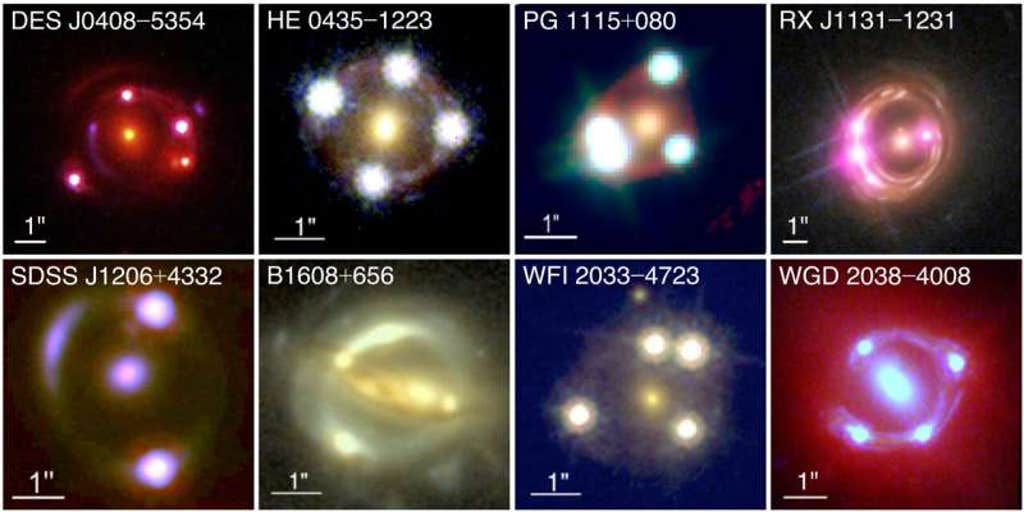
Meanwhile, time-lapse cosmography relies on gravitational lensing from massive objects in space to determine the Hubble constant. In this method, scientists use a huge galaxy as a lens. Superbright objects beyond this galaxy, called quasars, appear distorted because gravity bends their light. The changes in these distorted images allowed the researchers to measure the difference in time it took for light from the objects to reach them.
ADVERTISEMENT
Nautilus members enjoy an ad-free experience. Log in or register now.
Thanks to this intelligent methodology, the authors arrived at a value for the expansion rate consistent with the Hubble constant. This could help resolve a major cosmic conflict.
When astronomers measure this expansion rate using space telescopes (like the one named after Edwin Hubble), they get a number: about 45 miles/second/megaparsec; When they use another method, measuring the cosmic background radiation generated in the early universe, they get a different, smaller number – about 42 miles/second/megaparsec. This discrepancy is called “Hubble tension” and has sparked much debate over whether it was due to experimental error or the actual physics of the universe.
Read more: »What can we learn more about the Universe?»
ADVERTISEMENT
Nautilus members enjoy an ad-free experience. Log in or register now.
“Our measurement of the Hubble constant is more consistent with other current observations and less consistent with measurements from the early universe,” Kenneth Wong, study co-author and University of Tokyo astronomer, said in a statement. “This is proof that the Hubble voltage can actually come from real physics and not just from an unknown source of error in the different methods.”
The team nevertheless stressed that it will need to further refine its time-delay cosmography method to obtain more precise results. Its current accuracy is about 4.5 percent, but it would need to reach an accuracy of about 1 to 2 percent “to really fix the Hubble constant at a level that would definitively confirm the Hubble voltage,” study co-author Eric Paic, also of the University of Tokyo, said in the release.
The only true constant in astrophysics? Further research is needed.
ADVERTISEMENT
Nautilus members enjoy an ad-free experience. Log in or register now.
Enjoy Nautilus? Subscribe for free to our newsletter.
Main image: ESA/Hubble and NASA, C. Murray, J. Maíz Apellániz
ADVERTISEMENT
Nautilus members enjoy an ad-free experience. Log in or register now.


