A wildflower in California reveals a newly documented evolutionary process

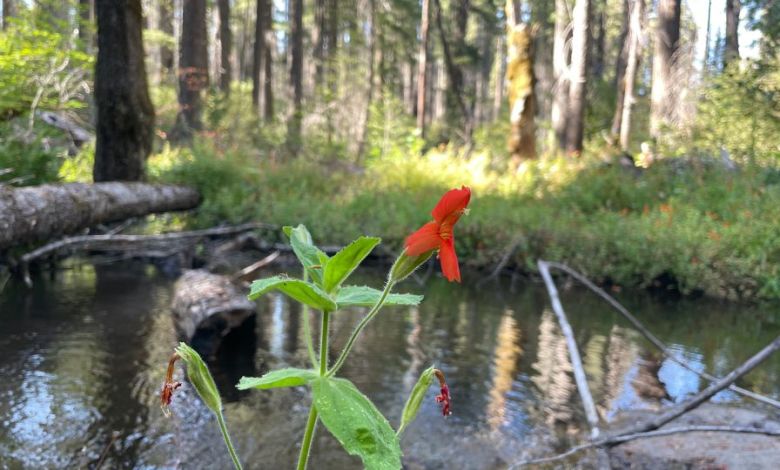
During California’s worst drought in 1,200 years, some wildflower populations defied odds to survive the ordeal. Researchers say they now believe these flowers rely on a type of rapid genetic evolution – the first time such a phenomenon has been documented in nature.
The drought period occurred between 2012 and 2015 and killed more than 100 million trees. This is a particularly brutal period during a mega-drought that began in 2000 and has been made worse by climate change. Even though the drought killed normally drought-tolerant plants, the scarlet monkey flower, a bright red wildflower that thrives in wetlands and along streambeds and springs, showed remarkable resilience.
A team of researchers spent eight years studying 55 populations of wildflowers, whose scientific name is Mimulus cardinalis, tracking their numbers in the wild and sequencing the flowers’ genomes to reveal genetic changes.
“We were able to show that these populations throughout the range in California were declining due to this extreme drought, and we found evidence of rapid evolution across the genome,” said Daniel Anstett, an assistant professor in the School of Integrative Plant Sciences at Cornell University and first author of a study on the findings, published Thursday in the journal Science. “And then we were able to relate a measure of this evolution to the ability of these populations to recover and not disappear.”
Even if the entire species was not threatened with extinction, individual flower populations probably were, experiencing declines of up to 90% from maximum population sizes. It took about two to three years for these populations to rebound, according to Anstett.

A stream in California is populated with monkey flowers, which were studied in recently published research. -Daniel Anstett
This rapid return is a process that biologists call evolutionary rescue, which occurs when a species is able to recover from the threat of extinction due to an external factor such as a drought, Anstett explained. “Evolutionary rescue occurs when the few individuals left have the appropriate genetic makeup to do better than those who died, so that they thrive or thrive in these new conditions, so that the population is just steps away from extinction,” he said.
Evolutionary rescue has been demonstrated in the laboratory, but researchers previously had only partial observations of it in nature: resistance to cancer in Tasmanian devils and adaptation to pollution in killifish. However, these studies did not provide comprehensive evidence of process implementation.
According to Anstett, this study offers rigorous evidence that an evolution has occurred and that it has led to a demographic recovery. “We had a lot of information about wildflower demographics and genes, which gave us more robust information that an evolutionary rescue was finally happening.”
An excellent indicator of drought
Scarlet monkey flower is a perennial herb, meaning it grows back every season from the same roots. It is pollinated by hummingbirds and can grow up to 3 feet tall and 3 feet wide.
“This plant is found in streams in California, Baja California and southern Oregon, which are often seeps of water that pass through the habitat seasonally,” Anstett said. “You really need the flowing water to complete its life cycle and then be able to grow to the seeds, so it’s a great indicator of drought.”
When a drought occurs, Anstett explains, the water stops flowing, so the plant has two choices: grow quickly and produce flowers and seeds before the drought really sets in – or grow much more slowly and perhaps live another year. This last strategy is the one used by wildflowers. “What we found was that the plants actually grew more slowly and moved more into storage, lived longer and grew less quickly, which is called drought avoidance,” Anstett said.
To understand the process, researchers tracked wildflower populations at 19 sites, visited each year to assess whether the plants were living or dying. They then collected the seeds from the plants, grew them in a laboratory, and then ground up the leaves of the plants they had grown to extract the DNA.

A researcher works at one of the sites sampled for the study. -Amy Angert
The DNA was then used to sequence the plant’s genome, its genetic instructions. “We were able to see this rapid evolution over seven years,” Anstett said, adding that the genetic mutations that the plant exploited to become drought-resistant were not new, but likely developed a long time ago. Plants that carried these drought-resistant traits were able to survive and transmit these mutations via seeds.
The next step in the study, which Anstett said could take 30 or 40 years, is to see whether these mutations that allowed plants to survive the megadrought will continue to benefit or harm plants if the drought ends.
Additional evidence of an evolutionary rescue doesn’t make drought or climate change any less of a concern, but it does suggest that there may be more plants or animals capable of showing resilience under extreme stress. Genetic diversity is essential to achieve this. This means that conservation efforts aimed at keeping plant populations as widespread as possible remain crucial.

The monkey flower plants were grown in the laboratory from wild-collected seeds. -Daniel Anstett
“The extent of genetic variation may be critical to this adaptation,” Anstett said. “It’s a trick for conservation biologists to try to improve the amount of genetic variation and connectivity between habitats so that organisms can ultimately be more resilient to a range of stressors.”
“A real breakthrough”
Demonstrating that evolutionary rescue occurs in nature and identifying the specific genes responsible has been a major and outstanding goal in evolutionary and conservation biology, David Field, associate professor of applied biosciences at Macquarie University in Australia, said in an email. Field was not involved in the new study.
“Researchers used an elegant experiment to demonstrate that evolutionary rescue actually occurs in nature over the course of our lifetime,” he wrote in an email, adding that the study provides an important demonstration of the possibilities of using similar experiments to support conservation efforts for endangered species globally.

The scarlet monkey flower, or Mimulus cardinalis, is also known as Erythranthe cardinalis, following a botanical reclassification of the species. -Seema Sheth
Other researchers who were also not involved in the research expressed similarly positive opinions: “This is a very important study,” Diane Campbell, professor emeritus of ecology and evolutionary biology at the University of California, Irvine, said in an email. “This provides exceptionally strong evidence that a process known primarily through theory can help wild plant populations recover from increasing droughts predicted by climate change in Mediterranean-like areas.”
A major question that concerns botanists is whether plants can evolve in time to survive extreme droughts that are expected to worsen with climate change, said Isaac Lichter Marck, a botanical researcher at the California Academy of Sciences. “Faced with extreme drought, animals can move, adapt or die – but wildflowers are rooted in place, leaving them with a much shorter list: adapt or die,” he wrote in an email.
The study provides a critical model for using genomics to predict which wildflower species are vulnerable to extinction due to climate change, he continued. But it also raises other concerns: “Pressures such as habitat loss and invasive species are eroding genetic variation in nature. As this research shows, the loss of genetic variation could further exacerbate the already alarming threats of climate change.”
Jeff Diez, an associate professor in the University of Oregon’s biology department, said in an email that the research represents a real breakthrough and is notable for its rigor. “The sobering thing is that it took an extraordinary effort to demonstrate this for one species,” he added. “If we want to understand how entire communities of interacting species will respond to climate change, we need to assess the evolutionary potential of many more species, and there is bound to be enormous variation in which species can evolve quite rapidly.”
Overall, he concluded, the study contains a real message of hope that some wild plants could evolve quickly enough to survive climate change. “But it also comes with a humbling reminder of how much we still don’t know.”
Sign up for CNN’s Wonder Theory science newsletter. Explore the universe with information on fascinating discoveries, scientific advances and much more.
For more CNN news and newsletters, create an account at CNN.com