A Wormhole Would Really Look Like a Sphere, Not a Hole – Here’s Why


The main dishes to remember on the green holes
-
In some respects, a green hole may look like a black hole. And the green hole would look like a sphere, not a hole.
-
The theory of general relativity of Einstein allows the possibility of worm holes, but there is no evidence of observation to prove their existence. But it is possible that if you had the right type of material, you could produce the type of curvature of space-time that would cause a worm hole.
-
Imagine living in a two -dimensional world, like a sheet of paper. When this sheet of paper is folded so that a long distance separates two parts, these separate locations in “space-time” are united in the same way as a green hole can do.
An Einstein-Rosend bridge is a hypothetical but not proven characteristic of space-time. In theory, these so-called worm holes provide a shortcut through the universe to connect two distinct points in space-time.
Often represented in science fiction as a cosmecally dramatic leap through an unknown and distorted part of the solar system, the worm holes, with regard to astrophysicists, are only that-an object of science fiction.
Robert ScherrerThe professor of physics at Vanderbilt University, says that the green holes are on the “edge of speculative physics”. The theory of general relativity of Einstein allows the possibility of worm holes, but there is no evidence of observation to prove their existence. As such, Scherrer says that they remain theoretical and “a little more speculative than black holes” to that.
Einstein’s theory of relativity indicates that gravity, a fundamental force of attraction, is the curvature of space-time itself. Matter tells in space-time how curves, and conversely, the geometry of space-time tells how to move. In other words, space-time is a conceptual model that combines the dimensions of space with a fourth dimension of time.
“The main thing to keep in mind is that Einstein’s theory is incredibly promised and allows all kinds of ways to bend in space-time. Christopher SmeenkProfessor of Philosophy of Physics and Science at the Western University of Canada.
What would a worm hole really look like?
Tunnel de Ver. (Image Credit: CG_Dmitriy / Shutterstock)
“We consider that space-time as having a kind of ordinary structure, but general relativity allows it to be really bizarre,” explains Smeenk, adding that such “exotic scenarios” provide a means of asking questions about physics, general relativity and quantum mechanics.
Imagine living in a two -dimensional world, like a sheet of paper. When this sheet of paper is folded so that a long distance separates two parts, these separate locations in “space-time” are united in the same way as a green hole can do. Likewise, if a person passed through a worm hole, it would change their location in space and time.
But are Green holes more than theory? Scientists are not convinced.
Find out more: What is space-time? Einstein’s time and gravity theory explained
Could humans travel through worm holes?
The simplest of the worm holes would not be stable, which means that they would collapse very quickly and would not give enough time for a person to cross them. To stabilize a hypothetical green hole, it would take an exotic question.
Exotic matter is a hypothetical form of theorized matter to contain unusual properties often characterized by a negative energy density, which means that it would have a negative mass or exert a repulsive gravitational force. Green holes would require a shell of exotic matter, but just like worm holes, exotic matter has never been observed and is considered hypothetical.
“If you could create this state of matter, then, depending on the general relativity, you may have a worm hole. But if you ask me if this kind of material is possible, I doubt it, ”explains Smeenk.
Even if a worm hole was stable, it should be large enough to allow a person to go through. And because the exotic matter is considered to be negative, the sending of a person through a green hole would be a “large piece of positive energy”, which could trigger the worm hole to collapse due to its requirement to maintain a repellant effect.
“The short summary is that if you want a classic and crossed worm hole, then you must constitute a negative energy or an exotic material, which probably does not exist,” adds Alexandru lupsascaDeputy Professor of Physics at Vanderbilt University.
How scientists have the hypothesis of the existence of a worm hole
It is not because science has not yet confirmed the existence of green holes does not mean that they are not there. But astrophysicists like Lupsasca say that the notion of real worm hole is contradictory because there are no proven worm holes.
“There are wishes wishes for reflection on the holes,” explains Lupsasca, comparing the theory of worm holes in Romeo and Juliet – the “cosmic version of the lovers of stars”.
“Romeo lives in the universe and Juliette lives in another universe. They want to meet because they are in love with each other, but how could they know the existence of the other?” said Lupsasca.
The only way they could meet, in this theoretical drama, is to jump into a black hole found in their respective universes which are connected by coincidence, essentially via a worm hole which links two regions of space-time which would not be otherwise combined.
“But of course, they need a tragic end. Once you fall into a black hole, you cannot withstand the gravitational attraction of the singularity in the center. Finally, they are pulled in the singularity and torn,” adds Lupsasca. “It is a condemned story of two stars lovers.”
The force of gravity is not uniform but disintegrates rather with the distance. In a much larger gravitational field like those of a black hole or perhaps a worm hole, the difference is much greater, which could potentially cause spaghettification – or separate a person.
Find out more: Here is what would happen if you were going through a black hole
Why are the green holes theoretical
Blackhole (Image Credit: Remotevfx.com/Shutterstock)
For the moment, scientists do not know enough about the characteristics of the green holes to identify them with confidence, such as the types of situations that would create a worm hole, the properties of a worm hole and how to detect said properties.
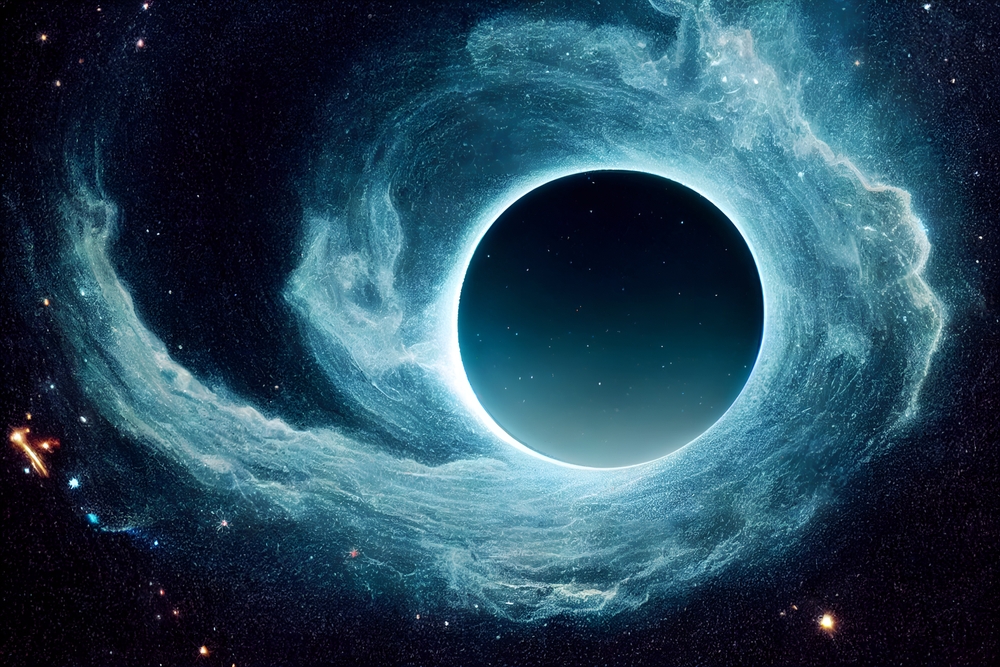
In some respects, a green hole may resemble a black hole. We could also have an event horizon, a theoretical border beyond a black hole where no radiation or light can escape. It is believed that the impact of a worm hole would depend on its mass, which could dictate how things behave or in orbit outside and around it.
A key feature is that a worm hole would look like a sphere, not a hole, says Lupsasca, adding that traveling through a worm hole would be like “being sucked in a ball then expelled from another ball”.
Other things for astrophysicists could look for by trying to find a worm hole include gravitational waves or radiations like those associated with black holes.
Possibilities in our universe
Ver holes represent the infinite possibilities of the means to describe our universe.
“The way physicists think of their theories is that everyone is an incomplete image of how the world is really. Part of the interest in these solutions comes from reflection on Einstein’s theory as an incomplete image of reality, ”explains Smeenk. “Physicists often explore these situations not because they will find workers’ holes in real astrophysical systems, but because it helps them to see how the pieces of the puzzle assemble.”
Green holes are just a piece of the puzzle, but they do not provide the complete image. However, an understanding of their potential helps to expand and deepen our relationship with known forces.
Find out more: What are the worm holes and could they be the response to time travel?
Sources of articles
Our writers at Discovermagazine.com Use studies evaluated by high -quality peers and sources for our articles, and our publishers examine scientific precision and editorial standards. Review the sources used below for this article:
Madison reports focus on marine and environmental issues, climate change and new scientific discoveries related to health and technology. Raised on an island in southeast Alaska, Madison is now based in west of Montana. His writing was presented in Time, Snopes, Business Insider, Mountain Journal, Ecowatch and Alaska Magazine, among others. When he does not write, Madison teaches yoga, pupil of chickens and promotes adoptable dogs and cats.


