Abortion Bans Are Never Just About Abortion


Company
/
November 10, 2025
People who desperately want to become pregnant may soon find their rights to procreate restricted by anti-abortion criminal laws protecting embryos.
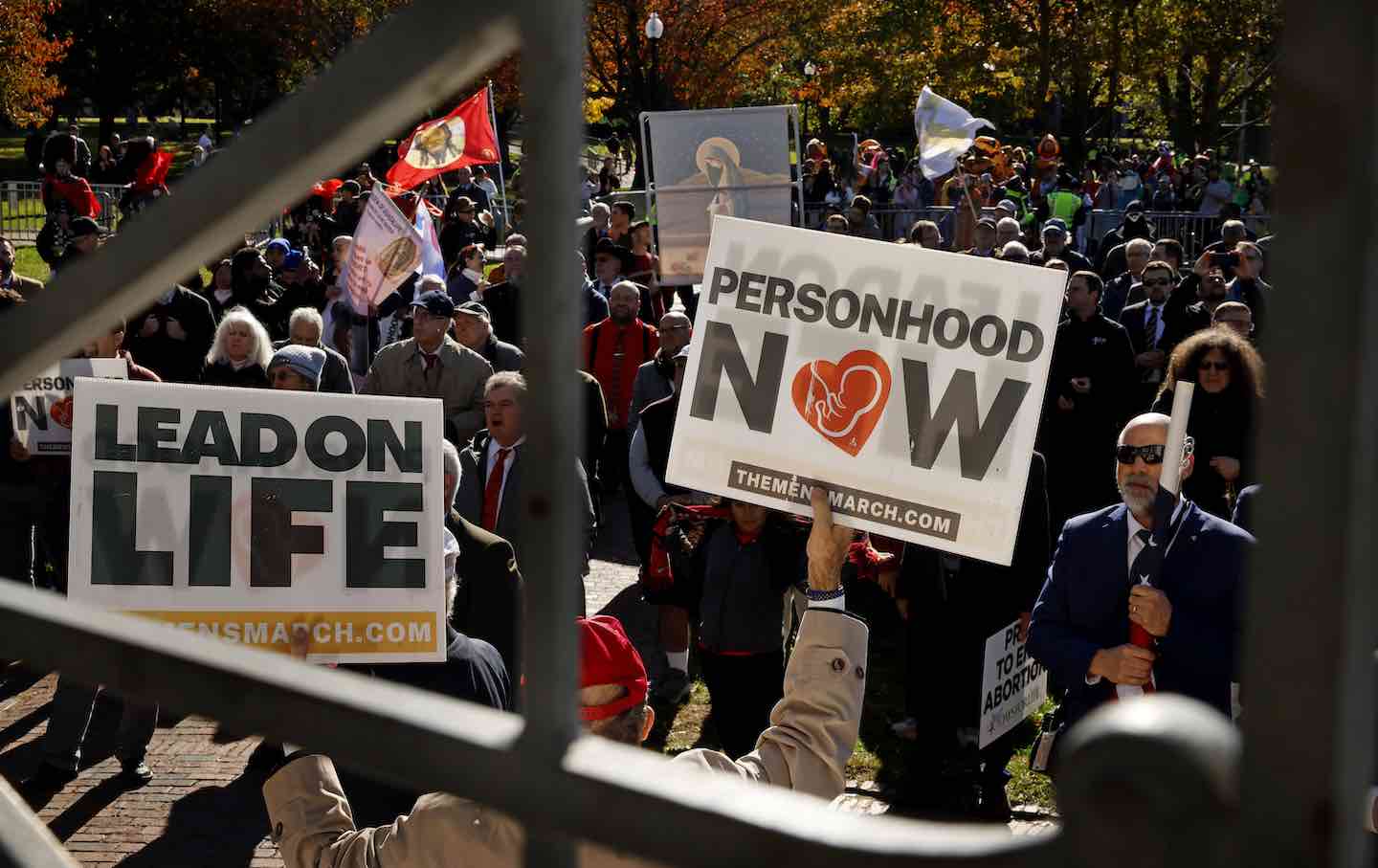
Protesters at the Parkman Bandstand during the National Men’s March for Abortion Abolition and Rally for Personhood, November 1, 2025.
(Craig F. Walker/The Boston Globe via Getty Images)
For more than three years, anti-choice state lawmakers have been engaged in a race to the bottom to get the worst abortion law in parts of the country where abortion is already severely limited or outright banned. Earlier this year, South Carolina lawmakers took the lead with their bill that would usher in an era of prosecutions against people who have abortions, not just those who “aid and abet” abortion seekers. All of this is deeply troubling, but what is also clear about the proposed bill is that it is not just about abortion, despite what its language and its supporters might suggest.
According to the bill, an unborn child is “an individual human being from conception.” [which happens when a sperm fertilizes an ovum] until live birth. Although abortion is the primary target of this proposal, this language has the potential to expand beyond abortion and to assisted reproductive technologies, such as in vitro fertilization. And people who desperately want to become pregnant could soon find their rights to procreate restricted by criminal laws protecting embryos.
IVF usually involves the creation of embryos that will ultimately not be used to make babies for a variety of reasons. Some embryos will not be used because preimplantation testing reveals chromosomal abnormalities. Some will be rejected because they are unlikely to successfully implant in a uterus and create a viable pregnancy. And still others won’t be used because they simply aren’t needed. These unused embryos may be kept indefinitely in cryogenic storage, donated to research (resulting in their destruction), destroyed outright, or even “adopted” by potential parents who do not have their own embryos.
A vocal segment of the religious right has long argued that the manipulation and destruction of embryos in IVF is as bad as, or worse than, the loss of fetal life caused by abortion, with one source claiming that “the business model…destroys more lives than are ever born.” Indeed, opposition to IVF is so strong within the anti-abortion movement that in October it pressured the president to give in to his campaign promise to make expensive treatments free. In a state like South Carolina that is considering a law that makes no distinction between an “unborn child” at 39 weeks gestation and an embryo in a petri dish, it is easy to imagine significant barriers to accessing IVF.
In 2024, another southern state provided a glimpse of the consequences of treating embryos as children. That year, the Alabama Supreme Court ruled that frozen embryos were comparable to children born for purposes of a wrongful death lawsuit against a fertility clinic where the plaintiffs’ frozen embryos were accidentally destroyed. In its opinion, this court described embryos alternately as “embryonic” and “ectopic” children being “kept alive” in a “cryogenic nursery.” This explosive notice sparked a period of chaos in which clinics canceled planned embryo transfers for IVF patients and stopped providing care for fear of civil and possible criminal penalties for any action leading to the destruction of an embryo. Only after the rushed and poorly drafted passage of a law meant to protect clinics from liability were patients able to continue their care in the state.
South Carolina’s abortion bill opens the door to an expansion of wrongful death lawsuits, as has happened in Alabama, on behalf of a woman who had an abortion (unless she consented), a man who believes he fathered a fetus that was aborted, or the parents of a pregnant minor who had an abortion. Wrongful death claims are a very old legal tool for people who have lost loved ones due to the actions of a third party to receive damages as compensation for those losses. As the name suggests, these statements assume that a living person has died. Even when states allow claims for wrongful death of an in utero fetus, they tend to require that the fetus be viable. This is already an expansion of what it means to be a living person, but it fits along the line of viability created in Roe v. Wade. Without this line, it is naive to think that the anti-choice movement will not continue to expand its reach beyond pregnancy to “unborn children” in “cryogenic nurseries” as the Alabama Supreme Court has done.
The American Society for Reproductive Medicine, a leading professional organization for fertility clinics and providers in the United States, describes South Carolina’s bill as an “extreme personhood ban,” referring to the pro-personhood movement that underpins many anti-choice laws in the United States. Some proponents of extending rights to fetuses demand that all abortions be illegal and that anyone who performs or consents to an abortion be subject to the same penalties as someone who commits murder. In recent testimony before the South Carolina Senate Medical Affairs Committee, Mark Corral, head of the anti-choice group Equal Protection South Carolina, told committee members, “Failing to treat the killing of unborn children as homicide in the same way that we treat the homicide of the unborn violates the law of God, the United States and the state constitutions.” »
State legislatures are not the best places to make medical decisions or establish standards of care for medical practice. Legislative interference in medicine leads to bad outcomes, especially when the state seeks to redefine terms with specific meanings, like conception, abortion, and contraception – which is what this bill does. Once a state like South Carolina successfully enshrines a broad definition of unborn children into law, it becomes easier to go further. Going further could mean lawmakers would directly address IVF by criminalizing providers who routinely engage in the destruction of embryos as part of their work. It could also involve police and prosecutors bringing criminal charges against pregnant women who suffer miscarriages or stillbirths that they deem suspicious. And in fact, South Carolina already has the dubious distinction of being “the originator of the hospital-to-crime investigative process that underlies the modern criminalization of pregnancy,” according to Pregnancy Justice, an advocacy group fighting the criminalization of pregnant women.
The successful campaign to overthrow Roe v. Wade has not only impacted abortion care: it has brought us ever closer to a world in which pregnancies belong to the state and not to the women and other capable persons who carry them. Those of us fighting for reproductive justice in America must continue to speak out about these connections and how abortion law can and will be used as a weapon against anyone with reproductive capacity, whether they are already pregnant, seeking pregnancy, carrying a doomed pregnancy, or even dying from pregnancy. We already see it in the dozens of states that ignore the wishes of pregnant women by excluding them from living will laws or courts that force obstetric interventions such as C-sections on nonconsenting patients, and as described here, the slow slide toward legal protections for embryos.
It is insoluble to give rights to an embryo or fetus without diminishing the rights of pregnant women. On the other hand, it is entirely possible to respect embryos and fetuses without denigrating the decision-making capacities of pregnant people. Today, not 50 years from now, it is time to decisively and provocatively defend pregnant people and those seeking to become pregnant before their status as second-class citizens is so deeply enshrined in law that it is almost impossible to break away from.


